
I’ve heard countless parents say, “I refuse to be a short-order cook.” Currently, with eight or nine mouths to feed, I don’t have the time to be a short-order cook either. It’s also almost impossible to fix something that everyone wants to eat. And also, because we have kids with trauma and food insecurities, we can’t say, “Eat it or go hungry.” And also, you can’t make your kids eat even though we know they need to.
So what’s a parent to do?
We rely a lot on modular or deconstructed meals. These provide healthy options for everyone that they have control over and can make into something even the pickiest eaters will want to eat. Here are four ideas of simple meals that will make even your picky eaters happy.
Tacos or Nachos
I provide tortillas, taco shells, scoop chips, and rice or lettuce as a base. For toppings, I set out shredded cheese, sour cream, cooked ground meat, black beans, avocado, and salsa. I also try to have bacon pieces on hand because bacon makes everything better
From here the possibilities are endless. They can make a rice bowl, salad, traditional hard or soft tacos, or nachos. Even if they only pile on only one ingredient, they won’t die.
Baked Potato Bar
I provide baked Yukon gold and sweet potatoes. For toppings, I set out butter, caramelized onions, chopped avocado, broccoli, shredded cheese, sour cream, bacon pieces, and leftover chili (if I have it).
Again, even if there’s only one ingredient your pickiest eater will eat, they won’t die.
Omelets
This one is a bit more time-consuming, but a family favorite. I try to chop all the fillings and take orders before I start cooking. A good quality, truly non-stick pan will make this dinner less frustrating as well. Another hint is to add a tablespoon of water for each egg you’re scrambling for extra fluffy eggs.
Our favorite fillings are caramelized onions, green peppers, bacon, mushroom, broccoli, spinach, salsa, and cheese.
If your kid only eats an egg with cheese or only eats a handful of toppings sans egg, it will be okay.
[bctt tweet=”If your kid only eats an egg with cheese or only eats a handful of toppings sans egg, it will be okay.” username=”corkboardblog”]
Stir Fry or Fried Rice
I provide rice and lo mein or glass noodles, sauce, stir-fried veggies, and a meat or two. If you’re feeling fancy, throw in a chopped Asian salad kit.
The kids fix themselves the parts they like and leave the parts they don’t.
If you have a deconstructed meal idea, join our free community to share your idea.
]]>
First, I want you to remember that these mean outbursts are the externalization and incorrect verbalization of your child’s inner experience. It’s like a baby crying when they’re hungry. Babies don’t have the skills to communicate properly, so they resort to crying. A lot of our kids have big feelings and not enough brain development or skills to understand their emotions, let alone communicate them properly. It just so happens that bigger kids “crying” has words attached to it that have meaning to us.
[bctt tweet=”Mean outbursts are the externalization and incorrect verbalization of your child’s inner experience.” username=”corkboardblog”]
I want you to ignore the actual words coming out of your child’s mouth and notice other cues. If we focus on the actual words, then we get triggered with our own big feelings. Then our thinking brain is useless too. Instead, stay curious. Could they be hungry? Sad? Mad? Scared?
Then, as Bryan Post encourages, “Ignore the behavior, but not the child.”
If your child is melting down over a school assignment at 4 PM, it’s probably not the assignment. Maybe it’s been a while since they’ve had a snack and a drink. You could try saying, “Wow! You seem pretty grumpy! I wonder if you’d like a __________. ”
There are actually only five reasons your child might be spewing nasty words at you. I give more details in the second video of my free masterclass on Parenting with the Brain in Mind.
If you’d like more help navigation this topic, join us for an upcoming live Behavior Management Q&A. Click here to RSVP.
]]>
Throughout the day, we have varying levels of energy. Zones of Regulation divides up energy levels into 4 zones–blue, green, yellow, and red.
Blue is low energy necessary for going to sleep.
Green is attentive and alert energy necessary for learning and meaningful conversation.
Yellow energy is upbeat for situations like playing or cheering at a sporting event.
Red energy is out of control.
Additionally, you’ve probably heard me talk about mirror neurons, but our nervous systems want to be like others around us.
A lot of parents think that when your child is out of control, you should stay calm. You should absolutely stay in control and regulated, but calm may not be what your child’s nervous system needs.
Watch the video below for more information and a powerful illustration.
[bctt tweet=”You should absolutely stay in control and regulated, but calm may not be what your child’s nervous system needs if they’re tantruming.” username=”corkboardblog”]
What was your biggest takeaway?
]]>Go Shopping
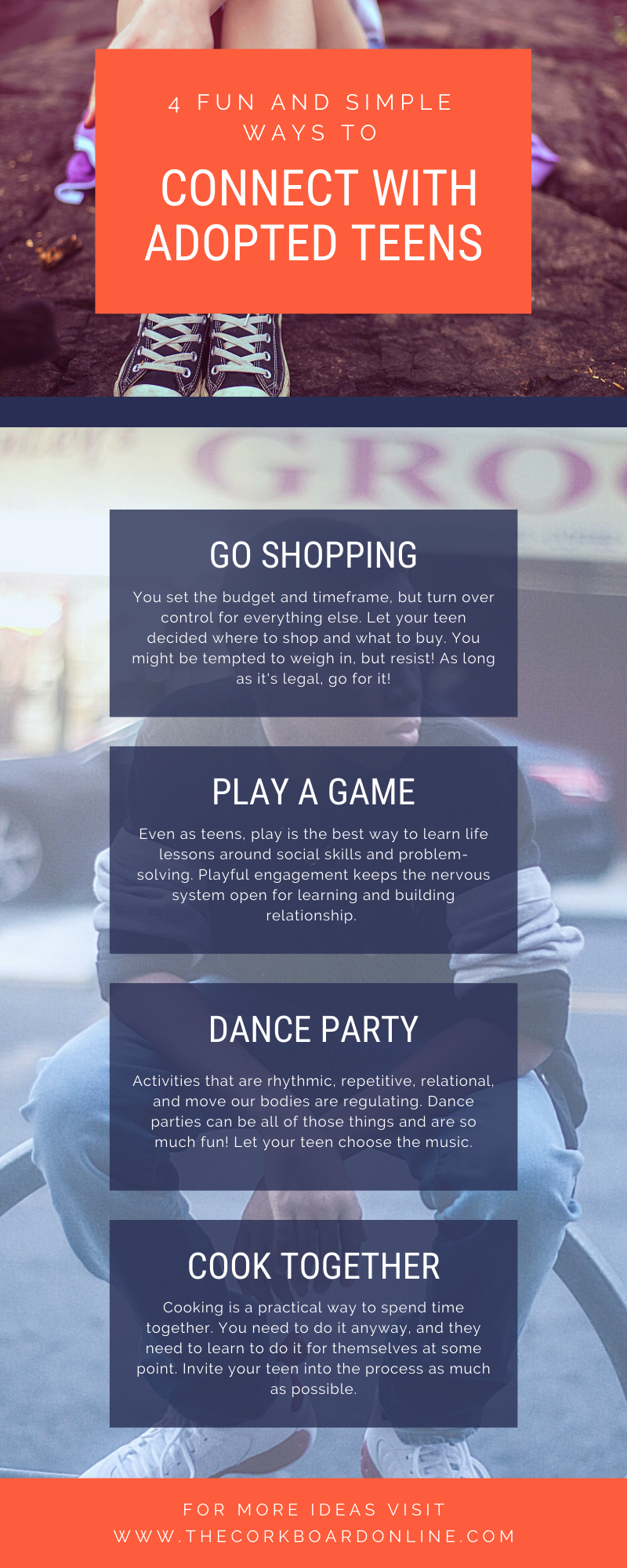
You set the budget and timeframe, but turn over control for everything else. Let your teen decided where to shop and what to buy. You might be tempted to weigh in, but resist! As long as it’s legal, go for it!
Play a Game
Even as teens, play is the best way to learn life lessons around social skills and problem-solving. Playful engagement keeps the nervous system open for learning and building relationship. Explore all types of games. Board games. Yard games. And, yes, even video games. If your teen struggles with losing, try collaborative games.
Dance Party
Activities that are rhythmic, repetitive, relational, and move our bodies are regulating. Dance parties can be all of those things and are so much fun! Let your teen choose the music. If they’re resistant, hold dance parties for yourself regularly anyway. Eventually, they’ll roll their eyes and join you for a beat or two  Just don’t turn it into a control battle.
Cook Together
Cooking is a practical way to spend time together. You need to do it anyway, and they need to learn to do it for themselves at some point. Invite your teen into the process as much as possible. Let them choose the recipes. Create a shopping list together. Go shopping together. If they don’t take direction easily from you, try learning a new kitchen skill together.
Our oldest son is currently converting our old 15-passenger van into a van house. Did I have reservations about the practicality when he proposed the idea? Of course. Has he made costly mistakes along the way? Yes.
Our youngest daughter is currently figuring out how to hang 18 feet of aerial silks in our backyard so she can learn to do drops. Am I afraid she’ll end up with a broken bone? Yes.
[bctt tweet=”Ultimately our teens need a sense of purpose and a cheerleader in their corner. Read more on connecting with adopted teens.” username=”corkboardblog”]
In both cases, we made conscious decisions to be the cheerleaders, not the naysayers. Ultimately our teens need a sense of purpose and a cheerleader in their corner. The best ways to connect are found by following their lead. We’re entering into their world with as much enthusiasm as we can muster. Because they feel like we’re on their team, they are accepting a tip here and there from us. We’re all learning a lot!
How do you and your teen connect?
]]>
- Posture.
- Humming and extended exhale.
- Viewing nature.
- Peeing.
- Splash cold water on your face.
Click here to download your FREE Enneagram Book.
]]>
But I know I still have work to do and want to be a part of quieting other noise this week to listen more intently to and amplify melanated voices.
Honestly, I was frozen on Monday wondering what to do next and where to lead you. I was processing for myself, worrying about our son who works in DC, but also feeling a responsibility to be a leader. To give you the resources you need to lead your family well.
This, of course, is not an exhaustive list, but some great places to start.
Just Mercy (movie)
The Just Mercy movie* is based off the fantastic book Just Mercy: A Story of Justice and Redemption* by Bryan Stevenson. It’s free through June on streaming services such as Amazon Prime and Apple TV.
Trouble I’ve Seen (e-book)
From the publisher, “What if racial reconciliation doesn’t look like what you expected? The high-profile killings of young black men and women by white police officers, and the protests and violence that ensued, have convinced many white Christians to reexamine their intuitions when it comes to race and justice.
In this provocative book, theologian and blogger Drew G. I. Hart places police brutality, mass incarceration, anti-black stereotypes, poverty, and everyday acts of racism within the larger framework of white supremacy. He argues that white Christians have repeatedly gotten it wrong about race because dominant culture and white privilege have so thoroughly shaped their assumptions. He also challenges black Christians about neglecting the most vulnerable in their own communities. Leading readers toward Jesus, Hart offers concrete practices for churches that seek solidarity with the oppressed and are committed to racial justice.
What if all Christians listened to the stories of those on the racialized margins? How might the church be changed by the trouble they’ve seen?”
Click here to download your free copy and use the code HART.
(Coupon only valid on the digital version.)
The Gospel in Color (e-books)
It can be hard to process racism for ourselves, let alone tackle it with our kids. But tackle we must. The Gospel in Color for Parents and the The Gospel in Color for Kids will help you navigate these tricky conversations through a biblical lens.
Click here to download them for free using the code ICANTBREATHE.
Not My Idea: A Book About Whiteness
This child-friendly book is about a little girl who sees TV coverage of a police shooting and has questions. Her parents want to protect her. Sound familiar?
Click here to download a free pdf of the book.
Transracial Adoption: Common Questions from White Adoptive Parents
This free resource is provided by Be the Bridge which helps bring awareness to the racial brokenness and system injustice in the world. When you request the download, it will come in their second email to you.
Adoption Heart Conference bonus session with transracial adoptee, Rhonda Roorda
Rhonda Roorda was adopted at the age of two into a white family, and raised as the only black in her family and community. You must hear about the moment she discovered she was black. She is the author of In Their Voices: Black Americans on Transracial Adoption*.
Click here to register for this free virtual conference.*
Podcasts
“Doing Nothing Is No Longer An Option.” — For the Love Live with Austin Channing Brown
Latasha Morrison on The Happy Hour with Jamie Ivey
Do you have additional resources to share? Click here to share them with our community.
*Denotes an affiliate link. This means I may earn a commission if you purchase a product through this link.
]]>
“You never do anything for me!”
My primary love language is Acts of Service. All I do is do things for you.
“You love them (siblings) more than me.”
Umm…our life basically revolves around keeping you stable. Whatevs.
“You’re never proud of me or tell me you love me.”
I call B.S.
“You just wanted slave dogs, not kids.”
Dude, a maid would’ve been so much easier on so many levels.
“We’re not really family because we don’t share blood.”
Seriously?!? You’re the second generation of adopted people in our family. No one shares blood.
The problem is that our kids are speaking in a code of sorts, so addressing the actual words that come out of their mouths is an exercise in futility. Plus, our experience shows responding with logic will probably escalate you and them.
[bctt tweet=”The problem is that our kids are speaking in a code of sorts, so addressing the mean words that come out of their mouths is an exercise in futility.” username=”corkboardblog”]
As Bryan Post often says, “Ignore the behavior, but not the child.”
Any of the above could be responded to with, “Do you need a hug?” or “I love you.”
I won’t lie. This is way easier said than done. It means we’ll have to do a lot of our own work and reflection about why those things bother us so much.
This morning I was reading in Mark.
So Pilate asked him, “Are you the King of the Jews?”
He answered him, “You say so.”
And the chief priests accused him of many things. Pilate questioned him again, “Aren’t you going to answer? Look how many things they are accusing you of!” But Jesus still did not answer, and so Pilate was amazed. (Mark 15:2-5, CSB)
We can be comforted and encouraged that we are not the first people to be falsely accused. Jesus was accused by his own people, rejected for a criminal (Mark 15:6-15), and denied by one of his best friends (Matthew 26:69-74).
Jesus knew what his job was. It wasn’t to argue with people he knew would not be convinced with words. He trusted that the truth would endure. He didn’t need to defend it.
May you be confident this Easter to know that you’re a good parent doing good work. Don’t let words from hurting kids threaten your foundation or your identity.
If you need some practical steps for building a strong foundation, make sure to grab your FREE Parent Success Plan.
]]>
Here are the top 5 mistakes parents make when using consequences:
- We forget to reflect and regulate first which results in reacting instead of responding.
- We address our child’s chronological age instead of their emotional/developmental age.
- We use punishments instead of supports and accommodations.
- We don’t increase nurture to balance out the increased structure.
- We create unsustainable situations.
[bctt tweet=”Are you making any of these five mistakes when using consequences with your kids?” username=”corkboardblog”]
I made all five of these mistakes recently.
]]>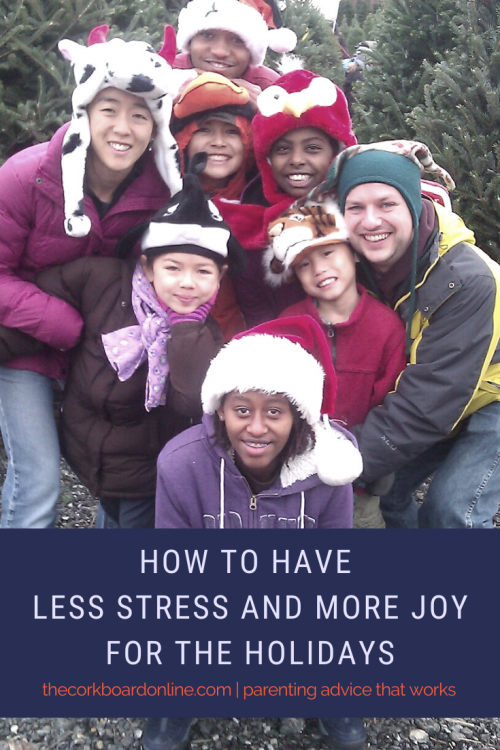
[bctt tweet=”You can have less stress and more joy during the holidays. #pblogger #adhd #adoption” username=”corkboardblog”]
Define Success
Get clear with yourself about what success will look like. For me, it’s managing my own sanity, not whether or not we had a Pinterest-perfect turkey or Christmas tree. If I get to January with some semblance of inner peace, it will be a win. That might mean I put off Christmas cards. Or RSVP “No” to the neighborhood cookie exchange to make time to read on the sofa with a cup of tea. For the past couple of years, success has also NOT been spending the entire holiday together as a family. This meant I felt the freedom to give my kids choices about what they participated in. No one wants to trek out to visit Great Aunt Bertha? No worries. I’m going by myself and it’s okay. As always, be sure to define success by something you can control.
Manage Expectations
Round up the family and have everyone narrate what they’re visualizing for the upcoming holiday season. Make a family holiday bucket list that includes at least one item from each person. Then focus on only those things. If decorating a Christmas tree isn’t on it, don’t do it. Also on expectations, remember that the holidays are hard and overwhelming for our kids. This is not the time to raise the bar and expect them to practice things like social engagement. If they want to hide under the table with a screen all day or eat and then disappear to their rooms, let them.
Think Outside The Box
If the old traditions stress you out, create new ones. No one in our nuclear family prefers turkey. Once the baton gets passed to me, we’ll probably have Chinese or Mexican. Where are you feeling the most stress about the holidays? What would you do differently if you weren’t boxed in by old traditions?
Keep Both Nurture and Structure High
For your kids who thrive on the structure of school, you’ll want to limit unstructured time at home. The key to increasing structure without getting more defiance is to increase nurture. So basically, you want to plan as much fun as possible. Keep in mind what will actually be fun for your child versus what is fun for everyone else but might overwhelm your child.
Stay Off Social Media
Put on your horse blinders. Pay no attention to the Instagram-perfect photos or fall into the trap of the “Shoulds.” If you need to feel better, ask me to see a photo of our boys’ room or the 10,000 chalkboard bags stacked my living room where a Christmas tree “should” be. You can also ask my kids about how many gifts we buy for them at Christmas. It’s ZERO.
You’re a good mom, doing good work!
This post is brought to you by Paperless Post.
]]>