
I started off as a pretty patient mom. With each additional child we added to our family, my patience decreased. By the time we had six kids, four through adoption with complex trauma and high needs, my husband was telling me I was the meanest person he knew.
I knew something needed to change. I wanted to be more patient. I would promise myself each night, “Tomorrow will be different.” But then tomorrow never was.
It turns out I was appealing to the wrong part of my brain. If you’ve been around for a while, you know I love brain science. Just as a quick review, the lower part of your brain includes the part that manages your emotions and logic happens in the pre-frontal cortex…the upstairs brain.
I was thinking a lot about patience and knew in my thinking brain I needed more of it, but that wasn’t helping my downstairs brain that didn’t feel any more patient each morning.
When I started caring for the downstairs part of my brain, I noticed that my window of tolerance increased along with the amount of patience I had. I was able to respond to my kids instead of react.
You’re probably wondering, “How do I care for the downstairs part of my brain?”
Three things made the biggest difference:
- Movement. I’ve mentioned before that Repetition + Rhythm + Relationship = Regulation for our kids and the same is true for ourselves.[bctt tweet=”Repetition + Rhythm + Relationship = Regulation for our kids and the same is true for ourselves.” username=”corkboardblog”]
- Therapeutic listening via the Safe and Sound Protocol. This protocol uses specially filtered music to send cues of safety to our nervous system and creates permanent shifts in how we experience the world. It helps you feel less irritable and overwhelmed. It helps you think more clearly. And it helps you connect more openly.
- Aromatherapy. Our sense of smell gives us direct access to the limbic system. Biochemistry tells us what smells will send cues of regulation and psychology tells us that we can also anchor a specific scent to the safe and grounded state provided by the Safe and Sound Protocol.
As I wove these pieces into my daily practice, I started finding my way back to the mom and person I wanted to be. I’ve been dreaming about how to offer this gift to other parents, and I’m ready to launch The Regulation Rescue.
If you want to increase your patience and regulation or just be in a really good place before school lets out for the summer, click here to apply to join the next cohort of The Regulation Rescue.
]]>

When I first became a parent, I set the bar pretty high.
I made home-cooked meals from scratch as often as possible. I even went through a phase where the only breads we ate were homemade from sourdough.
Limits on sugar and artificial ingredients.
Veggies at lunch and dinner. Corn and potatoes don’t count. Those are starches.
Water only between meals. No juice.
Only one hour of screen time for the kids per day.
I had myself convinced that this was the best life I could give my kids, and I was setting a good example. But was I?
The experts will also tell you that it’s okay to get away for a mom’s weekend or to date your husband regularly. But why did I feel so guilty about those things?
After some reflection, I realized why I felt guilt around practices that should be totally normal and acceptable for moms. My mom didn’t do those things. It seemed to me that my parents went on like one date night a year–probably their anniversary. And I never remember my mom not being there. Even when she went back to work when I was in middle school, she was only a block and half away from our house, was home by the time my little sister got home from school, and still had school holidays summers off with us. She was always there.
Eating out was also not a thing. Except for a monthly family night, she put dinner on the table every night come hell or high water.
Fast forward to my motherhood, and I felt guilty every time I left our kids with a babysitter or ordered takeout because I felt like I wasn’t living up to the example my mom set.
One day it hit me as I was internally berating myself for not meeting some arbitrary expectation I’d set for myself. What bar did I want to set for my kids?
Did I want my daughters to feel guilty for taking care of themselves once they became mothers?
Did I want my sons to hold an impossibly high bar for their wives?
Of course not!
So next time you feel guilty for not meeting your own arbitrary expectations for parenthood, ask yourself how you want your kids to view parenthood.
[bctt tweet=”Next time you feel guilty for not meeting your own arbitrary expectations for parenthood, ask yourself how you want your kids to view parenthood.” username=”corkboardblog”]
Do you want them to feel permission to order take out sometimes, to eat off paper plates when they’re too tired to do dishes, to hire a cleaning service, to take care of their own mental health, to be human without feeling guilty?
Then you have to set the example!
]]>
But parenting teens especially teens who are one age chronologically and entirely different ages social-emotionally, academically, etc can be super tricky.
Dan Hughes talks about having a PACE attitude when we parent. (Side note: I’m starting to realize it works in so many relationships including marriage and work).
But how can we apply this practically to our teens?
P: Playful
More than micromanaging screentime, friend choices, or schoolwork, our teens need us to find ways to have fun with them. Dr. Bruce Perry, well-known child trauma expert, tells us that maturity is the cumulation of positive social-emotional interactions a person has. If you think your teen needs to “grow up,” the best thing you can do is have fun with them and provide a safe relationship. Finding common activities that your teen will do with you might be tricky. I find food is usually a good bet. My husband joins them in gaming. I also try to appreciate being used as a taxi because it gives us “forced” quality time together. Sometimes I let them choose the music or sometimes we’ll stop for a quick treat…here I am back at food again!
[bctt tweet=”If you think your teen needs to “grow up,” the best thing you can do is have fun with them and provide a safe relationship.” username=”corkboardblog”]
A: Accepting
As our teens grow into their own people with their own preferences, it can be hard to accept their choices. But our kids have told us that one of the things we did right over the years was be their biggest cheerleader in their choices and helping them recognize their strengths. Our kids will thrive when they have a sense of purpose, but the tricky thing is that it has to be their choice! I describe two ways this is playing out with our teens in the video below.
C: Curious
It can be easy to assume the worst about our teens, but jumping to quick conclusions will always drive your teen away. You can’t fake this one! In the video below, I share a recent example of this.
E: Empathetic
Even if you can’t relate to your teen’s angst, be empathetic towards it. (What I want to say, but what you should say instead).
If you need support, encouragement or just some solidarity as you parent your teens, click here to see our upcoming dates for Teen and Young Adult Q&A’s.
]]>[bctt tweet=”When our kids are tired, dehydrated, or not getting the nutrition they need, their brains won’t have the fuel they need to make good decisions.” username=”corkboardblog”]
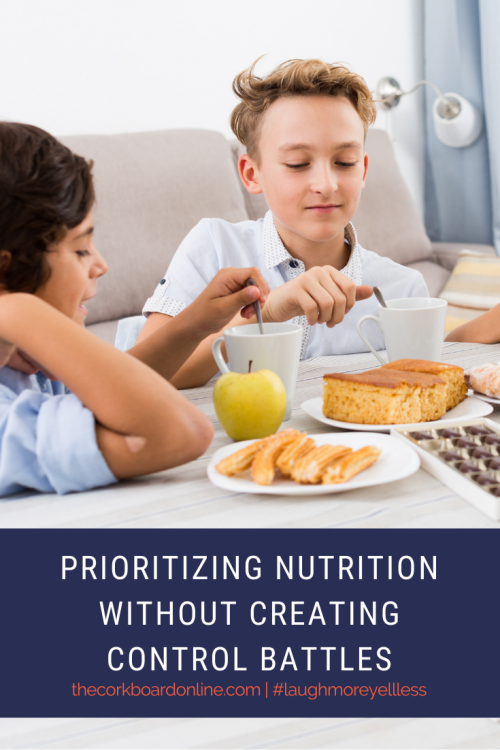
The tricky thing about helping our kids get the proper nutrition is that we can find ourselves in a control battle. After all, you can’t force your child to eat what you want them to.
Here are a couple of tried and true ways you can prioritize nutrition without creating control battles:
Get Sneaky
Take what your child is already eating and boost the nutrition. Does anybody remember the Sneaky Chef? If they’ll only eat Spaghettios, add a tablespoon of carrot baby food into the can before serving. When you make brownies, you can add purees of blueberries, spinach, and/or black beans. This one can kinda be gross, but puree free-range chicken livers or grass-fed beef livers. Freeze in ice cube trays and pop a cube or two into the pan whenever you’re cooking ground meat for tacos or meat sauce. Protein powders hide well in milkshakes and smoothies. And fiber powders hide well in oatmeal, cookies, and pancakes.
Give Choices and Shared Control
It seems counterintuitive, but your child will be more likely to try new things if you flex some of your mealtime rules. Ellen Satter outlines a suggested division of responsibilities on her website. One parent reported, “My son is cautious in all things, and offering him new foods wasn’t much fun at first. If I am careful not to push him, however, I have found he ever so slowly pushes himself along to learn to like new foods. He is so proud when he tries something new!”
Supplement
Even if your child ate the recommended food pyramid at every meal, they’d still benefit from a whole-food supplement. Current soil conditions and modern eating habits make it almost impossible to get all the micronutrients needed just through food. There are a lot of misconceptions out there about supplements and a lot of contradicting advice about what’s good for our kids, and us.
]]>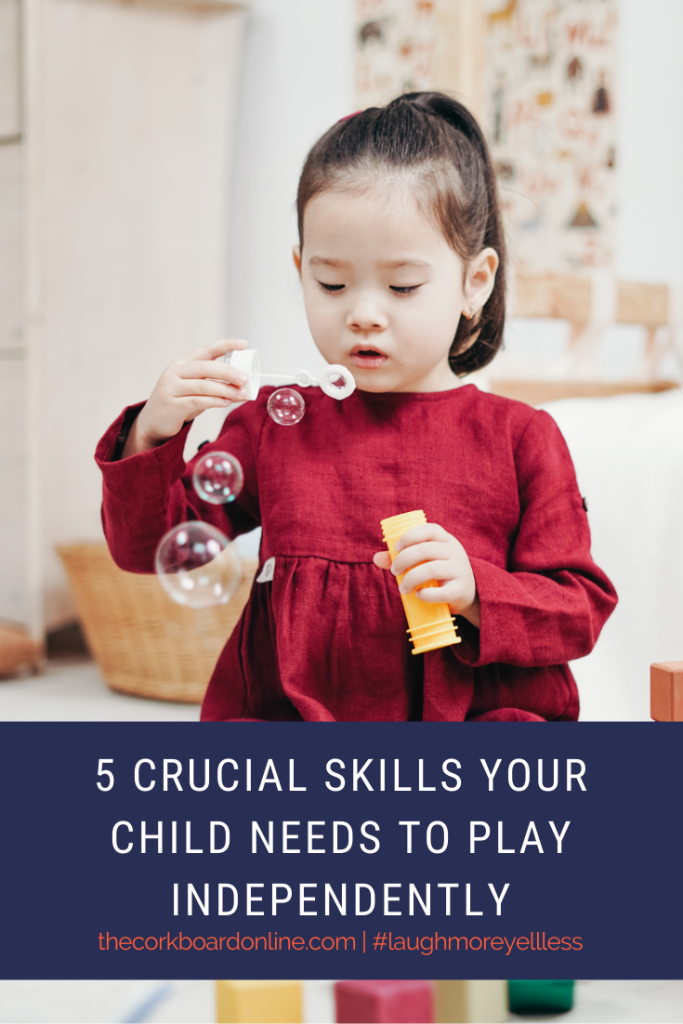
I talk a lot about assuming a CAN’T instead of a WON’T with our kids. So let’s apply this to independent play.
Just like there are physical developmental stages that need to happen in a certain order…sitting up before standing, walking before running, etc.
The same thing is true for learning how to play. There are the steps to learning to play independently and interactively.
1. Attunement
This syncing of a child and caregiver’s brain is the foundation for attachment, bonding, emotional regulation, and felt safety.
2. Body and Movement Play
Vestibular and proprioceptive activities are key for brain development. Rhythmic movement is also crucial.
3. Object Play
Manipulating objects is crucial for problem-solving later in life. This also involves constructive play like Legos.
[bctt tweet=”Manipulating objects is crucial for problem-solving later in life.” username=”corkboardblog”]
4. Imaginative Play
Imagination is a key to emotional resilience, creativity, and personal coping skills.
5. Social Play
This can include parallel play, cooperative play, rough-and-tumble play, celebratory and ritual play, storytelling and narrative play, or transformative-integrative and creative play.
Which stage do you think your child needs a booster in?
For more details on these concepts, watch the video below.
]]>
One of my favorite quotes from the late Dr. Karyn Purvis, author of The Connected Child* and The Connected Parent*, is, “If we give our children nurture when they need structure, we inhibit their growth. And if we give them structure when they need nurture, we inhibit their ability to trust.”
She often taught about the fact that our kids need both high nurture AND high structure from us.
[bctt tweet=”Our kids need both high nurture AND high structure from us.” username=”corkboardblog”]
As we’ve stumbled through almost every imaginable situation with our kids, we’ve found that our kids always do better when we can find the high nurture-high structure response. It’s like this magic space in parenting.
Just yesterday, I was watching our daughter get into a control battle with our granddaughter over eating chili, a meal she had gobbled up the night before.
Our daughter had put structure in place for our granddaughter but it was clear she also needed the nurture to balance it out. I did a couple of things. First, I validated that it was hard to have to do something you didn’t want to. I also offered to bring her close to help her regulate. In her own way, she ended up asking for a compromise. She wanted to eat the water chestnuts out of my Asian veggie soup. I provided structure by getting her to use respectful words and take a bite of chili before she could have a water chestnut. After going back and forth like that for about five bites, she finished the rest of the chili on her own.
I’ll admit it doesn’t always go that smoothly, and it definitely gets trickier as our kids get older, but we’ve never not been able to find that high structure high nurture solution.
*affiliate links
]]>
I want you to know that you’re not a bad mom if you don’t get down on the floor and pretend play with your kids.
[bctt tweet=”You’re not a bad mom if you don’t get down on the floor and pretend play with your kids.” username=”corkboardblog”]
There are actually six play personalities defined by Stuart Brown who wrote Play: How it Shapes the brain, opens the imagination, and invigorates the soul.*
The Joker
This person enjoys nonsense and making others laugh. He is often the class clown. Children who are jokers will respond well to playful engagement.
Activity to try: laughing
The Kinesthete
A kinesthete feel the happiest when he is moving. He may also need to move to learn.
Activity to try: playing sports
The Explorer
Whether it be physical, emotional, or mental, an explorer thrives on new experiences. Try engaging all of the senses when guiding an explorer.
Activity to try: going on trips, reading books, collecting
The Competitor
This play personality never does anything “just for fun.” She is out to win and can turn anything into a competition. Gamifying tasks works well for this play personality.
Activity to try: playing board games
The Artist/Creator
The artist/creator’s goal is to make something beautiful–either from scratch or as a restoration. Provide a steady stream of materials for projects to keep the artist/creator busy.
Activity to try: exploring crafts, collecting
The Storyteller
No matter what a storyteller is doing, she uses imagination to increase enjoyment. Learning through stories and parables will keep education fun for a storyteller.
Activity to try: reading and writing stories, imaginative play
Which one or two do you most resonate with? Which one or two do you think your kids most resonate with?
*affiliate link
]]> 
Last week, I asked in our FB community, “How do you keep from walking on eggshells around your kids?”
One mom said, “Are we not meant to?”
A bunch of other parents commented that they were following for suggestions, but didn’t have any of their own.
First, let me address why walking on eggshells is problematic. When our nervous systems are hypervigilant (aka. walking on eggshells), it can trigger or escalate our kids thanks to mirror neurons. It turns into a self-fulfilling prophecy of sorts.
So the key to not walking on eggshells is about learning to manage our own nervous system.
[bctt tweet=”The key to not walking on eggshells is about learning to manage our own nervous system.” username=”corkboardblog”]
This may seem overwhelming at first, but it’s in the little proactive things. I’ve recently found a trifecta of resetting my nervous system in three minutes.
- I listen to the Balance pathway of the Safe and Sound Protocol which is specially filtered music meant to ground the nervous system.
- While I’m listening, I also do three minutes of mindful breathing. Four seconds in, four seconds hold, four seconds out, four seconds hold.
- During the inhale I’m breathing in a drop of Adaptiv essential oil blend from my palms. This blend is specially formulated to balance brain chemistry.
I actually do this practice every morning, ideally before my most challenging child gets up. Even if I don’t have the opportunity to do this practice “in the moment,” the daily ritual is still making a difference in my resilience to challenging behaviors.
Besides knowing what cues your nervous system to safety, I also recommend having a plan for handling your child’s most common challenging behaviors. Just having a plan increases your confidence which allows your nervous system to settle and stop walking on eggshells.
Here are some related resources if you need additional help to stop walking on eggshells:
]]>