A book was recommended to me a couple months back, that I just got to reading… well… listening to. The book is Predictably Irrational
What I find interesting about this is how it seems to apply to our notion of “church.” For those of us that have grown up in the church, we have a certain norm that we have associated with church based upon how we grew up: our anchor. As for me, I have recognized that I have that anchor, and am questioning whether that anchor makes sense. It will always be, at some level, what I will compare church against, but at least that knowledge is helpful. Perhaps this is where open-mindedness comes from. If we are willing to accept that we have these anchors, which generally are arbitrary (I could have been born into a Catholic, Baptist, Muslim, Jewish or atheist family), perhaps we would be more willing to question those anchors and be open-minded. I am not saying that we are only open-minded if we shift from our anchors. Rather, I am suggesting that we should be open-minded, and be open to shifting, if it makes sense.
I am regularly reminded of the scene in the movie “Patch Adams” where Patch is having a conversation with a psychiatric patient who claims that he is dead. Patch is certain that he can convince him that he is indeed not dead and asks him if dead people bleed. The patient replies with certainty that dead people do not bleed. Patch pricks the man, who obviously begins to bleed. The man cries out in shock, “Dead people DO bleed.”
Are you willing to be open-minded in regards to what church looks like? Is it possible that your view of what constitutes church is poorly anchored? Or are you the type of person who is convinced that they are dead and that all evidence that suggests otherwise is invalid?
One of my kids asked me a question the other day where I had to explain ethics. This was quite the arduous task, especially given the language barrier. Regardless, I chose my favorite ethics paradigm, virtue ethics, and attempted to explain the 7 virtues: Prudence, Justice, Temperance, Fortitude, Faith, Hope, and Love (the last three are the theological virtues). I was greeted by constant blank staring.
So, maybe I wasn’t being so prudent.
It got me to thinking, though–a good place to start asking questions about anything is temperance (the idea of finding the middle or the mean).
For instance, should we all practice Christianity alone as individuals? No.
Should all Christians in the world gather in one place to worship all at the same time? No.
The answer lies somewhere in the middle.
In my exploration of ideas, I find that many people that I talk to think that I am talking about extremes. So, when I say that we should be a tight-knit community, people think that I am suggesting that we never have alone time. Or, when I suggest that we should reconsider always splitting up by demographics (i.e. women go here, men go there, and children somewhere else, and oh… college kids go there and high-schoolers over there), people think that I am saying that we should never separate by demographic.
When we start to question things, we need to be cautious and be wary of extremes. Extremes are attractive, and people are drawn to them. Middle ground is not as “cool”, but it is probably more where we should find ourselves in most cases.
]]>Melissa:
Disclaimer: This one’s corny and rambling 
Patrick:
So, as I was driving home today, I kept having the thought of Christ and the Church running through my head. I was listening to my David Crowder station on Pandora, realizing again how individualistic the vast majority of Christian music is. So, my brain wandered, which is dangerous when I am driving. What if music reflected more of the idea of what the Church is? We would have lyrics like “here comes the bride”, or “body in motion”, or “people of the way”. (Note that you will not be hearing any music that I write on the radio any time too soon.) Dietrich Bonhoeffer suggested that Christ is the Church living in community. That is a rather powerful statement, but what if we really thought about the intimate nature of Christ and the Church in that way? Do we see our relationship with Christ as a community thing? How are we acting as the body? The bride? Those metaphors have meaning and we have lost the meaning somewhere along the way. We need to explore them again.

Scripture gives us a picture of Christ and the Church. For instance, Acts of the Apostles is all about how the Church mirrored/imitated/acted as/carried on the work of/was/complemented/(pick some other verb) Christ. Our modern day American glasses, however, have distorted the picture.
Would you be willing to join us in taking off those “Son-glasses” so that we can explore Him more and let Him lead the way? (sorry if that was corny… it just kinda happened)
Side-note: Melissa wanted me to change it to “put on son-glasses,” but I refused since we all know that sunglasses block out the sun, and in-turn, Son-glasses must therefore block out the Son, and putting those on wouldn’t be such a great idea. However, I do recognize that there are 3D glasses, which allow you to see 3D, but the parallelism isn’t as strong.
Patrick here, again.
When I think of the times throughout my life where I experienced Christ, those experiences may surprise others.
I remember Brother Bob doing a talent show skit as Elvis, popping out of a coffin singing blue suede shoes.
I think of pot-luck dinners.
I think of when we hosted the Polks at our house while they sought Missionary support in Baltimore.
I remember playing soccer with kids at an orphanage in Ethiopia.
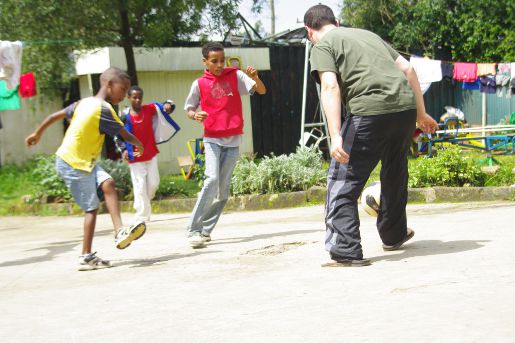
What seems to be the common thread is other people. This seems strange to me, being introverted and all, but it is true. There is something very powerful in that communal experience that I so deeply value. How can someone like me, who has anxiety over experiences with people that I do not know, find such joy and peace in such experiences? I can only come to one conclusion: Christ.
In what situations have you most strongly experienced Christ?
]]>

So, if you know me, you know that I grew up as part of a Catholic family. I deeply value this background now that I am older, but when I was younger, I really struggled. Somewhere around the age of 14, I began to struggle with going to church. My parents, I think, saw this as me not liking religion and trying to escape, or even rebellion. In fact, I really struggled with the fact that I believed in Christ, but could not reconcile my experience of Him—show up to church, sit, stand, kneel, recite, repeat– to what I believed. I was so conflicted because I felt that the thing that I didn’t enjoy, didn’t understand, and couldn’t love was a requirement to what I believed. I hated this, and tried to reject Christianity, but couldn’t, no matter how I tried. When I found others that seemed to truly experience Christ in ways other than those that I was familiar with, I became intrigued. I have spent the last 15 years exploring those ways, but I have come up dry just like when I was 14. There is little difference in the Protestant way of Christianity and the Catholic way of Christianity. Alas, I am left with a desire that has gnawed at me for a long time, yet I have no resolution. So, after a long journey of study (which includes an M.A. in Theology) and years of exploration in Catholic and Protestant religious practice, I am ready to put aside my fears of what others think and put new thought to who Christ and His body are. In the coming days, I will be hijacking my wife’s blog to explore a little.
Will you join me?
click here for the entire series.