Our week in Ethiopia before we came home was riddled (pun intended) with great humor. Sometimes it was a race up the four flights of steps to our room at the top of the guest house while their breathless giggles echoed off the marble. Then there was the night at the traditional restaurant…you had to be there. At the Embassy, it was a typo.
All these moments created a repetoire of inside jokes–connections across a wide language barrier–that was the beginning of a trust relationship. Now, when we are serious (albeit as seldom as we have to be), they take us seriously.
Don’t get me wrong, we still have a long road ahead of us and there are many other components to bonding, but don’t underestimate the humor when your bringing kids into your home.
As a sidenote: We didn’t have these laughing moments in Ty’s first days with us (maybe even first year). ‘Playful engagement’ wasn’t in our vocabulary nor was ‘trust-based parenting.’ We’re still recovering and trying to find common ground with him. Hindsight is 20/20.
]]>
1. Conclusive. Especially if you are adopting internationally. Things are left out, lost in translation or even lied about. Sometimes conditions are misdiagnosed or are just the result of institutionalization.
2. Representative. Profiles usually capture your child at one very specific point in time–his point of intake. There may be updates (sometimes monthly) but they usually focus on a few specifics like basic physical development.
3. Complete. Obviously there is so much about your child that does not show up on paper, pictures and/or videos.
The bottom line is that you never know what you are going to get when bring a child into your family–by birth or by adoption. No matter fantastic your pre-natal care is or how detailed your referral paperwork is, you just cannot predict all the ins and outs, positives and negatives.
In Ty’s case, we were prepared for a list of special needs a page long. He came with none of those but an entirely different page. When we received our Ethiopian referral, we almost did not read the profiles. We are fully committed to whatever God has in store for us. Besides we are pretty sure whatever expectations we build based on 20 pieces of paper will be blown out of the water hour by hour once we get the kids home.
More importantly than having a perspective referral analyzed up one side and down the other is to be open to anything just like you would a child you bore and get some solid general training on how to parent kiddos from hard places. No matter what your profile says, you should be ready for an exhausting, exhilerating, challenging, and rewarding journey.
]]>
 . I thought I remembered it all. Boy was I wrong! It was like an entirely new book this time around. I had read it before Ty came home. Two and half years later (and a lot of failures), there were so many insights I had missed the first time through. I only wish I had reread sooner.
Enter one of my biggest pet peeves about international (or any) adoption conversations–any focus on the plight of waiting parents. While many would argue that they are really concerned about the kids caught in the middle, comments like the one by Holt’s Vice President that she’d “like to resume taking applications from prospective parents” cause me to wonder. Is she really concerned about the children or is she concerned that the slow down is bad for business? Whille, I’m sure agencies are genuinely concerned about the children, I’m concerned that their need to satisfy their clients (a.k.a., waiting parents) clouds their evualtion of the situation.
If we were really ONLY thinking about the children, improving their living situations, and finding them safe, permanent situations, then there would be much less focus (if any at all) on all the waiting families because…
…it’s not about us.
If we were really ONLY concerned for the children, we would not have blinders on to the dozens of other ways to address the global orphan crisis. We would more readily get out of our comfort zones to find solutions because…
…it’s not about us.
If the children really were the focus, we would not be whining about four year process times and our empty arms, we would be going and doing because…
…it’s not about us.
Why are we so narrow-minded to think that children have to come to us to get help? We yank thousands of kids every year out of their birth culture and away from any family and anything familiar but how many families even consider making an equivalent sacrifice and taking the family to the orphan instead of the other way around?
Lest you think me incredibly naive, let me clarify that I know there are no simple solutions. Additionally, I am not opposing international adoption. Instead I am challenging families
- to think outside the box when it comes to orphan solutions.
- to entertain the idea that the U.S. is not necessarily a better place.
- to remember that entering the adoption process does not give you the right to a child nor is it about growing your family.
It’s not about us. It’s about whatever will give the most glory to God. It’s about restoring family relationships to orphans.
It can be about international adoption but it can also be about supporting foster care and domestic adoption in other countries, or supporting kids aging out, or relocating to another country to give a family to more orphans than you could support here, or training orphanage workers, or supporting communities to care for their own orphans, or supporting a family to keep their kids.
It just can’t be about us.
]]>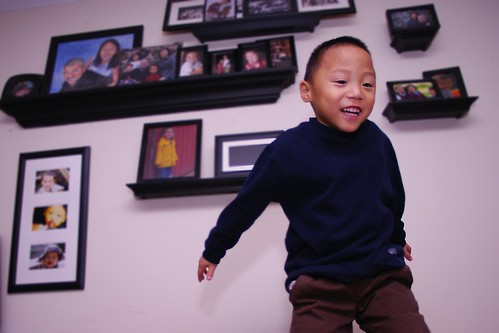
Unlike our other two, he didn’t respond to cause-effect discipline or intuitively learn anything. We still have to remind him to eat one bite at a time lest he shovel his entire plate into his mouth and then gag it all up…at every meal. This fall, I set out on a intense quest to figure this kid out. I’m an information hog by nature, and I wanted to make sure I knew as much as I could that would possible help us to raise Ty successfully.
So I read, read, read, and read some more. In fact, I’m still reading. I have found some common threads throughout the resources I’ve come across and started to come to terms with re-learning some of our parenting techniques.
Here are some things that Ty’s up against that may or may not be due to being a micropreemie and/or being adopted after 4 other placements. Either way, they are certainly compounded by those things…
- ADHD–I have no formal dianosis but we are 99.9% sure that these four letters describe our son. Lest you be skeptical, I fully agree that this is WAY over diagnosed (don’t get me started), but I fully believe, now that we have a Ty, that this is a bonified brain/neurological disorder. And Ty has it.
- Sensory Integration/Processing Disorder (SPD)–My jury’s still out on which of the three types most effects Ty, but he shows the majority of the symptoms in these diagnostic lists. The more I read about this, the more I can’t imagine not being able to process the world properly or how frutrating it must be and the more I’m convinced this plays into Ty’s struggles. These symptoms are all common in ADD kids.
- Explosiveness–I cried after reading the first couple chapters of the The Explosive Child
. So few had nailed our child the way this book had. Okay, I cried during a lot of the books. It’s just strangely reassuring to know that there are other kids like Ty and/or that other parents have struggled the way we have.
- Impulsiveness–Part of the reason cause/effect discipline does not work on Ty is that he’s doing whatever he’s not supposed to be doing long before he processes what the consequences could be.
Here are some hopefully helpful things if you can remotely relate to parenting a child like Ty…
- Diet–While some physicians may swear there are not food sensitivities outside of physiological allergies, I know a lot of parents who beg to differ. I’ve heard of kids having behavioral reactions to everything from gluten to rice to corn derivatives. I wish I knew more about this or how to diagnose it without pure trial and error. We’ve also started supplementing Ty with fish oil and probiotics. I didn’t notice a huge difference so the jury’s out on whether we’ll continue once this supply runs out.
- Connecting the physical to the neurological–The most fascinating books I’ve read are how holes in physical development impact neurological development and learning. It’s a recurring theme all around me lately. The infant/toddler play actions most of us take for granted (i.e., crawling, peek-a-boo, bubbles, baths, jumping, sand, etc.) can be detrimental if eliminated or skipped. The things our brains learn through those types of play lay the ground work for being able to learn and regulated ourselves emotionally.
Enter Exhibit A. This is what Ty produced in September. It represents his attention span as well as his lack of attention to detail.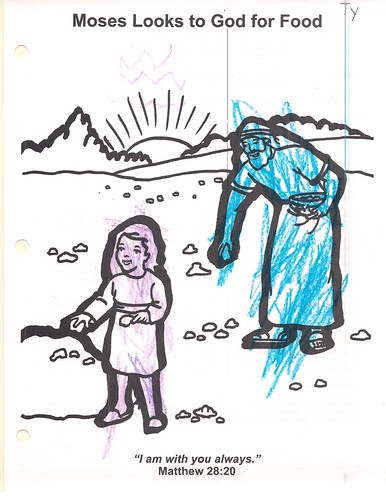
We started doing activities out of Growing an In-Sync Childin an attempt to start filling in missing developmental gaps in his foundation. Two weeks later, he sat down with a similar coloring page and VOILA! The improvement was not due to wrote lecturing about and practicing of drawing in the lines, but activities like pouring water in the tub across his midline and popping bubbles.

- Explicitness–It’s like having an Amelia Bedelia
. There is no intuition or sense of allegorical language. Everything is literal. No, “Cut it out!” It has to be, “Ty, please do not make siren noises. Please use words or be quiet.”
- Physical and eye contact–Not only does physical and eye contact provide a springboard for bonding, it’s required for kids who are ADD or have trouble processing sensory input. Your child might not be ignoring you, he may actually not hear you if there’s any other kind of noise in the area. Touching to get his attention and requiring him to look you in the eye insures you are heard and processed. Of course, if your child is impulsive, it feels like being heard doesn’t seem to matter anyway…
- Accomodations–I’m starting to be convinced that some kids with ADD and SPD need certain kinds of stimulation like others need sleep. Ty is one of those kids that needs the feeling of deep joint impact if he has any hope of concentrating or sitting still. Periodically the kid needs to go flying through the air and land…hard…on the ground. Seriously we started letting him jump down 4 or 5 steps about five times before preschool and his constant wiggliness during circle has greatly improved. We had to let go of our rule that jumping like that was unaccpetable due to safety reasons. We’ve found that Ty needs it more than we need to protect him, and he happens to be like a cat…7 lives and always lands on his feet. Volume of speech? Still working on that one. But we have found that he needs an appropriate, QUIET outlet of energy at all times. Wikki Stix
have been a great tool for him.
- Calm/Relax–I know this particularly relates to kids who have been through trauma but some kids seem to be addicted to adrenaline and other stress hormones. Apparently coming off of them can feel like falling. Kids are strangely intuitive enough to sense this and figure out which activities create stress, thus releasing more addictive hormones. Ty tends to operate at this constant high stress, intense level. You can watch him visibly struggle when required to do activities that are supposed to be calming. We are working on helping him to be able to feel comfortable at a relaxed state.
Lest you think by reading this post, that we have Ty figured out and we’re all hunky dory…
When he gets up every morning, I take a deep breath and prepare to enter a battlefield. I am way Type A if you haven’t figured that out, and he way pushes my buttons. We’re all exhausted and frustrated (including him), and we all yell way too much. However, God is gracious everyday and gives us glimpses of this really cute kid with a great imagination and fabulous sense of humor which is why we continue to fight to help him grow into his full potential. Here’s to his 6th year…
Happy 5th Birthday Ty!
P.S. Here are some resources I highly recommend…
]]>
On paper, Ty’s almost 5.
There’s one camp that see him as 5 and expect him to act that way. They lay out how he should be acting based on his age, find the things he can’t do, and have him practice doing them until he gets them. I used to fall in that camp. I guess, on some days, I still do. It was (and is) driving the Type A in me crazy. Mostly because it’s a road that does not seem to produce progress…just the feeling of needing to bang your head against a wall.
Honestly, it’s an easy camp in which to set up a tent. Because Ty is in speech therapy, CC, and preschool with kids his age, it’s easy to compare their skills.
The other camp consistently makes excuses for him because he’s not just “all boy” but he’s a micro-preemie and was adopted only 2 1/2 years ago. That camp thinks he’s adorable and will eventually just catch up.
That camp seems a little too much like a pity party to me and is all fine and well unless you have to live with him everyday. Additonally, in some ways, we’ve been expecting him to just catch up for 2 1/2 years now, and, frankly, it’s not working for me.
I’m pretty sure sanity and reality are some camp in between. I never in a million years thought we’d still be struggling to “figure him out” after 2 1/2 years home. On the plus side, he has come a long way, and I’ve learned more about reactive attachment disorder, parenting an explosive child, ADHD, sensory integration disorder, and early childhood development than I ever dreamed of. Honestly, I’d never heard of some of those things before Ty.
I’m still processing all the ideas that you were kind enough to share after this post, but I’m hoping to have something that makes sense to share soon.
But for now, I leave you with this: Focus on the best way to meet your child’s developmental needs where he is and think not of his biological age.
I’m off to tape my own advice on my dashboard, bathroom mirror, computer desk, and wherever else I frequently find myself.
Oops, almost forgot an adoption update. Our home study is finished! That’s high on our Thanksgiving list this year for sure. We’re hoping to have our dossier on its way to Ethiopia by Christmas. Stay tuned…
]]>Again, since each agency and country is different, your interview will probably look a little bit different but this is how ours went today.
Our social worker did a quick walk through of our house. It wasn’t very detailed because our county requires separate health and fire inspections which we already turned in. She did double check for smoke and CO detectors.
She asked the kids to draw a picture of them doing something with their prospective new sibling(s). PJ drew all of us plus 2 (or 3) kids in Van-Go. Mia drew us celebrating with balloons, and Ty just drew Mia. Along the way, she asked each of the kids how they felt about adoption and if they would prefer a sister or brother.
As for Patrick and I, she asked
- why we wanted to adopt
- what our strengths and weaknesses were as parents as a couple
- what our expectations were for after the kids were home
- what our education plan was
- how they adjusted to the last adoption
- how our families, friends, and church community responded to our adoption news
- what our support network looked like
- if we kept weapons, drugs, and/or fire arms
- what our biggest parenting challenge has been so far
- how we felt about birth order (since we said we would be open to disrupting ours)
- how we respond to unexpected changes in life
For whatever reason, I was a little nervous about our visit (even though we’ve been through it before) but I shouldn’t have been!
]]>For our purposes, I’m going to define the key words like this:
Strong-willed: Thrives on conflict. Has difficulty obeying right away…ever. Always fights to be “right.”
From a hard place: A child who was abuses/neglected, had a stressful prenatal or birth experience, has had multiple primary caregivers. These children have deep-seeded insecurities that are often communicated through acting out and whose brains do not process high-level, cause-effect discipline in a way that it modifies their behavior. In fact, traditional discipline may exacerbate negative behavior.
If you can identify with these terms, what has worked or is working for you? Books, techniques, websites, forums, therapies?
Ready, set, comment!
]]>So if you know me in real life and see me this week, just remind me…
BREATHE IN
BREATHE OUT
BREATHE IN
BREATHE OUT
]]>The other parts of attachement planning such as deciding on how long dad and mom will be sole caretakers are also individualized decisions. I am a firm believer in dad and mom being the sole caretakers for as long as possible. For older children, in hindsight, I think bonding games are crucial, too. We’re actually backtracking with Ty as we notice things like he can’t look anyone in the eye for longer than 5 seconds. It’s funny. I can’t either and I remember adults calling me out on it when I was growing up.
If you read other families’ attachment plans and think them a little over the top, remember that they are largely trying to redeeme many lost years, days, and hours that we who have bio kids take for granted. Research shows that all those hours of making eye contact parents do with infants that is really second nature actually facilitates the creation of thousands (if not millions) of nerve synapse connections in the brain. Many adopted kids have severe deficits in these connections. The good news is that they can still be created with proper healing, love, and therapy of which attachment plans provide.
]]>