
[bctt tweet=”Here are 4 things I wish someone had told me when I was new to the world of IEP meetings and adhd. #ieps #adhdparenting #pblogger” username=”corkboardblog”]
Here are four things I wish someone had told me when I was new to the world of IEPs:
1. Stay Calm. While it’s tempting to go all mama-bear on these people who seem to be failing your child, do everything in your power to take deep breaths and remain calm. Trust me, I’ve done this both ways. You have more credibility if you can keep your emotions in check.
2. Record It. Even if you take meticulous notes, it’s likely, you’ll want to go back and review what everyone said. Also, in the unfortunate case that you’ll need help from a student advocate or lawyer, you’ll want them to have the full picture. Rather than use the fact that you’re recording as a threat (which is my natural tendency), emphasize that you want what’s best for your child or that recording is the best way to share information with the other parent.
3. Know Your Rights. You should receive a booklet of parental rights when you request an IEP meeting. If not, look on your school system’s website. It will outline a timeline as well as other important rights. It’s your job to make sure the school system is treating you the way it’s supposed to. Sometimes it’s not malicious, but an oversight. You are your own best advocate.
4. Don’t Sign Anything. Meetings can be emotional and overwhelming. Despite what the team will pressure you to do, don’t sign anything in the moment. It’s your right to take it home and process all the information. Then you can make a more objective decision if the outcome of the meeting is a good fit or if you need to continue to advocate.
Are you unsure of what can happen at school to best set your child up for success? Are you not even sure what to ask the school to do?
Click here to download a list of over 100 IEP accommodations.

I’m not proud to admit it, but I’m guilty of contributing to this feeling of failure with our youngest son. His disability is invisible. It’s hard to remember to keep my expectations appropriate. I’m often frustrated when I have to explain something again or when he needs yet another reminder.
Kids with learning differences are painfully aware of the gap between them and their peers. They may struggle socially as a well as academically. Most school environments are not set up to foster success in our kids.
As parents, it’s hard to watch our kids struggle with shame and low self-esteem. We want them to walk with their heads held high and know they can contribute to the world.
Keep these four tips in mind when parenting your child with learning differences.
Focus on Strengths.
I’ll be the first to admit that this is not my natural tendency. This is also not where the school system focuses. If a student is struggling, they get extra time and services in the weak area. Imagine if we made rabbits spend more time in water because they struggle with swimming? Of course not! What if we let our kids put their extra energy into their area of strength? Research shows engagement, productivity, and self-esteem rises. [1] I encourage parents to read Strengths-Based Parenting for compelling stories of what is possible when we focus on strengths.
Understand Behavior is Related to Brain Function.
We’re tempted to see misbehavior as controlling, manipulative, or disrespectful. Children who misbehave are sometimes labelled as “bad” or “defiant.” I always do better with kids when I see behavior as a can’t instead of a won’t. This causes me to look for a collaborative solution instead of a punishment.
Set Students Up for Success.
Look for ways to create an environment where your student will thrive. This might include good brain food, essential oils that increase focus and decrease anxiety, sensory breaks, and visual reminders.
Redefine Success.
Society tells us that independence is
[bctt tweet=”Keep these four tips in mind when parenting your child with learning differences. #pblogger”]
How do you increase self-esteem for your student?
*This post contains affiliate links.
]]>The result? Kid-approved by each of our 3 who were here, and one of the sweetest community times we’ve shared in a long while.
I hesitated to even publish this post this year because there just aren’t that many days until Easter. But if you’re a fly-by-the-seat-of-your-pants family like us, then you have plenty of time to pull off a Seder. You could even make this your Easter dinner!

What exactly is a Seder?
In short, a Jewish ritual service and ceremonial dinner for the first night or first two nights of Passover. Because we don’t follow the Jewish calendar in our family…and life…we just celebrate it on a night sometime leading up to Easter.
What will I need?
Everything you need can be found at your local grocery store. I don’t worry about getting true Kosher items.
- Matzoh
- Parsley
- Horseradish
- Hard-boiled eggs (1 per person)
- Lamb shank (or chicken bone in a pinch)
- Charoset (I used this recipe and subbed some honey for the brown sugar)
- Wine or grape juice
- Romaine lettuce.
- Small bowl of salt water for each table.
- Large bowl of water for hand washing at each table.
- Simple meal. I make a simple roasted potatoes, carrots, and chicken. Recipe below.
- Haggadah. This is basically the script for the night. Download the one we use here. Print 1 per person.
- 10 Plagues Masks (Seriously, we found these at our local Wegmans. You can also Amazon Prime them here. But really, as much fun as they are, you can pull off a last minute Seder without them.)
- A simple prize. This is for the child who finds the Afikoman. Wegmans struck again, and we were able to pick up a Passover Bag of Plague Toys as our prize about 30 minutes before our Seder. But, seriously, anything goes here.
Lastly, if you have really little kids, we gave them a cup of crayons and this coloring page to keep them engaged as we went through the ceremony.
Now what?
- Set a date and gather all the materials.
- (Optional) Invite others.
- Print a Haggadah for each person.
Set up:
- Set each place at the table with a plate that includes a sprig of parsley, a hard-boiled egg, a dollop of horseradish, and a leaf of lettuce.
- Each table should have a hand washing bowl, a bowl of salt water, a tray of Matzoh, and a bowl of Charoset.
- Get the dinner roasting (recipe below).
Simple Dinner Recipe
Okay, I used the word “recipe” loosely. This isn’t really the type of meal where you need exact quantities. It’s really forgiving.
You’ll need enough red potatoes, chicken pieces (we used drumsticks and boneless thighs), and baby carrots for everyone.
Brine the chicken for a couple hours. I used diluted pickle juice, but you can just use salt water. I also like to add about 1/4 cup of hydrogen peroxide. It helps to tenderize the meat.
Chop the potatoes.
Rinse the chicken and pat dry.
Toss the chicken, baby carrots, and chopped potatoes in a roasting pan with enough olive oil to coat it all. Generously sprinkle with your choice of spice blend and salt and pepper to taste. I had a Safeway Selects Mediterranean Roast Rub in my spice cabinet that worked really well, but any rub or blend would work. Your spice aisle in your grocery store will probably have some great options.
Roast uncovered at 375 F for about an hour or until the chicken reaches 160 F and the potatoes are tender. This can totally be roasting while you do the ceremonial part of the meal and then just pull it out when it’s time to serve.
The Actual Seder
- Gather the people.
- Use the Haggadah as your guide and enjoy!
Do you have any favorite Easter traditions?
]]>
Last week in a neighboring high school district in our county, students were disciplined for staging a photo where their spirit week Scrabble letters spelled out, “N****r.” [1] Obviously, this incident is restarting a conversation about racism in schools.
According to a Change.org petition [2], the students were only suspended for 9 days. The outrage on the petition and across social media platforms was swift and clear. To date, more than 6,000 people have signed the petition which asks for stricter and more appropriate discipline.
As a side note, I’m following a fellow adoptive mom whose daughter was just suspended for several WEEKS for consensual horseplay on school property. As in a group of students of color were stupidly goofing off in a way where physical contact was made. All students assured the administration that it wasn’t fighting, they were just playing a game. They weren’t heard. Just suspended and now there’s a hearing on the incident. My friend’s daughter is still not back at school…being denied her education. She is black.
My visceral reaction to racism is anger and disgust and the need for retribution. After reading the news story on this, my lid was flipped. [3] However, we’ve started to extrapolate connected parenting principles to other aspects of our lives. After my initial seething, I could hear my thinking brain encouraging me to have a response rather than a reaction.
[bctt tweet=”Have a response rather than a reaction. #racism #parenting #education” username=”macorkum”]
Expulsion for racism in schools
It’s what the people are calling for. They are angry. I was quick to agree. Then there are comments that expulsion doesn’t actually address the heart of the issue. Such wise folks. I mulled and thought. True. Straight up punishment is not the answer. Something more restorative and educational is in order. But back to expulsion. I’m actually for it. Not because that’s what they deserve or because it makes me feel better. Expulsion is appropriate because of the victims—all of the students of color at the school. If you were a black kid, how would you feel knowing that these white kids, who were ballsy and racist enough to post such a photo, were loose at school with barely a slap on the wrist for such a heinous act? As a mama of black kids, I can tell you my kids wouldn’t be forced to go back until the administration addressed their felt safety needs which would include knowing that the guilty parties were nowhere near my kids.
Similar felt safety sentiments were expressed by students in another Maryland county last year following offensive social media postings.
“People should have the right to be informed if the student is expelled or when the student returns to the school/school system,” students wrote in their proposal. “When people are left without information, they are in constant fear that the threatening student will return. At this point in time, administration and HCPSS cannot share any knowledge of the student’s return or lack thereof. The feeling of safety is jeopardized when students are not informed properly.” [4]
Restorative Justice for Racism in Schools
But expulsion is to protect the victims, so what about the restorative justice [5] piece? Rather than straight punishment, connective principles ask what is being communicated by the behavior and think about what would be an effective solution. I don’t know these kids at all, but the offensive photo seems to indicate a lack of understanding, thoughtfulness, and awareness. Often, kids who are willing to hurt other kids are often hurt and insecure kids themselves. I’m thinking that a reasonable consequence would be putting the kids in situations where they got to know students and families of other colors and their stories. Initially they should hear how students of color were impacted by their photo. In addition, there should also be long term plans to put the white kids face to face, and elbow to elbow, with the group of people that they are so relationally far enough away from right now that they have no problem dehumanizing them. I think the parents and siblings of the kids should be involved, too. Paradigms are not formed in a vacuum.
Parenting special needs kids (and some who I didn’t form and shape from birth) makes me aware that there are not always ignorant, racist parents behind some kids, but involving families will never hurt.
Proactive Education to Prevent Racism in Schools
Systemically, it would be appropriate for Harford County Public Schools to implement some kind of diversity education. At 85% white (more white than the average across Maryland and the US), it should be obvious that education to combat prejudice and racism is a necessity. Students need to have their paradigms challenged and stretched. They need to learn how to think outside their racist boxes. [6].
If your child has been the victim of racism at school, what would have been helpful steps toward reconciliation and restorative justice?
]]>Also, it might be relevant to note that while I had our son who is fetal alcohol affected in mind while writing, these tips are also useful for students with other developmental disabilities and special needs.

- Go for exposure not mastery. Mastery (especially of the abstract) can be elusive for kids who have prenatal alcohol exposure. We use a lot of memory work. Most days we hit mastery (mostly because it’s all to catchy tunes), but I stopped getting frustrated if we didn’t.
[bctt tweet=”Exposure not mastery. #specialneedseducation #keepyoursanity” username=”macorkum”] - The more concrete, the better. I’m a visual learner, so I always joke, “If I didn’t see it, it didn’t happen.” For our kiddo with FASD, if he doesn’t experience it, it doesn’t happen. Whether it’s a historical event or a math problem, if he can’t experience it was all 5 of his senses, he’s lost. Similarly, if I can’t find a way to make it concrete, I definitely rely highly on #1 or just skip it all together.
[bctt tweet=”The more concrete the better. #specialneedseducation #fasd” username=”macorkum”] - Think outside the box. You’re homeschooling for goodness sakes! Take advantage of it. Maybe you just take field trips all year and creatively match them all to core subjects for your review. Depending on your state’s review requirements, this may be easier said than done. If you live in a state with heavy overview, get an IEP or ask for your child to be placed on a non-diploma track so you don’t have the pressure to jump through all the academic hoops that will probably end up crushing your child’s self-confidence and driving you batty.
[bctt tweet=”Think outside the box. #specialneedseducation #fasd #fieldtrips” username=”macorkum”] - Keep the end in mind. Think about what life skills your child will need to live as independently as possible. If you’re trying to teach something that doesn’t contribute to those life skills, refer to #1 or skip it entirely. Memorization of math facts? Really not necessary in real life. Everyone has a calculator on their phone. Knowing how to identify which key will unlock your front door, and then actually being able to use that key consistently. That’s worth spending some time on.
[bctt tweet=”Keep the end in mind. #specialneedseducation #fasd #lifeskills” username=”macorkum”] - Visuals and routine are your friends. We pretty much have the same routine every week with memory work, presentation, and spelling lists. It’s been the same routine for quite a few years. Tweaking it can be painful. As I’m writing this, I’m reminding myself how many weeks and years it took for this routine to actually be routine. I need to extrapolate this to how long I expect it to take for him to assimilate to other routines. <sigh> We started putting visual reminders up around our house this summer. A 5-step poster of what to do when I say, “Get ready to go.” Four cards on the bathroom mirror that remind him how to appropriately brush his teeth. A list of instructions of what he’s to do when he enters his Language Arts class at community (he’s in a new level this year.) He doesn’t always follow them to a “t” because…well, you know…FASD, but they are helping my sanity.
[bctt tweet=”Visuals and routine are your friends. #specialneedseducation #fasd ” username=”macorkum”]
If you’re in special needs education or homeschooling a child with special needs (maybe even FASD), I’d love your additions to the list!
]]>
Among other things (like the launch of the new unCorked podcast), September is apparently the month to increase awareness about Fetal Alcohol Syndrome and other related diagnoses. It’s also the month that we start back to a more intentional homeschooling schedule. While these things may seem unrelated, they have significant overlap in our lives since a practitioner recently confirmed what I had started to suspect…all signs point to the likely reality that Ty is fetal alcohol affected.
I probably don’t need to tell you, but just in case…No amount of alcohol use is known to be safe for a developing baby before birth. Not even a sip…especially if you’re Asian. Apparently Asians are likely to have the alcohol dehydrogenase enzyme genetic variant, leading to a doubling of the blood alcohol concentration compared with a Caucasian or other ethnicity consuming the same amount. [1]
While it was sobering to see all of his challenges lined up in black and white in yet another diagnostic report, it’s been freeing as well. I have concrete evidence via countless evaluations and an MRI that Ty has a legitimate disability. It means that I should stop banging my head against a wall over math concepts, and we don’t have to keep up with the homeschooling Joneses (or even our state’s basic academic requirements). #somuchlesspressure
Even though the most current (and I think most complete) diagnoses is fresh off the press, we’ve been dealing with the reality of it since we met Ty. We’ve also homeschooled him since the beginning (minus a trial year at a 3-afternoon preschool). Looking back, I wouldn’t have changed too much except some of my expectations.
Side note: I would go with these curriculum recommendations for students with other special needs besides FASD. Technically we’re also dealing with what looks like ADHD, Sensory Processing Disorder, and Autism Spectrum Disorder.
On expectations
When we started off, I had the same expectations of Ty that I had of the other kids. That he could learn, and we would work until he conquered. Except that sometimes he just can’t. His brain electrical activity is abnormal, and there is global atrophy of his brain. So now, I present an assignment with a wonder-if-he-can-do-this-today attitude rather than a we-have-to-get-through-this. It’s game changing. We looked at fractions on number lines today. About 30 seconds in, I thought, “Nope, so not here yet.” Instead of pushing through and getting us both frustrated like in years past, I just skipped it and moved on…or in this case back (more on our math curriculum below).
This is what we’re using for curriculum this year.
History
We’ve been using memory work as the backbone for all our grade-school-aged kiddos since the beginning. At first it was Classical Conversations, but now we use Claritas Publishing. I like Claritas’ 4-year cycles better, and they’re a perfect complement to the Story of the World materials. Each week, there’s a history song to memorized. One of Ty’s strengths is memorization through song, but even if he couldn’t memorize, we would just go with over-exposure of the song 😉 Besides using an MP3 player to listen to the memory work ad nauseum, he also copies the history sentence each week, reads the corresponding chapter from Story of the World, and participates in an enrichment activity at Bridges. If you don’t have an independent reader yet, use audiobooks liberally. Again, the expectation is for exposure…mastery or comprehension is icing on the cake.
Science
Claritas also provides a memory sentence and corresponding song each week for science. This subject looks just like history with the addition of a science experiment that is provided by our community (Bridges) every other week.
Geography
This is also provided by Claritas…see a pattern yet? I make games from our blank maps on Purpose Games to play as review. Again…go for exposure. Any amount of mastery or comprehension–for however long it lasts–is bonus.
English
Besides the memory work provided by Claritas, Ty is part of the Advanced Readers Language Arts class in our community. It uses a systematic approach to grammar and another one for writing that beautifully dovetails with classical education and memory work. The repetition and introduction of new concepts in small chunks is really FAS-friendly. Additionally, it’s a one-room schoolhouse model where I teach multiple levels at once and the class is meant to be taken multiple years in a row. This is a perfect set up for kids with special needs because they come in knowing that there will be a range of skillsets and that they don’t have to get it all on their first time through. It allows for a lot of flexibility and accommodating on home assignments as well. The grammar curriculum is also from Claritas, and we use the theme-based writing books from IEW.
Math
This is the subject where the struggle is the most apparent and intense. It’s also the place where I’ve floundered the most to find a curriculum that works. Of course, my definition of “working” has also evolved over the past couple years. Right now, we’re using Khan Academy. It’s free and there’s a great iPAD app. I like that you can hop to various concepts but it still gives you a measure to see where mastery stands overall for a certain grade. I also like that it checks the problems for you and provides video tutorials. Also, did I mention the smart technology that knows if you’re struggling on a concept based on whether you get problem correct on the first try or fifth and whether or not you used a tutorial video or step-by-step hint? I could go on and on…the on-board scratchpad, etc. I also acquiesced and allow Ty to have a calculator for any problem he wants. Honestly, having quick recall on math facts is not going to make or break a person’s ability to survive in the world. I expect it of my neurotypical kids, but the bar is different when a kid already has so many challenges to overcome.
Art and Music
Bridges provides lessons on these in community. #totalwin
When in doubt? Just do a lot of reading. Reading—out loud, silently, audiobooks, whatever—covers a multitude of homeschooling sins  I think the only school we did for the entire last quarter of last year was silent reading. But God’s mercies are new every morning…and certainly every school year. #onwardandupward!
[bctt tweet=”When in doubt? Just do a lot of reading. #homeschoollife #specialneedskids” username=”corkboardblog”]
If you’re homeschooling a child who has neurodevelopmental delays, what’s working for you? Stay tuned. I feel a tips and tricks post coming in the near future!
**UPDATE** Here’s that tips post.
]]>
Our homeschool community, Bridges, is officially back at full swing. I’m excited to be the tutor for our Logic level program which is equivalent to 7 and 8 grade (middle school). We do both grades together with a 2-year curriculum that can be taken in any order.
This is the stage where learning is driven by asking questions and applying formal logic to check your answers. In addition to traditional core subjects, one year we cover formal logic, and the other year we do fallacies. We’re on fallacies this year and using the popular Fallacy Detective book. My favorite teaching book on this stage of education is The Question by Leigh Bortins (feelings about CC aside).
Here’s the line up for this year.
Latin-I use Henle First Year as my base. I teach it from beginning to end each year adjusting the assignments for first and second year students respectively. I focus less on memorization and more on how to use a set of declension and conjugation charts and a dictionary to translate. If students have come through our Grammar (or grade school program), they have a tremendous grasp of English grammar and the Latin follows much easier than the students anticipate. I also find that moving quickly through the book keeps their attention more than spending an entire year on declensions and not understanding verbs and other parts of speech until later levels and years.
Science-I’m pulling from Science World magazine and ScienceWise 2 to design discussion-based and experiential lessons. The students will also be writing formal lab reports based on the scientific method.
English– Writing is integrated across many of the subjects. We continue to use IEW tools to guide us. For literature, we will read one classic together and dig deeper into the IEW critique model as well as explore literary critique methods and vocabulary. The rest of the books are student chosen. Each month the students read a book, write a critique, and present it to the class. I was inspired to use a more student driven approach for choosing literature after reading the Reader’s Odyssey.
Health– We’ll be reading and discussing articles from Scholastic Choices magazine.
Social Studies-The focus will be on world geography and current events. I like the Mapping the World with Art curriculum because it also checks off the required art box requirement for our state. I have the students read the lesson’s reading at home, and we complete the drawing lesson in class. We don’t do the extra enrichment activities. Additionally, we’re using Seterra to help us memorize all the countries in the world. We’re going continent by continent. For current events, the class has a subscription to WORLD Teen (yes, we’re magazine heavy in this year of the curriculum). We’ll be doing discussion around those articles through the month.
Bible-We’ll start by exploring praying in the Bible. Then we’ll study and pray for countries around the world using
Window on the World: When We Pray God Works which ties into our World Geography focus. We’ll also learn about world religions as we go.
Math– Because math is the one thing I couldn’t figure out how to teach modularly, we just provide some math study hall time. Fallacy Detective won’t take us all year, so we will also use Uncle Eric Talks about Personal Career and Financial Security as an intro to economics.
I’m in the market for a great one-year, comprehensive formal, logic course for next year. Any recommendations?
]]>[bctt tweet=”Families often underestimate their children’s ability to memorize. #education” username=”corkboardblog”]
The Auditory Learner
From the beginning, we’ve always had a tune (some catchier than others) for each piece of memory work. We’ve memorized skip counting of numbers, science facts, history facts, Latin vocabulary and grammar, locations for geography, Bible verses, an extensive timeline, and English grammar. My auditory learner could study using an mp3 player with headphones or in the car while we drove.
The Visual Learner
This is the child who I was worried about because she could never remember our phone number. However, we always practiced in the car where I would say it and have her repeat it. One day, she saw it written on our white board and memorized it on the spot and never looked back. I’m embarrassed it took me that long to figure out because, much like me, if she doesn’t see it, it doesn’t happen in her world. Our memory work songs were only helpful to her as reinforcement after she had read and re-read the memory work. Visual learners may also benefit from copying the memory work. Additionally, visual representations of certain memory work–creating charts or color-coding it–can be great tools. Our visual learner is a great example of how memory can be developed. She struggled early on and seemed generally clueless about the memory work. Memory Master which came naturally to our auditory learner seemed an insurmountable goal for our visual learner. However, she was diligent, and by the time she was 9ish, she was totally owning her own memory work and retaining exponentially more and more. Now her memorization skills could put most people to shame.
The Kinesthetic Learner
While I think all learning experiences are more robust with an experiencial or kinesthetic piece, some students can only learn if this piece is in place. We ended up with one of these, too. He’s the kid who has to jump each letter of his spelling words out on a trampoline and has to experience something concretely to really understand it. A verbal explanation or even a diagram aren’t good enough. He has to experience and feel it. He takes in memory best when singing and listening to the song while seeing it written down and doing matching hand motions. Then he doesn’t understand the words until you can stand on the “X” where JFK was shot or walk the battlefields of the Civil War.
Despite all of their differences (including one who has documented brain abnormalities), they have all found their niche in how to memorize their memory work. They’ve committed a ridiculous amount of information to memory, and we’re watching how our now Logic and Rhetoric stage students are able to use that knowledge as the foundation of their education as they add strong analytical and communication skills to their repertoire.
If you use memory work in your homeschool, what works for your students?
]]>Last year, we beta-tested a new classical homeschool community. While we were only 3 families, it was a really sweet year with a fabulous dynamic–kids and mamas alike. This year, we dreamed to expand in number and offering. Meet Bridges Classical Community. We added 6 families and now offer a Logic level (7th and 8th grade-ish) and a Rhetoric level (high school).
With two kids moving up a stage (Mia to Logic and PJ to Rhetoric), less opportunity for crisis, and a business still to fit in, I decided to be more intentional with our routine this year.
<<drum roll, please>>
Here is what an ideal week would look like:
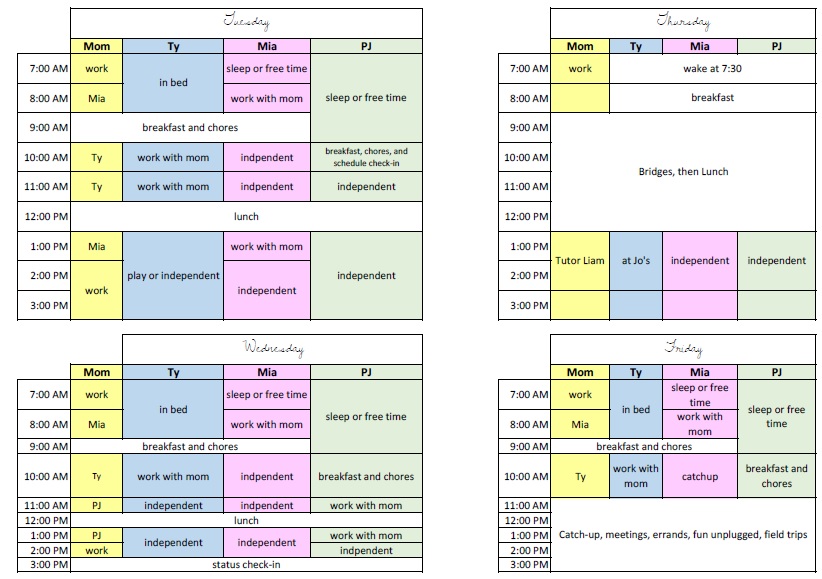
My work and planning will happen before 8AM and after 3PM most days with answering and sorting emails during lunch. While there are times listed, I’m going for routine over schedule.
Curriculum you wonder?
Click here for our Claritas Cycle 1 Resource List
Ty (Grammar Stage, independent reader, special needs)
Bible, Science, Language Arts, Art, Music, Latin, Geography, History will all be covered in our 1.5 community days. #wewin.
At home, we’ll handle math, read lots, and master the weekly memory work and spelling list.
Math is a struggle. We rotate between Math Mammoth (main spine), Right Start Math, and Khan Academy. Basically when we get stuck at a concept, we drop it and move to another concept in another curriculum, gain some confidence, then come back to where we were stuck. It pretty much always works that we get it on the second go-round.
Mia (Logic Stage)
Everything but music will happen and/or be assigned from community. #doublewin
Click here to see specifics. We’re in Year A.
For math, she’ll continue in Math Mammoth.
For music, Mia will continue to practice and teach herself piano with a little guidance from me.
PJ (Rhetoric Stage)
Again, all of PJ’s credits this year will originate in community. #stillwinning
He’ll be completing the Alpha year credits.
Patrick is putting his MA in Theology to write the Hebrew scripture course content.
Credits that don’t have a curriculum link we’re creating with the kids using a bit of Thomas Jefferson Education philosophy. The plan is to take good notes and have our experience documented to be able to share with other communities in the future.
For math, PJ will do Life of Fred Algebra. He enjoys the sense of humor and non-repetitiveness of it.
If you need help picking homeschool curriculum for your family, please let me know. I’d love to help.
If you’re all planned for this year, care to share?
]]>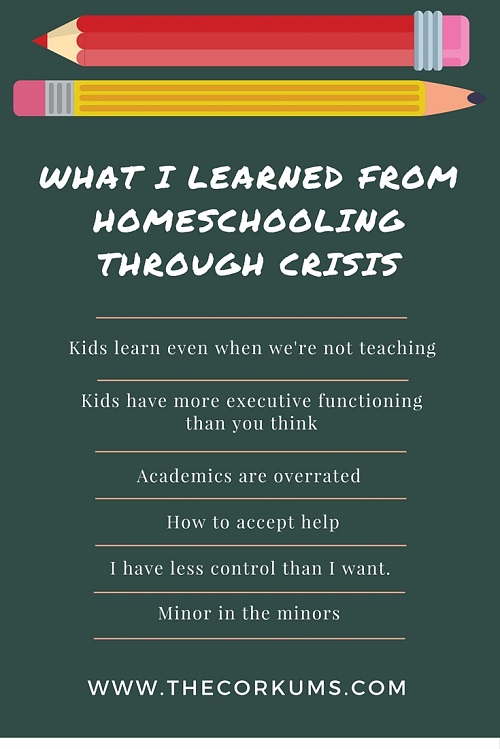
We’re entering our sixth year of homeschooling. More than half of our homeschooling years, so far, were marked by crisis and trauma. The feelings of my inadequacy to keep up the academic home front were strong. However, I knew in my gut that homeschooling isn’t just school at home, it is a family philosophy of sorts where life is our learning medium and academics aren’t the end all be all. Plus, I wanted to be with my kids to help them process everything that was going on in our life. In hindsight, I’m glad we stuck it out because it taught me a lot, too.
- Kids learn even when we’re not teaching.
Despite the fact many check boxes went unmarked and the best of intentions were left just that—intentions, all of the kids learned something. Some kids didn’t even fall behind. The momentum of years of nurturing and valuing education carried them through the rough season. Plus the extra free time allowed them to explore and learn within their interests, not mine.
[bctt tweet=”Kids learn even when we’re not teaching. #homeschoolingthroughcrisis”] - Kids have more executive functioning than you think.
Left to manage their own time, they explored their interests, learned to feed themselves, and apparently did some schoolwork.
[bctt tweet=”Kids have more executive functioning than you think. #homeschoolingthroughcrisis”] - Academics are overrated.
Even if they had fallen years behind academically, they were learning about people, relationships, character, and faith. I just started a book called, How Children Succeed, which claims all those soft skills are better predictors of success anyway.
[bctt tweet=”Academics are overrated. #homeschoolingthroughcrisis”] - How to accept help.
We had to be desperate to ask for help, but I’m glad we did. Our friends wanted to help and were blessed when we accepted. We weren’t imposing. They brought food, tutored, prayed, and listened. The truth is that had the roles been reversed, we would have wanted to help. I’m glad we were able to experience the power of community through this time.
[bctt tweet=”Accept help. You aren’t imposing. #homeschoolingthroughcrisis”] - I have less control than I want. It’s okay.
I joke sometimes that the intensity of crazy in our lives is just evidence of how stubborn and serious of a control freak I am. God knew what it would take to teach me this lesson and nothing less would have broken me. Nothing will test the faith you proclaim with your mouth like a family crisis where you learn how little control you have and how at the mercy of God you are. People often wonder how we managed what was on our plates the last couple years. We didn’t, none of it really makes sense unless you take into account the God factor.
[bctt tweet=”God’s really in control. #homeschoolingthroughcrisis”] - Minor in the minors.
There’s nothing like crisis to force you to prioritize. Math and English are important, the rest is minor. The kid playing Minecraft for 12 hours? Also, minor.
[bctt tweet=”Minor in the minors. #homeschoolingthroughcrisis”]
While I wouldn’t wish crisis on anyone, I am thankful for the perspective we’ve gained given the fact that we did walk through a crisis season.