Go Shopping
You set the budget and timeframe, but turn over control for everything else. Let your teen decided where to shop and what to buy. You might be tempted to weigh in, but resist! As long as it’s legal, go for it!
Play a Game
Even as teens, play is the best way to learn life lessons around social skills and problem-solving. Playful engagement keeps the nervous system open for learning and building relationship. Explore all types of games. Board games. Yard games. And, yes, even video games. If your teen struggles with losing, try collaborative games.
Dance Party
Activities that are rhythmic, repetitive, relational, and move our bodies are regulating. Dance parties can be all of those things and are so much fun! Let your teen choose the music. If they’re resistant, hold dance parties for yourself regularly anyway. Eventually, they’ll roll their eyes and join you for a beat or two  Just don’t turn it into a control battle.
Cook Together
Cooking is a practical way to spend time together. You need to do it anyway, and they need to learn to do it for themselves at some point. Invite your teen into the process as much as possible. Let them choose the recipes. Create a shopping list together. Go shopping together. If they don’t take direction easily from you, try learning a new kitchen skill together.

Our oldest son is currently converting our old 15-passenger van into a van house. Did I have reservations about the practicality when he proposed the idea? Of course. Has he made costly mistakes along the way? Yes.
Our youngest daughter is currently figuring out how to hang 18 feet of aerial silks in our backyard so she can learn to do drops. Am I afraid she’ll end up with a broken bone? Yes.
[bctt tweet=”Ultimately our teens need a sense of purpose and a cheerleader in their corner. Read more on connecting with adopted teens.” username=”corkboardblog”]
In both cases, we made conscious decisions to be the cheerleaders, not the naysayers. Ultimately our teens need a sense of purpose and a cheerleader in their corner. The best ways to connect are found by following their lead. We’re entering into their world with as much enthusiasm as we can muster. Because they feel like we’re on their team, they are accepting a tip here and there from us. We’re all learning a lot!
How do you and your teen connect?
]]>
But I know I still have work to do and want to be a part of quieting other noise this week to listen more intently to and amplify melanated voices.
Honestly, I was frozen on Monday wondering what to do next and where to lead you. I was processing for myself, worrying about our son who works in DC, but also feeling a responsibility to be a leader. To give you the resources you need to lead your family well.
This, of course, is not an exhaustive list, but some great places to start.
Just Mercy (movie)
The Just Mercy movie* is based off the fantastic book Just Mercy: A Story of Justice and Redemption* by Bryan Stevenson. It’s free through June on streaming services such as Amazon Prime and Apple TV.
Trouble I’ve Seen (e-book)
From the publisher, “What if racial reconciliation doesn’t look like what you expected? The high-profile killings of young black men and women by white police officers, and the protests and violence that ensued, have convinced many white Christians to reexamine their intuitions when it comes to race and justice.
In this provocative book, theologian and blogger Drew G. I. Hart places police brutality, mass incarceration, anti-black stereotypes, poverty, and everyday acts of racism within the larger framework of white supremacy. He argues that white Christians have repeatedly gotten it wrong about race because dominant culture and white privilege have so thoroughly shaped their assumptions. He also challenges black Christians about neglecting the most vulnerable in their own communities. Leading readers toward Jesus, Hart offers concrete practices for churches that seek solidarity with the oppressed and are committed to racial justice.
What if all Christians listened to the stories of those on the racialized margins? How might the church be changed by the trouble they’ve seen?”
Click here to download your free copy and use the code HART.
(Coupon only valid on the digital version.)
The Gospel in Color (e-books)
It can be hard to process racism for ourselves, let alone tackle it with our kids. But tackle we must. The Gospel in Color for Parents and the The Gospel in Color for Kids will help you navigate these tricky conversations through a biblical lens.
Click here to download them for free using the code ICANTBREATHE.
Not My Idea: A Book About Whiteness
This child-friendly book is about a little girl who sees TV coverage of a police shooting and has questions. Her parents want to protect her. Sound familiar?
Click here to download a free pdf of the book.
Transracial Adoption: Common Questions from White Adoptive Parents
This free resource is provided by Be the Bridge which helps bring awareness to the racial brokenness and system injustice in the world. When you request the download, it will come in their second email to you.
Adoption Heart Conference bonus session with transracial adoptee, Rhonda Roorda
Rhonda Roorda was adopted at the age of two into a white family, and raised as the only black in her family and community. You must hear about the moment she discovered she was black. She is the author of In Their Voices: Black Americans on Transracial Adoption*.
Click here to register for this free virtual conference.*
Podcasts
“Doing Nothing Is No Longer An Option.” — For the Love Live with Austin Channing Brown
Latasha Morrison on The Happy Hour with Jamie Ivey
Do you have additional resources to share? Click here to share them with our community.
*Denotes an affiliate link. This means I may earn a commission if you purchase a product through this link.
]]>
“You never do anything for me!”
My primary love language is Acts of Service. All I do is do things for you.
“You love them (siblings) more than me.”
Umm…our life basically revolves around keeping you stable. Whatevs.
“You’re never proud of me or tell me you love me.”
I call B.S.
“You just wanted slave dogs, not kids.”
Dude, a maid would’ve been so much easier on so many levels.
“We’re not really family because we don’t share blood.”
Seriously?!? You’re the second generation of adopted people in our family. No one shares blood.
The problem is that our kids are speaking in a code of sorts, so addressing the actual words that come out of their mouths is an exercise in futility. Plus, our experience shows responding with logic will probably escalate you and them.
[bctt tweet=”The problem is that our kids are speaking in a code of sorts, so addressing the mean words that come out of their mouths is an exercise in futility.” username=”corkboardblog”]
As Bryan Post often says, “Ignore the behavior, but not the child.”
Any of the above could be responded to with, “Do you need a hug?” or “I love you.”
I won’t lie. This is way easier said than done. It means we’ll have to do a lot of our own work and reflection about why those things bother us so much.
This morning I was reading in Mark.
So Pilate asked him, “Are you the King of the Jews?”
He answered him, “You say so.”
And the chief priests accused him of many things. Pilate questioned him again, “Aren’t you going to answer? Look how many things they are accusing you of!” But Jesus still did not answer, and so Pilate was amazed. (Mark 15:2-5, CSB)
We can be comforted and encouraged that we are not the first people to be falsely accused. Jesus was accused by his own people, rejected for a criminal (Mark 15:6-15), and denied by one of his best friends (Matthew 26:69-74).
Jesus knew what his job was. It wasn’t to argue with people he knew would not be convinced with words. He trusted that the truth would endure. He didn’t need to defend it.
May you be confident this Easter to know that you’re a good parent doing good work. Don’t let words from hurting kids threaten your foundation or your identity.
If you need some practical steps for building a strong foundation, make sure to grab your FREE Parent Success Plan.
]]>
It’s something that’s tricky to talk about because I don’t want to throw my kids under the bus. Their hurt and trauma are not their fault. However, child on parent violence is a real thing. And there are definitely not enough resources for parents who find themselves in this predicament.
Unlike other abusive relationships, you can’t walk away…unless you want to risk losing custody of your other children.
[bctt tweet=”Child on parent violence is a real thing. Unlike other abusive relationships, you can’t walk away. #adoptionishard” username=”corkboardblog”]
Four years after escaping the worst of our crisis, the PTSD still haunts us. Practically, it means I need a lot of rest. It may seem like we’re a busy family, but we carefully plan downtime into our schedule. I only have meetings and see clients two days a week. Most weekends, we spend the majority of the time on the sofa. Staying in relationship is important to us but also exhausting. We haven’t been able to be active in a church community in years.
I don’t share because I want pity. We’re actually in a really good place right now. I share because I want y’all to have a realistic view of us which is hard through social media. I also want to bring awareness to a mostly ignored reality of adoption. ⠀⠀⠀
So what do you do if you struggle with PTSD from child on parent violence?
First, find a safe community who understands. Isolation is the worst thing for an experience like this. We convince ourselves that we’re the only ones or even that we’re the problem. In our case, no one witnessed our child’s violence. In fact, she was charming to others which made me seem like such a bad mom because I didn’t have the same warm fuzzies that everyone else had.
Second, find a bodywork practice to release the trauma. I personally recommend Trauma or Tension Release Exercise (TRE). I try to practice this weekly, and it has changed my life. Other options are Brainspotting, EMDR, and the Safe and Sound Protocol (SSP).
Third, practice mindfulness. The first step of the REALife Behavior Plan I coach families through is reflecting on how a specific behavior affects you. How do you feel when it starts? Identify both the emotions that surface as well as any sensations you have in your body. The next part of the plan is to think about how to empower yourself in that moment to be in control and not let fear and panic drive your actions or close your mind to possible solutions. You need a pattern interrupt. The things that help our kids can also help us.
There’s so much more I could share, but I want to hear from you if you’ve experienced child on parent violence. Have you found resources in your community? What can I do to help?
If you’re an exhausted adoptive mom who feels trapped, I see you. Please reach out for help.
If you know an adoptive family, don’t judge them by their public appearance. They may be silently drowning.


How do you increase felt safety for your child?
]]>
Actually, I should say, “Who.”
Meet Andrea.
She regularly kicks her friends (who are foster parents) out, tells them they can’t home any earlier than 10 PM, and asks for nothing in return.
She notices needs like a worn out pack ‘n play and has the Amazon fairy deliver a new one.
She gifts bags of cool weather clothes when cool weather comes a knockin.’
She sends random texts asking to take the littles while the bigs are at school.
Do you know what she says when she’s thanked?
“No, thank YOU! You’re the one caring for the kids in need!”
[bctt tweet=”No, thank YOU! You’re the one caring for the kids in need! #truefriend #fostercare” username=”corkboardblog”]
Not everyone is called to foster or adopt, but maybe you’re being called to be an Andrea. Every family needs one!
Who will you help in 2019?
Adapted from a post by @phillourhome. Shared with permission.
]]>
We’ve told our kids repeatedly, “When we tell you to do something, you may say, ‘Yes, ma’am/sir,’ and go do it or ask for a compromise.”
In a perfect world, a compromise would replace a defiant, “You can’t make me go to bed! I’ll go when I want!” or a whiny, “I’m noooot tired, and my friends are still playing!” with “May I have 10 more minutes to finish up this game? Then I promise I will get ready for bed!”
But what about when you feel like you’ve moved from a battleground to being a doormat and your child is running your life?
Or what if you compromise and your child sees you as weak or uncaring and the challenging behaviors only escalate?
That’s what happened when we offered compromises to circumvent homework battles. Our child twisted that to mean that we actually didn’t care about her grades or her education because we decided to not care about whether or not homework got done. She couldn’t live with the rule…or without the rule.
It’s like you’re in between a rock and a hard place. You just can’t win! What a horrible feeling!
Watch this quick video for a couple tweaks you can make to stay off the crazy train and help your child get the structure he needs to feel safe without getting in a control battle.
[bctt tweet=”Watch this quick video for a couple tweaks you can use when using a compromise with your child to make it more effective. #parenting #pblog” username=”corkboardonline”]
]]>
Sure, we can all find small gratitudes each day.
We have food to eat.
We only called the police once last week.
The sun came out today.

But what about deep gratitude for the life you’re living?
After all, you may be living a life that you didn’t sign up for.
Maybe each day is a living hell. You feel like you’re being held hostage.
Maybe you feel isolated and alone. Like no one else gets it. Or even worse, that everyone thinks you’re crazy.
Maybe you’re starting to feel like you’re crazy.
If we focus on the injustice of just wanting to complete our families or help a child in need but ending up victimized and with no help, it is hard to think about being thankful.
Plus, the actual celebrating of the holiday with extra people, overstimulation, and lots of extra foods to have to police, it can be easy to become a Scrooge about Thanksgiving.
I was thinking I could do without this particular holiday.
Then I read Psalm 136 this week and was reminded of something powerful.
Give thanks to the LORD, because he is good.
His faithful love continues forever.
Give thanks to the greatest God of all.
His faithful love continues forever.
Give thanks to the most powerful Lord of all.
His faithful love continues forever.
Give thanks to the only one who can do great miracles.
His faithful love continues forever.
By his understanding he made the heavens.
His faithful love continues forever.
He spread out the earth on the waters.
His faithful love continues forever.
He made the great lights in the sky.
His faithful love continues forever.
He made the sun to rule over the day.
His faithful love continues forever.
He made the moon and stars to rule over the night.
His faithful love continues forever.
Give thanks to the One who killed the oldest son of each family in Egypt.
His faithful love continues forever.
He brought the people of Israel out of Egypt.
His faithful love continues forever.
He did it by reaching out his mighty hand and powerful arm.
His faithful love continues forever.
Give thanks to the One who parted the Red Sea.
His faithful love continues forever.
He brought Israel through the middle of it.
His faithful love continues forever.
But he swept Pharaoh and his army into the Red Sea.
His faithful love continues forever.
Give thanks to the One who led his people through the desert.
His faithful love continues forever.
He killed great kings.
His faithful love continues forever.
He struck down mighty kings.
His faithful love continues forever.
He killed Sihon, the king of the Amorites.
His faithful love continues forever.
He killed Og, the king of Bashan.
His faithful love continues forever.
He gave their land as a gift.
His faithful love continues forever.
He gave it as a gift to his servant Israel.
His faithful love continues forever.
Give thanks to the One who remembered us when things were going badly for us.
His faithful love continues forever.
He set us free from our enemies.
His faithful love continues forever.
He gives food to every creature.
His faithful love continues forever.
Give thanks to the God of heaven.
His faithful love continues forever. — Ps 136
True thanksgiving isn’t about being thankful for the circumstances as much as it is being thankful for the eternal, unshakable truths.
[bctt tweet=”True #thanksgiving isn’t about being thankful for the circumstances as much as it is being thankful for the eternal, unshakable truths. #lifeishard” username=”corkboardonline”]
We aren’t to be thankful because we feel like it, but because The LORD is GOOD. And that never changes.
If we are thankful for nothing else, we can be thankful that The LORD who created the world and will eventually restore and redeem it all is GOOD.
Regardless of whether or not our kids use their words, face their demons, or become what we consider functional adults, God is still GOOD.
Regardless of what others think about us as parents or whether or not our kids can receive our love, God is still GOOD.
So when you’re sitting around the Thanksgiving table this week, and you’re kids are running amuck, just remember that God is still GOOD and be thankful for that. And you are NOT ALONE.
DISCLAIMER: I am not condoning any disrespectful behavior or advocating that you sit around and do nothing if you are experiencing child on parent violence. If you are in this situation and need help, please send me a message.
]]>Then we attempted to parent a child from a hard place with traditional, cause-effect parenting. Guess who went to go dig that book out? You’ll do anything out of desperation, right?
I was shocked when the few tools we dabbled with worked. It didn’t take long before we were all in.
While there are still consequences in our house, we do our best to eliminate, what I’ll name for the sake of argument, punishments.
[bctt tweet=”There are consequences in our house…just not punishments. #parentingwithconnection” username=”corkboardblog”]
A [kon-si-kwens] is the effect, result, or outcome of something occurring earlier.[1]
If my child is mouthy or rude or makes some other myriad of poor choices, there will be a consequence. It may be a re-do or a time-in or a simple verbal correction. However, I won’t punish mouthiness by withholding an activity or privilege. The goal is to help our kids feel safe and develop better skills. A traditional punishment will put a Band-Aid on a gaping wound at best or further escalate a situation to violence and aggression at worst. I don’t know about you, but I don’t really want to be anywhere on that scale of “success.”
There are also what are often referred to as natural consequences. If you leave your iPod outside and it rains, it will get wet. It probably will also cease to function.
If my child has trouble with impulse control when playing with other children, he will not be allowed to play unsupervised with others.
Here are some things to consider when thinking about natural consequences with children from hard places:
- Fragility. It is not necessarily our job to protect our children from natural consequences. However, some children are more fragile than others. If you see a water bottle and a snack that is about to be left on the kitchen counter as you rush out the door, you may want to grab it if your child will rage because of a blood sugar crash. Going on a short errand and have a kid who will just be a little whiny and frustrated about it? Leave it.
- Drama. Dramatic threats of what will happen or “I told you so”’s, as tempting as they are, will cause dysregulation and disconnection. If you see a bike in the driveway or an electronic left out, try a question, “Johnny, why is the driveway not where we usually store bikes?” or “What might happen if…?” If you’re really good, use a playful voice! Similarly, if a child misses a beloved dance lesson because she was melting down and missed it, console her broken heart rather than coldly stating, “Well, I guess that’s what happens when you can’t pull yourself together.” Wait to debrief and rehearse what could’ve been done better after you reconnect and she calms down. You may even have to debrief days later.
- Stretching. “Well you were rude to me all afternoon and that wears me out. I’m pretty sure I don’t have the energy to take you to soccer practice. That’s just the natural consequence.” There may be some truth there, but your kid will see through it, and if we’re honest with ourselves it’s just a way to sneak in a punishment.
The real magic happens when there is a balance of high structure and high nurture in how you respond to any situation. The structure may be letting the iPod get wet, and the nurture may be validating your child’s feelings of how much it sucks to experience the natural consequences of irresponsibility.
Lastly, I’ll just speak a few words to those who are still gagging. You may need to go put on big person panties first.
Why do you think you feel the need to punish? It is wrapped up in how you were raised or what a portion of society has told you about what it looks like to raise children “properly?”
How do YOU feel when your child misbehaves? Fear? Embarrassment? Is your need to fix your child’s behavior through punishment more about easing your feelings of discomfort when the misbehavior happens?
Is punishment even working for you? Is it helping your child move toward healing and making better independent choices? Is it causing you to expend any less energy in the long term?
I know. Tough questions. I know them well because they run through my internal dialogue every day. I feel the pull to punish when I have to address the same thing for the 140 millionth time, but I know that it’s more for me and my big feelings than an actual solution.
You’re not alone.
]]>I noticed after our first Christmas with our older kids, that tree trimming was a huge trigger because it emphasized all the years they’d missed with us as our younger kids oohed and ahhed over their ornament collection from years past. Each ornament had a memory or special story. My parents had also had a tradition where they gave an ornament to each child every year. Our older kids were clearly in an ornament deficit.
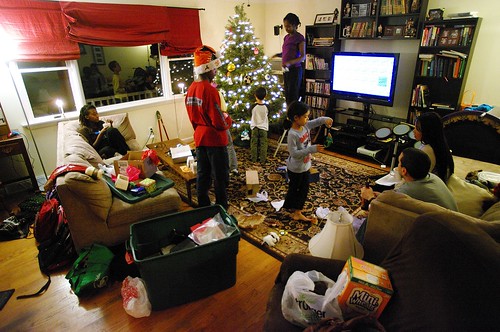
That’s when I decided to mount the Ornament Project. I sent out a message to all of our friends and family.
It’s a tradition for Melissa’s parents to get an ornament for the kids every year. The missing ornaments from past years for John, Kayla, Grace, and Ty really stir up a lot of grief and sabotage their sense of belonging. We’ve decided to fix it! On Christmas morning, we’d like to present them with a large box of ornaments…one for every year that they weren’t with us. As friends and family who have loved and supported them during their transition into our house, we’re inviting you to participate in this project by sponsoring an ornament. Please do not feel pressured if you are receiving. We just wanted to extend the invitation as wide as possible. The ornaments don’t have to be expensive or fancy. We thought it would be cool if you sent a little note of encouragement with it. Here are some housekeeping notes:
You may sign up for as many ornaments as you want.
Please mark each ornament with the name and year (even if it’s just with a marker).
In lieu of a physical ornament, you may just send $5/ornament, and I’ll shop for you.
Please let me know if you have any questions and thanks again for loving our kids so well!
[bctt tweet=”Check out this cool ornament project if you have kids by foster or adoption. #adoption #fosterlove” username=”corkboardblog”]
In the message, I also included sign up and delivery deadlines and directed them to a SignUpGenius where they could claim an ornament. Within 24 hours all of the ornaments were claimed! With 3 of the kids each having over a decade of missed Christmases with us, that was impressive.

While everyone was out buying ornaments, I got each of the kids an ornament storage box. The actual opening of the ornaments was a bit anti-climatic (especially considering how proud of myself I was for pulling it off), but there was unspoken, deep appreciation in each of their eyes.
Depending on how big your tree is and how many kids you have (and how old they are), you may want to limit how many ornaments each child may display each year.
What are your best holiday survival tips?
This post contains affiliate links. I may be paid a small commission if you purchase something after clicking on a link in this post.
A version of this post was first published here.
]]>