Also, it might be relevant to note that while I had our son who is fetal alcohol affected in mind while writing, these tips are also useful for students with other developmental disabilities and special needs.

- Go for exposure not mastery. Mastery (especially of the abstract) can be elusive for kids who have prenatal alcohol exposure. We use a lot of memory work. Most days we hit mastery (mostly because it’s all to catchy tunes), but I stopped getting frustrated if we didn’t.
[bctt tweet=”Exposure not mastery. #specialneedseducation #keepyoursanity” username=”macorkum”] - The more concrete, the better. I’m a visual learner, so I always joke, “If I didn’t see it, it didn’t happen.” For our kiddo with FASD, if he doesn’t experience it, it doesn’t happen. Whether it’s a historical event or a math problem, if he can’t experience it was all 5 of his senses, he’s lost. Similarly, if I can’t find a way to make it concrete, I definitely rely highly on #1 or just skip it all together.
[bctt tweet=”The more concrete the better. #specialneedseducation #fasd” username=”macorkum”] - Think outside the box. You’re homeschooling for goodness sakes! Take advantage of it. Maybe you just take field trips all year and creatively match them all to core subjects for your review. Depending on your state’s review requirements, this may be easier said than done. If you live in a state with heavy overview, get an IEP or ask for your child to be placed on a non-diploma track so you don’t have the pressure to jump through all the academic hoops that will probably end up crushing your child’s self-confidence and driving you batty.
[bctt tweet=”Think outside the box. #specialneedseducation #fasd #fieldtrips” username=”macorkum”] - Keep the end in mind. Think about what life skills your child will need to live as independently as possible. If you’re trying to teach something that doesn’t contribute to those life skills, refer to #1 or skip it entirely. Memorization of math facts? Really not necessary in real life. Everyone has a calculator on their phone. Knowing how to identify which key will unlock your front door, and then actually being able to use that key consistently. That’s worth spending some time on.
[bctt tweet=”Keep the end in mind. #specialneedseducation #fasd #lifeskills” username=”macorkum”] - Visuals and routine are your friends. We pretty much have the same routine every week with memory work, presentation, and spelling lists. It’s been the same routine for quite a few years. Tweaking it can be painful. As I’m writing this, I’m reminding myself how many weeks and years it took for this routine to actually be routine. I need to extrapolate this to how long I expect it to take for him to assimilate to other routines. <sigh> We started putting visual reminders up around our house this summer. A 5-step poster of what to do when I say, “Get ready to go.” Four cards on the bathroom mirror that remind him how to appropriately brush his teeth. A list of instructions of what he’s to do when he enters his Language Arts class at community (he’s in a new level this year.) He doesn’t always follow them to a “t” because…well, you know…FASD, but they are helping my sanity.
[bctt tweet=”Visuals and routine are your friends. #specialneedseducation #fasd ” username=”macorkum”]
If you’re in special needs education or homeschooling a child with special needs (maybe even FASD), I’d love your additions to the list!
]]>“He’ll grow out of it.”
“He’s just all boy.”
“Isn’t he only 3?”
After bringing home a whirlwind of a toddler at age 2 1/2 from Korea, these phrases were the backdrop of many conversations I had with friends and family about our youngest, Ty. The problem was that he wasn’t growing out of it, other boys were not like Ty, and he was 5 but just really small for his age.
My mother’s intuition told me there was something more. The letters ADHD floated around in my mind while I watched my child routinely climb to the highest point he could find and jump.
I’m an avid reader and verbal processor so I started reading and talking. Reading lead me to checklists that all but formally diagnosed our son’s behavior as ADHD. Books and adoptive parent training also told me his past traumas had altered his brain chemistry making him more likely to suffer from any number of lettered diagnoses. Then, during a conversation with a dear friend who is a Doctor of Physical Therapy, she said her profession is phasing out ADD/ADHD and recognizing that a person’s inability to attend is usually due to a Sensory Processing Disorder (SPD). If one’s body is misinterpreting what is going on around him, it is almost impossible to attend to a task at hand.
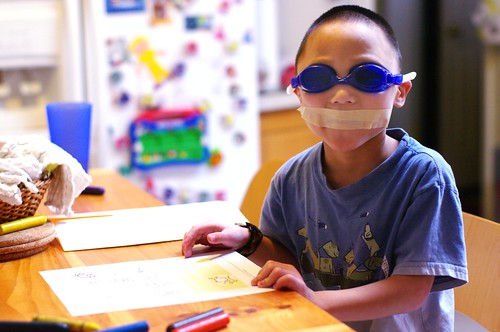
SPD. I had read about that and was fairly certain it was another 3 letter diagnosis that fit my son. We found a phenomenal Occupational Therapist (OT). She confirmed that his seemingly hyper behavior and constant motion was indeed to a sensory seeking brand of SPD. Additionally, Ty was diagnosed with a dyspraxia that impaired his ability to know where his body was in space. This could explain why he often looked like he was not paying attention during group activities such as Tae Kwon Do. His body was almost never doing what it was supposed to which made it look like he just was not following directions. A dyspraxia diagnosis meant he may have been paying attention and trying all along but actually had been unable to conform.
To address the sensory seeking, our OT suggested that a steady “diet” of activities that purposely engaged Ty’s proprioceptive and vestibular systems would calm him enough to function. Our decision to homeschool would allow Ty the sensory breaks he would need to get through a school day. The problem was that no amount of carrying heavy books, joint compressions, swinging, or spinning seemed to satiate his voracious sensory appetite.

Under the constant guidance of a physician who specializes in pediatric integrative medicine and allergies, we have been adjusting Ty’s diet and supplements as well, to see if there is an underlying allergy. Currently, Ty follows a dairy/gluten/phenol-free diet and takes a digestive enzyme, high doses of liquid fish oil, folate, zinc, a yeast inhibitor, probiotic, and l-theanine.
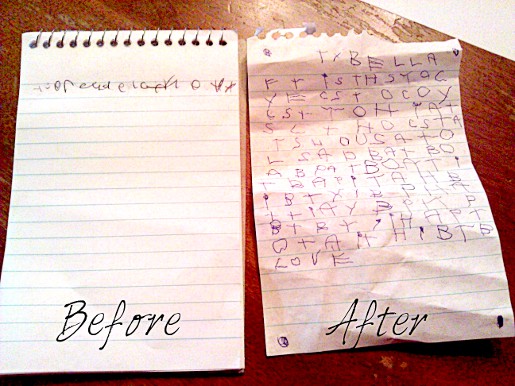
I’m happy to say that my son has recently had a language explosion, started making eye contact and speaking at appropriate volume, and his social skills improved. While he has come a long way, Ty still has a long way to go. I am also stocking up on sensory activities to create a school environment that sets him up for success. There are wiggle seats, balance boards, fidget toys, therapy putty, climbing apparatus, an MP3 player, and plenty of planned break time.
We start our school day with Bible listening time. During that time, I provide fidget toys such as Wikki Stix, therapy putty, and pipe cleaners to keep his hands busy so his mouth can stay quiet. Sitting on a T-stool or standing on a balance board also helps to activate the brain’s language center during speech and listening activities. When Ty moves into table work, he has a wiggle seat that allows some kinetic movement while he works. Using a weighted lap pad or making sure his seat is as close to the table (horizontally and vertically) as possible also helps him sit longer. A whiff of peppermint essential oil can help him concentrate for a couple extra precious minutes.
After each still activity, I make sure Ty has a break to climb, swing, or do heavy work like hauling laundry baskets for me. These activities help organize his sensory systems so he can be successful at the next task. Music can also be very relaxing for kids. Ty loves to sit with an MP3 player loaded with his weekly memory work to song while he’s waiting for his turn for me to help him.
In the afternoons, he spends time in a soothing, hot bath with Epsom salts and calming essential oils. And, hopefully, by the end of the day, his specialized routine helps both of us feel successful and hopeful for what the future will bring.
If you are managing ADD/ADHD behaviors without medication, what does your day look like?
]]>