Here are the top 5 mistakes parents make when using consequences:
- We forget to reflect and regulate first which results in reacting instead of responding.
- We address our child’s chronological age instead of their emotional/developmental age.
- We use punishments instead of supports and accommodations.
- We don’t increase nurture to balance out the increased structure.
- We create unsustainable situations.
[bctt tweet=”Are you making any of these five mistakes when using consequences with your kids?” username=”corkboardblog”]
I made all five of these mistakes recently.
]]>A lot of moms (myself included) start to see their child as the adversary when bad behavior persists. One of the most helpful visuals that I learned when becoming a parent trainer was to stay on the same side as your child. Instead of imagining you against your child and his aggression, think about you and your child fighting the aggression together. It's a subtle, but powerful shift. It allowed me to keep some semblance of compassion toward my child instead of feeding the resentment monster.
"We need a common enemy to unite us." ~Condoleezza Rice

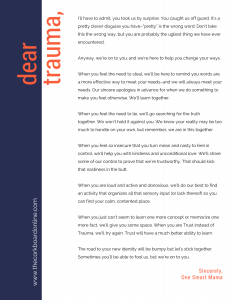
Here's a letter I penned to trauma (our family's common enemy) a while ago. It has a lot of great reminders that I still need.
Dear Trauma,
I’ll have to admit, you took us by surprise. You caught us off guard. It’s a pretty clever disguise you have–”pretty” is the wrong word. Don’t take this the wrong way, but you are probably the ugliest thing we have ever encountered.
Anyway, we’re on to you, and we’re here to help you change your ways.
When you feel the need to steal, we’ll be here to remind you words are a more effective way to meet your needs–and we will always meet your needs. Our sincere apologies in advance for when we do something to make you feel otherwise. We’ll learn together.
When you feel the need to lie, we’ll go searching for the truth together. We won’t hold it against you. We know your reality may be too much to handle on your own, but remember, we are in this together.
When you feel so insecure that you turn mean and nasty to feel in control, we’ll help you with kindness and unconditional love. We’ll share some of our control to prove that we’re trustworthy. That should kick that nastiness in the butt.
When you are loud and active and obnoxious, we’ll do our best to find an activity that organizes all that sensory input (or lack thereof) so you can find your calm, contented place.
When you just can’t seem to learn one more concept or memorize one more fact, we’ll give you some space. When you are Trust instead of Trauma, we’ll try again. Trust will have a much better ability to learn.
The road to your new identity will be bumpy but let’s stick together. Sometimes you’ll be able to fool us, but we're on to you.
Sincerely,
One Smart Mama
[bctt tweet="Helpful #parenting tip: Stay on the same side as your child. Go after a common enemy together. #momhack" username="corkboardonline"]
It's so easy to forget this simple concept of staying on the same side as your child. Grab a printable copy for your fridge, bathroom mirror, and as a reference for your tatoo artist when he puts it on your forehead.

Here are some reasons why we’re such fans of hand massage in our family:
- Less triggering than affectionate touch. Warm touch stimulates the release of the hormone oxytocin which enhances a sense of trust and attachment [1] and can be a crucial component of healing. However, for kids with attachment challenges, physical affection like hugs can actually be triggering rather than healing. My favorite hand massage technique, the AromaTouch® Hand Technique, is just clinical enough to not trigger while still delivering all the benefits of touch. For especially fragile kids, you may need to avoid eye contact while giving the massage.
- Rhythmic and predictable. The realm of the unknown, even not knowing what will be served for dinner, can be dysregulating for kids from hard places. I love that the AromaTouch® Hand Technique is repetitive and is given the same way each time. It also has a clear beginning and an end, and it’s not too long. Once they’ve experienced one, kids can rely on the predictability and feel confident because they know exactly what to expect.
- Calms the limbic system. Essential oils are an important part of the AromaTouch® Hand Technique. Smells are processed by the limbic system which is also the part of the brain that regulates emotions.[2] Adding essential oils to your hand massage increases its effectiveness for calming.
- Portable. Hands are easy to access in public places and, while essential oils are part of the magic, the AromaTouch® Hand Technique can be given without any oil making it the perfect way to connect quickly on the go. In full disclosure, I actually carry my favorite blend, Balance, with me at all times so we can always get the extra benefit of aromatherapy with the massage technique. I’ve even offered hand massages to strangers in public places who look like they need a little TLC. Most of these encounters happen on airplanes.
- Beneficial for both caregiver and child. Research by Tiffany Field, director of the Touch Research Institute, demonstrates that the person giving a massage experiences as great a reduction in stress hormones as the person on the receiving end [3]. I don’t know about you, but I need any and all opportunities to reduce my own stress hormones.
Because I know that connection needs to happen before correction, I’m endeavoring to create a habit of utilizing this hand massage technique as a buffer before I correct a behavior. Will you help hold me accountable to that? Pretty please? Ty thanks you. Speaking of Ty, here’s a video we created a while back to demonstrate the AromaTouch® Hand Technique.
*In full disclosure, the link to Balance is an affiliate link for my doTERRA business. I may earn commissions if you purchase from doTERRA using that link.
]]>
This week’s guest, Kristin Taylor was nominated by #17 Kathleen Guire. We had a super fun conversation because it turns out we have a lot in common including our Enneagram numbers and how we don’t separate white from colors when doing laundry. I mean what more could you ask for in a friend?
I think you’re going to love her heart for community and what she’s been learning by volunteering at her local pregnancy center.
You can connect with Kristin at her blog. If you need some mismatched socks, check out Pals*!

*In full disclosure, this is an affiliate link, but I never share things I wouldn’t actually use myself or share even if I wasn’t being compensated.
]]>
Kathleen Guire is the founder of the Whole House Blog. She also recently released her first novel, Defining Home, meant to increase awareness about the tragedies of slavery and sex trafficking. She had wise words to share about FASD, self-publishing, and how she keeps her large family organized.
Related Links
Episode #2 with Bethany Kaczmarek on Abusive Relationships
Cool video on electronics sniffing dogs
YouTube channel on parenting kids from hard places
Create Space for self-publishing
Vellum (e-book formatting software)
Connect with Kathleen
Website | Podcast | Instagram | FB Page | Personal FB
]]> This week, I’m excited about welcoming my BFF, Tricia Anderson, to the show. As you’ll hear, we’re kinda the same person…and kinda not. We’re a rare example of besties who are on opposite side of pretty much every ideological spectrum we can think of. She’ll be coming back every so often to offer her perspective on some tough topics. We’ll probably disagree a lot, but the beautiful thing is that we’ll still love each other in the end! We definitely need more of this civil discourse (no blaming and name calling) in our world!
]]>
This week, I’m excited about welcoming my BFF, Tricia Anderson, to the show. As you’ll hear, we’re kinda the same person…and kinda not. We’re a rare example of besties who are on opposite side of pretty much every ideological spectrum we can think of. She’ll be coming back every so often to offer her perspective on some tough topics. We’ll probably disagree a lot, but the beautiful thing is that we’ll still love each other in the end! We definitely need more of this civil discourse (no blaming and name calling) in our world!
]]>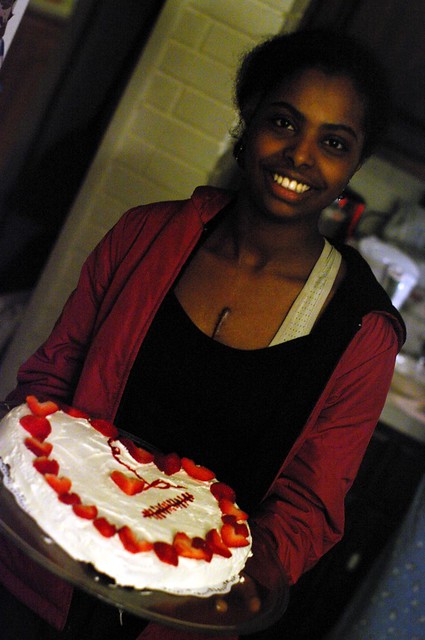 I struggled with what to write when these pictures came up in my flashback (a.k.a. never got around to being edited and shared) file. The emotions evoked when viewing these photos are hard to accept and raw. Instead of affection, I feel resentment. Instead of joy, I feel immense sadness. Friends, our family is battle weary and tired.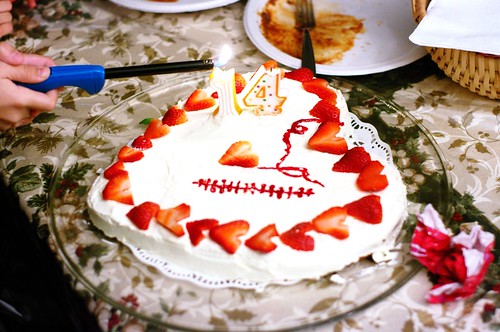
Grace currently isn’t living with us. Many have sympathized with what a hard decision that must have been. Can I be completely honest without being judged? It’s had hard moments, but generally we are relieved to have a break from the constant barrage of aggressive, maladaptive behaviors. Trauma was once defined to me as the consistent feeling of not being able to control a situation. By that definition, we all (including Grace) had been living in a persistent state of trauma for almost 3 years. We all (including Grace) need a breather. We can break the hypervigilance we were all living day in and day out by having Grace temporarily live in a safe place that’s not with us. In this arrangement, she will not need to be hypervigilant about how she’s being treated in relation to her siblings, AND her siblings will not need to be hypervigilant about whether or not they will be the target of her next tirade.
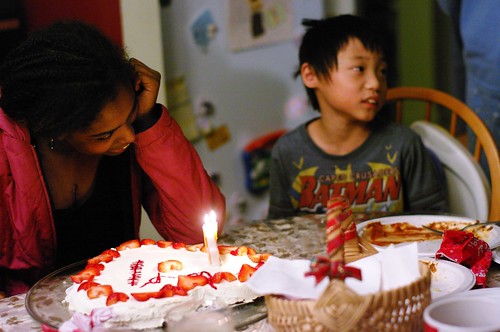
To be clear, we love Grace, are continuing to coordinate and participate in her care needs, have frequent contact with her, and are working with her therapist to make this a successful and healing respite. We recognize in our heads we are battling against trauma not a child and are begging our hearts to follow suit.
I debated on whether or not this was an appropriate post to share.
“Hi, my name is Melissa, and I’m an over-sharer.”
I decided it was important because I hear from too many families that they were convinced they were alone in their hardness before chatting with me OR that they had no idea that adoption could be this hard–even after the dozens of hours of required agency training. Part of stewarding our childrens’ stories well is protecting what is theirs. However, part of stewarding our family’s story well is that it be shared so that our suffering may not be in vain because there’s a chance that it could help another family not feel alone or be better prepared before bringing trauma kids into their home.
Back to the lighter, regularly (or not-so-regularly)-scheduled Foto Flashback Friday next time.
]]>The segment starts with a recap of the story of Hannah Williams. While the Williams’ treatment of Hannah is in no way excusable, I have a sense of empathy for them that possibly only the parent of a traumatized teen may understand. Raising kids from trauma has tested my self-restraint and anger-management skills more than any other experience of my life. We have been in the horrible downward spiral that punitive actions toward trauma kids triggers. I fully understand how parents without the correct tools and support could end up where the Williams ended up.
The majority of the story focused on children of a Richard and Julia who allegedly have 28 children, many adopted from Ethiopia. All the clips of Julia seem to be taken from previous news stories run on the family. Her side of the story is not represented by Dan Rather at all. While I have concerns about how a family can possibly care for that many kids from hard places well, I also am skeptical of the sob story painted by Rather through interviews with a couple of the older children.
One of the older girls, Belanesh, starts by telling how she just wanted to have “parents and someone to be a mother-figure.” Our kids have voiced similar laments. However, it turns out they thought mothers were supposed to give them whatever they wanted and to otherwise leave them alone. Most of the time when I am doing typical mother things like assigning chores, requiring politeness (e.g. please and thank you), or giving advice, I get push back that I am making them “slave dogs,” am obsessed with “please,” or aren’t their priest or doctor. If we do anything less than give them everything they want all the time and ignore all misbehavior, they claim we don’t love them or want them.
One of our kids thinks that turning 18 means you can still live at home but do whatever you want because you’ll be an adult and no one can tell you what to do. When we try to communicate a conditional, “If you cannot follow certain basic rules such as be kind to others, then we will need to ask you to live somewhere else at 18,” it is immediately interpreted as, “I knew you want kick me out at 18. I knew you not want me and no one will ever love me.”
Eventually, Rather turns to Abiy who had a run-in with police after being accused of having sex with an adopted sister. He defends himself by saying he didn’t have sex, only touched her behind and breasts. Is that really supposed to be a defense? With trauma kids, it’s common for them to never be able to accept responsibility for their actions. We see this daily in our house. While Julia’s accusation may have been exaggerated to the point of untruth, she still had a valid reason wanting her son to leave the home.
If Julia did, in fact, slap her children around while Richard was holding them down, they should definitely be held accountable. However, I also know that perception is not reality in our home. “How could someone misperceive something that seems so cut and dry?” you may ask. Four letters. PTSD.
Playing Devil’s Advocate with the side that Dan Rather portrayed does not mean there aren’t valid concerns to address in this situation. However, the point is that there are multiple sides to every story, and our experience with older kids from Ethiopia causes us to watch stories like this with very different eyes than the general public. I am sad for Abiy and Belanesh, but could sense how they set out to emotionally manipulate the pastor interviewed and eventually the viewers. It’s a maladaptive behavior we are all too familiar with.
Bottom Line: I hope you will watch stories about adoption with an open and critical mind and dig to find ALL sides of the story.


I had never heard of the WRETCHED Network or Todd Friel before yesterday, but now a video he recorded has gone viral in the adoption community. As anything viral, it evokes strong emotions; However, this video has been rather polarizing. Folks either really identified with it or found it untrue and offensive.
Todd’s delivery is drippy and sarcastic which is why I think viewers will react so viscerally. He is down right obnoxious. However, there is more truth than not in what he’s saying which is why it’s worth the watch. I’ve included my commentary below the video.
First, I have no idea what “yesterday’s” program contained. A basic search of his blog didn’t turn up anything.
An issue that accompanies every adoption.
This small phrase seemed to ruffle the most feathers. While getting a clinical diagnoses of Reactive Attachment Disorder (RAD) is not common, I consider attachment disorder a spectrum and present in some way, shape, or form in E.V.E.R.Y. child who has lost a primary caregiver. Regardless, don’t get hung up here. That’s not his point.
They [child] always need to be in control because they’ve always had to be in control.
Children from hard places definitely need to control things. However, it’s more about a maladaptive way to create felt safety than how he explains it throughout the video.
Reason #1: Full disclosure
As I mentioned above, every child who has lost a primary caregiver (even at birth) will suffer from attachment challenges. More importantly, statistically, more than 60% of children will have trouble adjusting and relating moderately to severely. The probability is that the behaviors he listed will more than likely effect an adoptive/foster family. While there are no guarantees of this, a family must be fully willing to check the “box” for every. single. one. of the listed behaviors. If they don’t present, GREAT! However, if agencies let families think that they can get away relatively unscathed (as they have been for decades), the results of damaging for everyone (as we’re seeing play out now with hundreds of disruptions).
Reason #2: Call to Churches
This is one of the few places I have seen the church called out so bluntly. It’s why we started the Grafted. The only part I take issue with is that it ends when the child leaves your home or that it will only take sacrificing weekends and money.
Not every person is equipped to parent an adoptive child.
We certainly weren’t. Moreover, families generally find themselves isolated and without the support network they need to fully address the needs of a child from a hard place. #churchfail. Also, living with traumatized kids will dig up any emotional dirt you thought you had buried making YOU reactive.
They want chaos out of you because that brings them peace.
This can be true, but is not always the case. Some kids want chaos because they are chemically addicted to cortisol and other stress hormones and chaos helps them get their “high.” Additionally a lot of kids are not necessarily after chaos as much as they are out to emotionally manipulate and control you. Remember, that all the “bad” and “scary” things that have happened in their lives (i.e., moving around, changing countries, watching a parent die) made them feel extremely OUT of control. In turn, they believe if they can be in control at ALL times, they can stop more bad and scary things from happening.
Shoe example. So true.
He missed some zeros. Try 752 MILLION times!
The Symptoms
Disclaimer: Rather than taking this as a list of “official” symptoms toward a clinical diagnoses of RAD, hear this as the list of behaviors every perspective family should fully expect. Any you don’t experience is a “win.” It’s much better than seeing each as a “loss” as they start to appear. While I know not every child has all, all have at least a few.
In our house, our older kids have all but 2 and Ty has had more than half. He nailed some of these so accurately. It was kind of like he’s been hanging out in our house. We laughed until we cried. It felt so great to have a voice for families like ours. There were some thoughts I had along the way…
#15. Cruelty to Animals On the flip side, animals can be therapeutic to kids who have trouble attaching to people.
Return from commercial break. So true. If anyone had remotely shown that they had done some research into what our family might be experiencing and had cracked that door open, they would have gotten a flood from me. Yes, we showed up regularly at church looking together, but we were silently drowning while the entire church looked on and even gushed over that cute, multi-cultural family that always paraded in and sat in the second row. And, NO, we’re not going to REALLY tell you how it is in front of THE KIDS.
#9. Poor peer relations. Generally just poor social skills (unless they’re wooing an adult as per #20 and #19). This is also not the only reason these kids struggle in school, but that’s an entire post in and of itself.
#5. Persistent nonsense & chatter. Attention vs. attachment. A phenomenal distinction. Our kids definitely want our attention on their terms and without actual attachment or relationship.
#2. False allegations of abuse. I know a family walking through this right now. It’s debilitating every time I really stop to think about it because we know it could happen at any time to us. I just keep singing Psalty’s I Cast All My Cares Upon You.
I certainly will never deny we have joyful times or that we see breakthroughs in our kids. However, we are not linearly moving forward, and it is easy to doubt if the light at the tunnel will ever appear this side of heaven. With 18 of the 20 listed “symptoms” assaulting us 24/7, it’s a spiritual discipline to keep getting out of bed every morning and to keep remembering that we believe in God’s providence and sovereignty and greater purpose. We press on.

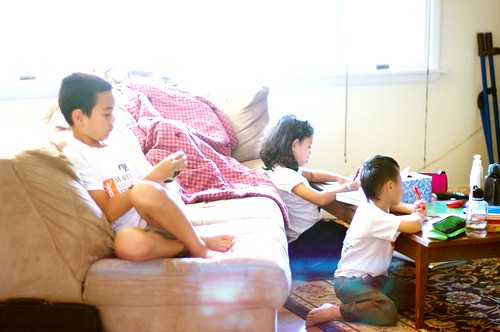
Note to self: When dealing with kids from trauma, never underestimate the toll that transitions can take.
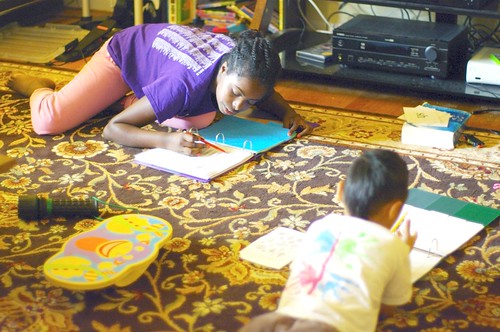
While most of the world was posing for “first day of school” photos and waltzing off with shiny new school supplies, the hypervigilance in our house skyrocketed at an alarming pace. Patrick had to be home 4 of the last 9 school days.
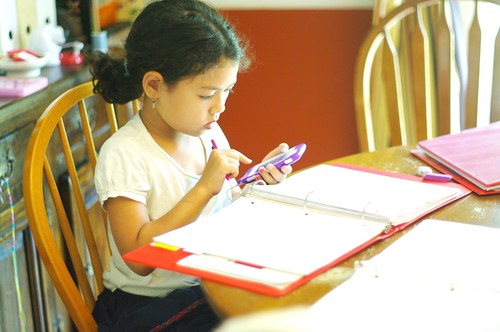
On the plus side, only one of those days was this week. So here’s hoping for next week.
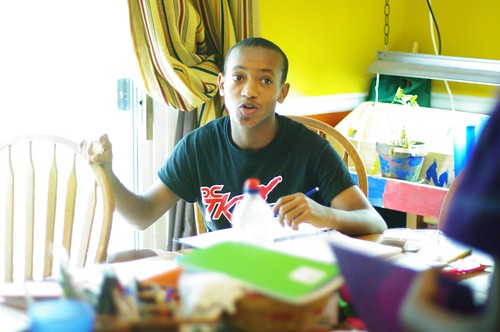
Despite the trauma drama, we are accomplishing some school. At least that’s what the photos seem to say.