[bctt tweet=”Sometimes anxiety in kids comes out in behaviors that may look disrespectful without a closer look.” username=”corkboardblog”]
Have you ever had a child giggle or laugh hysterically while you were trying to be stern? Makes your blood boil, right?
Maybe your child never stops moving. If he’s not running around the room, he’s drumming, tapping, or humming.
Have you ever seen a child get super silly or use a silly or high-pitched voice?
What about the kid who asks incessant questions? Or never shuts up.
Do you have a child who seems like a hypochondriac? Unending stomaches and headaches?
Maybe it’s a “bad” habit like biting her nails or sucking his thumb?
All of these behaviors, and more, are ways that anxiety builds up in our kids and then leaks out.
Once we recognize our child’s anxiety, we can be proactive about giving appropriate ways to relieve the build-up of anxiety. Think of these things as releasing a little anxiety at a time like the valve on your pressure cooker so that they don’t blow up!
Warm Water
Baths or showers can be very calming. For a while, we scheduled hour-long “therapy baths” into our son’s schedule that served as a respite for us (he was 6 so able to play without constant, direct supervision) and a calming tool for him–WIN! WIN! We use Epsom salt and essential oils, but they’re not necessary. If you have access to a therapy pool, all the better. Sometimes swimming (even if the water isn’t warm) does the trick, too.
Extended Exhales
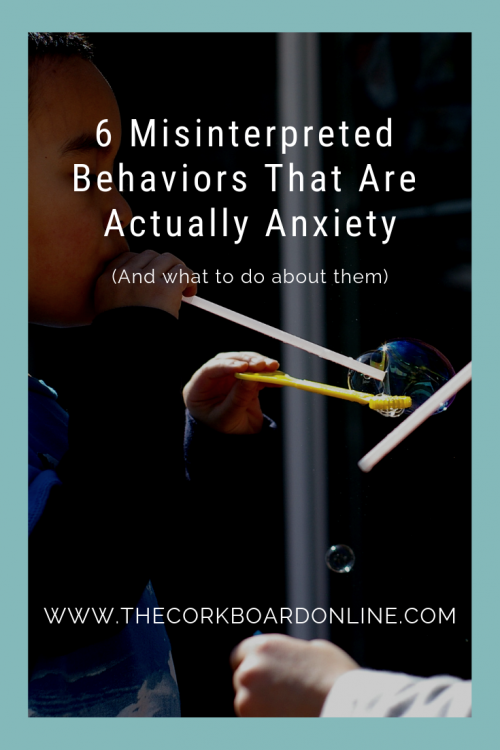
This is one of the easiest ways to regulate excitatory neurotransmitters…no equipment needed. Some kids need help learning how to make their body do this. If you’re using the bath as a tool, try blowing bubbles in the bathtub or with a straw into a cup of water. Challenge your child to see how long he can blow without taking a breath. If we’re out and about, I’ll often try to get our son to try to blow me as far away from him as possible with one breath.
Essential Oils
Scents are the quickest way to impact the Limbic System in the brain. “Essential oils in the floral category are typically composed of monoterpene alcohols, which hold calming properties. Tree, herb, and grass oils are known to promote grounding, soothing emotions and feelings of renewal, as they primarily include sesquiterpenes, esters, and oxides.” [2] Keep a calming blend on hand for quick sniffs throughout the day and as needed. For more on using essential oils to calm anxious feelings, click here.
Nutrition
The majority of serotonin (the happy chemical) is produced in the gut. The gut also has more nerve cells than your spinal cord and sends more messages to the brain than it receives. What we eat matters when it comes to mood stability. Rather than jump on a bandwagon, start with a food journal. Document what goes in food-wise, and what comes out behaviorally. Try eliminating foods with artificial anything or try a week with just whole, unprocessed foods. Many individuals with trauma have compromised digestive systems which is why our kids may be more sensitive to foods and nutrition.
Exercise
We could all probably benefit from the serotonin released during exercise. Whether your child shows signs of depression or hyperactivity, exercise is the universal “fix.” If your child suffers from sensory issues, exercise can have a double benefit. Keep track of which types of movement seem to excite versus calm your child and use them appropriately.
Rather than seeing these as quick-fixes, remember they are the most effective if you incorporate them frequently in your routine. If your child is really struggling, you may want to break for some of these as often as every 2 hours.
Do you have a simple way that you use to decrease anxiety in your family?
References
[1] https://en.oxforddictionaries.com/definition/anxiety
[2] https://media.doterra.com/us/en/brochures/emotional-aromatherapy.pdf
]]>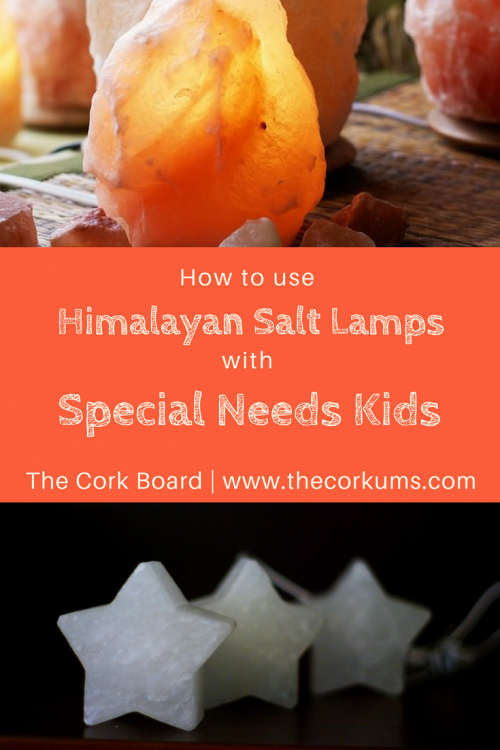
A couple weeks ago, So Well, who specializes in Himalayan salt products reached out to me. I received a free product in exchange for writing this review. (I’ll also receive compensation if you decide to buy a salt lamp through a link in this post.)
As I was researching the benefits of salt lamps, I found that they:
- Release negative ions into the air which can reduce anxious feelings and promote a peaceful environment for sleep [1]. Anxiety and sleep are probably the 2 top concerns that parents ask me about. It’s always better when our kids are sleeping, right?
- Boost serotonin levels [2]. This is your happiness chemical [3]. And who doesn’t need more happy in their life?
- Minimize the effects of electromagnetic radiation or electrosmog which is released from electronics [4]. I’ll speak for myself, but as much as I’d like to minimize screens around the house, they are kind of inevitable. I mean, how can my kid learn mindfulness and meditation without his Breathe Kids or Headspace app? I’m certainly not going to spend 10 minutes speaking to him in soothing Australian tones when there’s an app for that!
- Purify the air of nastiness. Things like mold, bacteria, and other allergens. The idea is that the salt attracts water from the air. Water which is carrying all the nasties. Then the water re-evaporates into the air because of the heat from the bulb in the lamp leaving behind everything it was carrying [5]. The pollen count is about to get very high, so having a salt lamp running can only help, and it definitely won’t hurt.
- Calm mood and increase focus through their soft amber glow [6]. The soft amber glow is also great for combating the blue light from electronics that can disrupt sleep [7]. Just say, “No!” to disrupted sleep!
Seriously, what’s not to love about salt lamps?
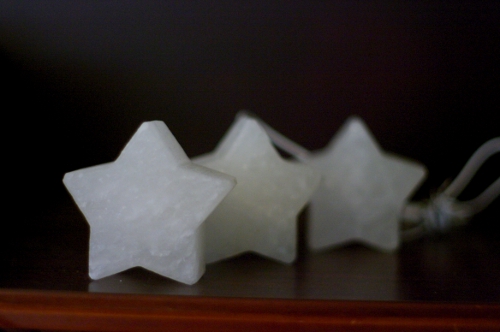
Of course, I was the shotgun customer who just bought on appearance and ended up with a white LED lamp. That just means that my bulbs won’t heat my lamp for that negative ion release and it’s missing that calming amber glow. On the plus side, it’s super cute, and it’s close enough to my over-heating laptop that I’m sure that the water that condenses on my lamp is in fact evaporating.
[bctt tweet=”Better sleep, decreased anxiety… what’s not to love about salt lamps? #pblogger ” username=”macorkum”]
So, now what?
- Gain buy-in (if your child is able). Skip to Step 2 if this step doesn’t apply. Start with a question where the answer you want is actually, “No.” For example, “Do you want to keep feeling anxious?” Then ask, “What impact would feeling more calm have on your life?” Keep asking, “What else?” until you have a pretty comprehensive list. Lastly, go in for the kill. “If I put a salt lamp in your room that will help you feel calmer, would you be open to that?” Be respectful of a, “No.” Just respond, “No problem. If you ever change your mind, you know where to find me. I’m always happy to get one for you.” Go to Step 2 anyway because now you want one. And if you can decrease your stress, everyone in the family will win.
- Head to SoWell and see what promotions are going on and browse their collection of Himalayan Salt Lamps. I appreciate their commitment to fair trade and quality. Our kids with special needs are even less resilient to toxic load, so what we introduce to their environment matters.
- If you have a teenager who is glue to a computer, try to place the lamp close to where he sits. If you have toddlers, place it somewhere out of reach. Basically, know your child and choose a wise place for this new lamp accordingly.
- Keep it on as often as possible [8].
For answers to all the questions you have that I haven’t answered, click here to visit the SoWell FAQs page.
Do you use Himalayan salt lamps in your home? What do you think?
]]>