Our homeschool community, Bridges, is officially back at full swing. I’m excited to be the tutor for our Logic level program which is equivalent to 7 and 8 grade (middle school). We do both grades together with a 2-year curriculum that can be taken in any order.
This is the stage where learning is driven by asking questions and applying formal logic to check your answers. In addition to traditional core subjects, one year we cover formal logic, and the other year we do fallacies. We’re on fallacies this year and using the popular Fallacy Detective book. My favorite teaching book on this stage of education is The Question by Leigh Bortins (feelings about CC aside).
Here’s the line up for this year.
Latin-I use Henle First Year as my base. I teach it from beginning to end each year adjusting the assignments for first and second year students respectively. I focus less on memorization and more on how to use a set of declension and conjugation charts and a dictionary to translate. If students have come through our Grammar (or grade school program), they have a tremendous grasp of English grammar and the Latin follows much easier than the students anticipate. I also find that moving quickly through the book keeps their attention more than spending an entire year on declensions and not understanding verbs and other parts of speech until later levels and years.
Science-I’m pulling from Science World magazine and ScienceWise 2 to design discussion-based and experiential lessons. The students will also be writing formal lab reports based on the scientific method.
English– Writing is integrated across many of the subjects. We continue to use IEW tools to guide us. For literature, we will read one classic together and dig deeper into the IEW critique model as well as explore literary critique methods and vocabulary. The rest of the books are student chosen. Each month the students read a book, write a critique, and present it to the class. I was inspired to use a more student driven approach for choosing literature after reading the Reader’s Odyssey.
Health– We’ll be reading and discussing articles from Scholastic Choices magazine.
Social Studies-The focus will be on world geography and current events. I like the Mapping the World with Art curriculum because it also checks off the required art box requirement for our state. I have the students read the lesson’s reading at home, and we complete the drawing lesson in class. We don’t do the extra enrichment activities. Additionally, we’re using Seterra to help us memorize all the countries in the world. We’re going continent by continent. For current events, the class has a subscription to WORLD Teen (yes, we’re magazine heavy in this year of the curriculum). We’ll be doing discussion around those articles through the month.
Bible-We’ll start by exploring praying in the Bible. Then we’ll study and pray for countries around the world using
Window on the World: When We Pray God Works which ties into our World Geography focus. We’ll also learn about world religions as we go.
Math– Because math is the one thing I couldn’t figure out how to teach modularly, we just provide some math study hall time. Fallacy Detective won’t take us all year, so we will also use Uncle Eric Talks about Personal Career and Financial Security as an intro to economics.
I’m in the market for a great one-year, comprehensive formal, logic course for next year. Any recommendations?
]]>Last year, we beta-tested a new classical homeschool community. While we were only 3 families, it was a really sweet year with a fabulous dynamic–kids and mamas alike. This year, we dreamed to expand in number and offering. Meet Bridges Classical Community. We added 6 families and now offer a Logic level (7th and 8th grade-ish) and a Rhetoric level (high school).
With two kids moving up a stage (Mia to Logic and PJ to Rhetoric), less opportunity for crisis, and a business still to fit in, I decided to be more intentional with our routine this year.
<<drum roll, please>>
Here is what an ideal week would look like:
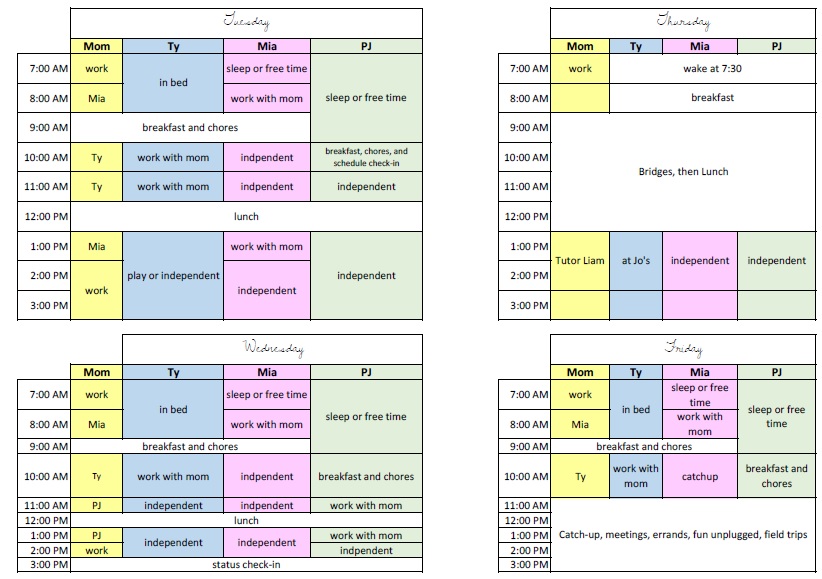
My work and planning will happen before 8AM and after 3PM most days with answering and sorting emails during lunch. While there are times listed, I’m going for routine over schedule.
Curriculum you wonder?
Click here for our Claritas Cycle 1 Resource List
Ty (Grammar Stage, independent reader, special needs)
Bible, Science, Language Arts, Art, Music, Latin, Geography, History will all be covered in our 1.5 community days. #wewin.
At home, we’ll handle math, read lots, and master the weekly memory work and spelling list.
Math is a struggle. We rotate between Math Mammoth (main spine), Right Start Math, and Khan Academy. Basically when we get stuck at a concept, we drop it and move to another concept in another curriculum, gain some confidence, then come back to where we were stuck. It pretty much always works that we get it on the second go-round.
Mia (Logic Stage)
Everything but music will happen and/or be assigned from community. #doublewin
Click here to see specifics. We’re in Year A.
For math, she’ll continue in Math Mammoth.
For music, Mia will continue to practice and teach herself piano with a little guidance from me.
PJ (Rhetoric Stage)
Again, all of PJ’s credits this year will originate in community. #stillwinning
He’ll be completing the Alpha year credits.
Patrick is putting his MA in Theology to write the Hebrew scripture course content.
Credits that don’t have a curriculum link we’re creating with the kids using a bit of Thomas Jefferson Education philosophy. The plan is to take good notes and have our experience documented to be able to share with other communities in the future.
For math, PJ will do Life of Fred Algebra. He enjoys the sense of humor and non-repetitiveness of it.
If you need help picking homeschool curriculum for your family, please let me know. I’d love to help.
If you’re all planned for this year, care to share?
]]>
I know I’m pretty late in posting this, but I wanted to make sure what I chose was actually going to stick. Plus, I figure this is when other people start realizing what they chose isn’t working and are looking for Plan B. The subjects listed are what we are required to teach in our state. (Bible is the obvious exception and that is required by our oversight organization.)
Bible
- We are listening through the Bible is approximate chronological order based on a reading plan from Bible.com. I’m varying the translations as we go. Have you ever listened to the Message’s paraphrase of Proverbs? You should.
- As we listen, I am introducing our passages with information from the Catholic Study Bible
. No matter the denomination your identify with or don’t, the study guide at the beginning of this Bible is second to none.
- This year’s memory work also includes a scripture each week.
English
- Our classical learning community, Bridges, has a built in language arts time which is super helpful this year.
- Ty (beginning reader): He’s memorizing his English grammar memory work, getting an activity to reinforce it at community, doing modified lessons from Primary Language Lessons (mostly copywork), and reading (to himself and out loud and listening to read alouds) a lot.
- Mia (advanced reader): Claritas Press has a language arts curriculum that is complements their memory work and is comparable to CC’s Essentials. We are also using IEW’s Fables, Myths, and Fairy Tales book in community for the writing portion of our language arts time. She spends time reading every day and listens to stories in the car. Our book lists are shelved at Goodreads this year.
- Both kids are doing Spelling this way with lists appropriate to their levels. We introduce the lists in community which is also super helpful.
- PJ (diacletic stage): We have a reading contract inspired by The Reader’s Odyssey
. For writing he opted to write a beginner’s Minecraft manual. We’re also working through First Year Henle Latin
together.
Math
- For the main curriculum we use Math Mammoth (MM) which is based on the Singapore methodology but written for homeschoolers. Periodically, you can score a deal through Homeschool Buyers Co-op to buy 6 levels in pdf form. Another large family, budget-friendly curriculum. We us a math manipulative that I really like to reinforce number sense. It’s the Learning Resources Desktop Abacus
. You can read about how cool it is here.
If your child struggles with math concepts, I recommend holding off math until he can read fluently or check out the Right Start Math curriculum. It’s pricey and teacher-intensive but totally worth it if you can make it happen. - The one thing MM lacks is drilling so everyday the kids sign in to Xtra Math and do a set of drills. I love this because it’s FREE and tailors itself to the student.
- The kids will also have plenty of math memory work.
- PJ: He completed all the levels of MM and transitioned to the set of Life of Fred Pre-Algebra 0-2 books. To supplement he does about 20 minutes of Khan Academy a week. For logic, I’m facilitating a discussion between him and a friend that is guided by the The Fallacy Detective
.
Science
- Besides memory work, Mia and Ty will get 14 science projects loosely coordinated to the memory work at Bridges. I also include related books in our weekly book list.
- PJ: Patrick is teaching him to code plus there are science lessons woven into his math curriculum (win for Life of Fred).
Social Studies
- We start every morning (that we do school) by watching CNN Student News.
- Mia and Ty have history memory work that follows The Story of the World
. There is also Geography memory work.
- PJ (dialectic): He is doing Mapping the World with Art and dialectic discussions on current events with a friend. Currently, they are (with me helping) writing a policy for the NFL on whether or not to imposed further consequences when players find themselves in trouble legally.
Art
- Mia and Ty get 14 art lessons at Bridges.
- PJ’s art is covered in geography. #twobirdswithonestone.
Music
- Mia and Ty get a music lesson each week at Bridges, and this year’s memory work includes a portion of a hymn each week.
- PJ plays in a band organized by the music school where he took drum lessons.
Health
- We’re using Easy Peasy All in One Homeschool’s suggested health lessons. I chose the odd set because we are in an odd year.
Physical Education
- We’re still doing Tae Kwon Do as a family. In addition each kid has a physical activity of some sort at some time during the year (soccer, dance, gymnastics, etc.).
Other
- We’re involved in a social co-op that does field trips and special small group activities. For example, Mia’s getting home-ec and additional art, and PJ has a Middle School study hall. We also have various field trips and service projects planned.
What’s working (or not) for your family this year?
]]>I developed this methodology for spelling in our family when I was homeschooling all 6 of our kids who ranged from 7 to 16 and included special needs and non-native English speakers. I needed a system that worked across multiple levels (and wasn’t leveled), worked within our budget, and required minimum mom-help.
Spelling Foundations
I’m an engineer and I like to be able to answer the “whys” in life. Phonograms and spelling rules make it so that there are actually very few exceptions when reading and spelling. Starting at around 4 or 5, children should start drilling and memorizing the phonograms that are the building blocks to spelling English words. These should be drilled daily (or at least multiple times a week) until mastered, then reviewed a couple times a month. (Check out my ABC’s at Home for a multi-sensory curriculum for introducing the single-letter phonograms).
Spelling Schedule
Once your student has mastered the phonograms, he can start mastering spelling lists. It would be nice if our kids mastered a list a week, but sometimes that doesn’t happen. Instead, I recommend working a list until it’s mastered, then moving on. You can just ignore that they’re labelled by week…
Day 1: Watch the appropriate spelling lesson video. Set A are beginner lists, Set B are intermediate, and Set C are advanced. There are 22 lists in each set. They are sourced from CC’s EEL program which are sourced from Spelling Power.
The rest of the days: Test your student on the list (or send them to Spelling City to test). If they get 100%, start over on Day 1 with the next list. Otherwise, have your student practice any incorrect words using these Spelling Review Ideas.
Weekly: Drill one spelling rule a week.
Last thoughts:
You can obviously use this methodology with your own lists. You’ll just have to teach the Day 1 lesson instead of using the video. I teach a word by saying the word so it can be heard, using the fingerspelling visual from SWR, and writing the word using SWR markings for visualization. I then ask the student to repeat the and spell the word verbally (spelling bee style) so the sequence of letters can be heard and file appropriately. I also try to link the word to the appropriate rule as they apply.
For non-writers, I love the All About Spelling phonogram tiles. You can buy them or print them.
For an interesting lecture by Andrew Pudewa (of IEW fame) on Spelling and the Brain, go here.
Here are activities I found when we did Cycle 3 last time. I’ve added a book list at the bottom which also includes resources relevant to Geography.
___________________________________________________________
Can you believe Week 24 is upon us? The unseasonably warm weather and upcoming trip to Ethoipia has us all itching to be finished school for the year. At the same time, I’m gearing up for next year, writing curriculum, reviewing curriculum, buying curriculum, and selling curriculum.
History: Bill of Rights
For the younger kids, I really like this lesson plan that uses picture books to explore the first 10 Amendments. A lot of the books seem to be out of print, but there are enough we found at the library to make due. This simple game would make a good review.
For older kids, you may want to check out this plan or this plan. They will also really enjoy this game.
Science: Solutions
This week we’ll learn how to make a saturated solution from Lesson 23 in Christian Kids Explore Chemistry
]]>
Here are activities I found when we did Cycle 3 last time. I’ve added a book list at the bottom which also includes resources relevant to Geography.
____________________________________________________
History: Preamble of the U.S. Constitution
Mia decided to be a History Memory Master which CC does not recognize on a national level but our community will recognize via parent-issued certificates at our end-of-year party. With her and PJ both studying, we will have history-lite at our house the next two weeks while they spend extra time reviewing material.
- For older kids.
- For younger kids (with art crossover). The Visual Thesaurus may help if your kids have brain block on drawing pictures.
I also found great hand motions and a visual. It’s a Word document, so you can right click on the link to save it.
The best book seems to be We the Kids: The Preamble to the Constitution of the United States

Science: Charles’ Gas Law
Basically, this law states that gas expands when it gets hotter and contracts as it gets cooler.
This is Lesson 21 in Christian Kids Explore Chemistry
P.S. I wish I had found www.middleschoolchemistry.com earlier. I probably would have used it instead of Christian Kids Explore Chemistry
]]>
Here are activities I found when we did Cycle 3 last time. The book list has been updated (and also includes books relevant to geography).
____________________________________________________
History: September 11
While I came across plenty of lesson plans, I really like these. They are divided by age group.
Science: Acids, Bases, Salts
These topics are covered well in Christian Kids Explore Chemistry
]]>
Here are activities I found when we did Cycle 3 last time. The book list has been updated.
___________________________
History: Astronauts and the first moon landing
I feel like I’m in the minority, but I can’t get into lapbooks. The funny thing is that I love crafts and scrapbooking. I think I can’t get past the product enough to use the process. I know they will just get trashed and that irks me. Anyway, all that to say, I’m going to give it a whirl this week with this great lesson plan/lapbook. I think Mia will love it so we may have to do more of them next year.
If you have older students or can’t get into the lapbook, check out this lesson plan or this one with a heavy writing focus.
On the other hand, if you have littles to occupy, check out this or this.
This audio of the moonlanding or this timeline may also be useful.
Science: Chemical Reactions
This is Lesson 15 in Christian Kids Explore Chemistry
Here are activities I found when we did Cycle 3 last time. A book list has been added at the bottom.
___________________________
History: Brown vs. Board of Ed (Civil Rights)
We will re-visit Civil Rights using this lesson plan. PBS also has a great site to explore. In the car, we’ll be catching up on stories from Week 13 that we didn’t get around to. The resource/book list for Civil Rights can also be found back at Week 13.
Science: Formulas and Naming Compounds
I know the memory work has veered off to Origins but we’re sticking with Chemistry for our more in-depth science exploration. This is the week for Lessons 13 and 14 in Christian Kids Explore Chemistry
This site has many downloadable Word files. We will do the Types_of_Food_Chemicals_Known_as_Nutrients as our health lesson this week.
There is also fun practice activity here.
]]>
Here are activities I found when we did Cycle 3 last time. The book list has been updated.
___________________________
History: NATO (and Communism and the Cold War)
Intro: From the NATO website.
We’ll probably follow this lesson plan.
Other lesson plans:
- Based on primary documents (+)
- With an economic focus (+)
- Based on pop culture music of the time (+)
- More of a unit study
Interactive web material:
Science: Chemical Bonding (specifically ionic and covalent)
First we’ll start with an understanding of valence electrons using this PPT and this worksheet.
That will make this video make a lot more sense.
Chemical bonding is covered in Lessons 11 and 12 of Christian Kids Explore Chemistry
]]>