
I mentioned in this post how I was learning to LET IT GO!
Here are some ways that is playing out in our family.
- FOOD. One of our kids uses food as a control mechanism. She’ll get upset and one of her attempts at control can sound like, “I’m not eating,” or “I’m not packing any food to take with me.” (We eat a lot of our meals on the go). Because I know how important it is for our kids to have regulated blood sugar and proper nutrition, I used to try to share control. “You can eat whatever you want as long as it includes a protein but not eating is not an option.” However, in the end, I can’t make a kid eat…especially without escalating the situation or without damaging our fragile relationship. Now, I just say, “That’s your choice. I’ll have a snack with me if you change your mind.”
- MEDIA. This is a tough one and the LET IT GO only applies for our oldest two kids. One of our older kids especially was used to making independent decisions. The authority of parents is a foreign concept. Forcing a change of paradigm was a relationship dead end. We decided we want to be a safe place, and we cannot provide that and micro manage. So for the older kids, there are no media content restrictions. We chat about making smart and God-honoring decisions in this area of life, but do not monitor the content input. We do not assist our kids in getting inappropriate media but if they choose to listen to an inappropriate radio station on their mp3 player, for example, we don’t police that. The one caveat is that it has to be done in such a way that the other kids in the house are not exposed to it.
- SCHOOL. As a homeschool family in a less-regulated state, we have the flexibility to not pick battles in this arena as well. The kids have assignments but they work as they can handle it. With so many relational and culture adjustments on top of years of complex trauma, there is just not always capacity to move ahead academically.
- BEHAVIOR DURING DYSREGULATION. Our kids do and say rude, obnoxious, hurtful things when they’re triggered. For our kids, they are totally for a reaction out of us. Until a child is re-regulated, we are attempting to LET IT ALL GO! We find that ignoring all that button-pushing nonsense gets us back to regulation way faster. Once we’ve reconnected, we can address and redo ways to more appropriate communicate BIG feelings.
Trust me, I know that letting go is a lot easier said than done. However, contrary to popular fear, our letting go has created room for increased connection and trust. In the end, they usually do what we want (as they are able). It just needs to be on their terms.
But one day, they will have to just follow the rules. Isn’t this just enabling them?
Kids from hard places have altered brain chemistry and structure. They need years of felt safety and thousands of positive social/emotional interactions to be able to trust or develop empathy. If you are helping them find their voice and identify what they’re truly feeling while you’re giving them space to heal, you are not enabling them. However, pushing them before they’re ready could permanently stunt them.
What about spoiling them…because it sounds like they get what they want?
There is definitely a fine line between what I’m proposing and spoiling. We do not give our kids whatever they want, but we do give them as much as we can. We do not give into whining or manipulating but we do entertain compromises and creative problem solving given it’s done with respect. We also recognize that the cycle of meeting needs is normally not seen as spoiling when a parent is doing it with a newborn. In many ways, our kids are in the same attachment stage as a newborn and they need millions of repeated cycles of having their needs met by us.
How do you get past the feeling that they’re winning?
If you never enter into a battle, there is no winning or losing. It’s like no one can steal from you if you always willingly give. We’ve also had to redefine what victory is. For us, now, victory is a day that doesn’t get violent. If letting go produces that, we are ALL winning. It’s NOT winning if I win a control battle but my child is now at odds with me. We can’t afford at this stage of our relationship to go there.
There is no way my kid would make the right choice.
I’m with you. However, I realized I couldn’t force them to and keep our relationship. We give reasons for why we suggest the choices we recommend and we make it seem really great to go with what we say. We also encourage other adults in their live to reinforce lessons we may be trying to teach. It also turns out that natural consequences are great teachers. After a couple nights of refusing to pack enough food and coming home hungry, our one daughter all of a sudden claimed that she wasn’t going to do that anymore. When she had come home hungry, we reluctantly let her have a small snack, all the while playfully reminding her we were right. The last night, we challenged her to learn her lesson. We didn’t forcefully make her go to bed hungry but suggested it may be a good idea to help her remember not to let this keep happening. We kept the tone light and she stayed regulated enough to learn a lesson. She’s been tempted to use that as a control card since, and I’ve been really proud of how she’s handled it. Will it be a lesson she has to learn again sometime? I’m sure of it. But we’ll take what we can get. Baby steps.
What about kids that aren’t from trauma?
Yup, it’s working for our bio kids, too.
Trust me. I wouldn’t propose such a preposterous tactic if it hadn’t been such a game-changer in our family.
I dare you. A 30 Day Challenge of LETTING GO! What do you need to let go?
Not sure how to implement it in your house, leave a comment or contact me. I’d love to help, and I’ll be your biggest cheerleader!
]]>
Someone recently shared a video on a Facebook that really resonated with me. It’s a really-smart guy, Dr. Bruce Perry, validating our ETC Training, reasons for homeschooling, and experiences we’ve had with our kids. Watching this video (or a comparable one) should really be required of all politicians, parents, and education majors…or just everyone. I’m considering asking anyone who interacts with our family to watch it.
If the video is not displaying properly, click here
Dr. Perry starts by recognizing that society is into requiring training for and regulating lots of things…except parenting. Now, I lean toward libertarian-ism, but if there were ever something to regulate, it should be something that could rock our society by its foundation instead of a million band aids. When it comes to parenting, there is this momentum because our brain development reflects the environment in which we are raised, and we, in turn, pass on that environment to another generation if we’re not intentional.
It seems from some of the comments that Dr. Perry does not subscribe to a strong Christian faith or intelligent design, yet about 12 minutes in, he makes the statement that we are “physiologically designed to connect to others.” In fact, his entire presentation is based on the premise that his research shows that brains need other people. I do not want to get into a debate, but I love when science confirms what how I believe God designed us.
I am not a well-read Bruce Perry person (yet), so I don’t fully understand his take on the hunter-gatherer type society. However, he repeatedly references them, mostly in the context of how relationally rich they probably were. Instead of living in fragmented subgroups (average of 4 people to a household), hunter-gatherers lived in large heterogeneous groups where there may have been up to 4 adults consistently interacting with 1 child. Now, we think 1 adult to 6 kids is a phenomenal ratio and most of our youth spend the majority of their time in situations where there is 1 adult to upwards of 30 children. You do the math…for brains that depend on positive, social interactions with people who are more mature than them, we are putting our culture at serious risk.
On digital devices. “We are essentially shooting ourselves in the foot every time we break away from a human being and we pay attention to a digital device.” This is definitely something I need to be more intentional about compartmentalizing for myself. Dr. Perry estimates we check our devices approximately 150 times a day. Technology (and I love me some good technology) is changing the relational landscape of our society.
We talk about mirror neurons in ETC training. You don’t have to get too scientific with me but just know that “human beings are contagious” in a scientific, brain-sciency way. Everything from cognition, motor activity, and feelings are contagious. Think about people who spend a lot of time together tend to have similar mannerisms, thoughts, and body language. The most contagious relationship is a primary caregiver to a child.
Additionally, “people who are touched are healthier.” Everyone knows this for infants but it applies to everyone.
This next statement seems to come straight from Dr. Purvis…Positive, playful interactions are rewarding, regulate us, help us learn better, and be more creative. Corroboration from two extremely smart people. Our brains need rewards. If we don’t get them from positive, people interactions, we look to food, drugs, and a host of other maladaptive habits that fill the void. Mmm…what impact could this knowledge of brain science have on helping people with eating disorders and chemical dependencies.
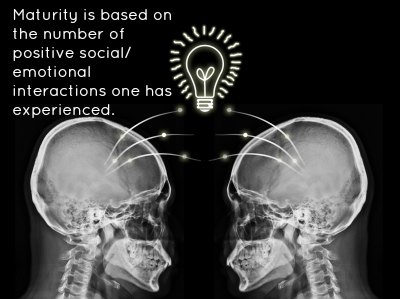
Maturity is based on the number of positive social/emotional interactions one has experienced. Repeat that with me.
Maturity is based on the number of positive social/emotional interactions one has experienced. Period.
Not age.
So, no, driving, summer jobs, or even getting them “caught up” academically is not on the agenda, necessarily. We don’t need to raise the bar so they’ll rise to the occasion. Is that what you’d do with a 5-year-old?
One of the biggest paradigm shifts we’ve had since discovering trust-based, trauma-informed parenting is our increased compassion for dysfunctional people. We realized that folks at a deficit in the positive social/emotional interaction department will not just “grow up” or suddenly “get it.” We understand that age means almost nothing. If a 2-year-old steals from a peer, it’s handled much differently than when an adult steals from a store. However, what if that adult had the same number of positive social/emotional interactions of that 2-year-old? For the 2-year-old, we continue to pour into them and teach them and fill up their relationship bank…for the adult, incarceration. How many deposits in the positive social/emotional interaction department will that produce?
People at a deficit in the relationship department have “unexpressed relational capabilities” and is “less capable of handling stressors in the future.” This explains why life is so hard for kids from hard places. When you’re wondering why we spend hours dealing with a trantruming teenager over the fact that I walked away during her 1 minute plank rather than counting the entire minute out loud for her or because I gave a compliment to her sister, refer back to that statement. This is why our kids would rather spend 4 hours in a room staring at a wall that have to interact with a family. “Adverse experiences early in life will translate to abnormal organization of neural networks.”
The good news is that relational health can help a brain heal from adversity. Enter trust-based parenting. I agree with Dr. Perry that society’s “therapy models are far too relationally imporverished.” How can we expect 52 one hour sessions to put a dent in years of relational neglect? I’m not saying therapies or interventions are bad, but we have to have realistic expectations for them. They are good support tools to a full-time therapeutic, relationally-intentional environment.
It’s common knowledge that the brain is more malleable earlier in life. The cognitive part of the brain remains fairly easy to teach. However, the social/emotional centers are much harder to reach later in life (although it can be done). As Dr. Perry states, it’s easier to teach someone to read at 35 than to share. Imagine if we applied these concepts to our education system. Currently, we are sacrificing prolonged periods of rich relationship for seat work in a relationally void environment and wondering why our Ivy League grads don’t have soft skills.
Further, instead of measuring kids’ skills based on their number of brain-organizing opportunities (which come from, say it with me, “positive social/emotional interactions” and which they have no control over), we measure them based on age and label them with a disorder when they fail to measure up. How well do you take negative criticism? I obsess over it. Imagine if that’s all you hear because you never measure up.
I’ve been trying really hard to sandwich correction for our kids in between two positives.
The bottom line is that the brain is a reflection of its environment. For good or bad.
So your challenge.
How will this information change how you parent, educate, or even just think about other people?
I’ve been working on me because I have power in what my kids’ brains are reflecting. More to come…
]]>