
I mostly identify as homeschooling mama, but truth be told, three out of our 6 kids have spent time in not just school, but public school. <GASP>
Our latest launch has been the most successful to date. Clearly this makes me an expert, so I figured I would impart my pearly words of wisdom to you.
Disclaimer: These steps should only be used on your first born child for whom you have the highest aspirations.
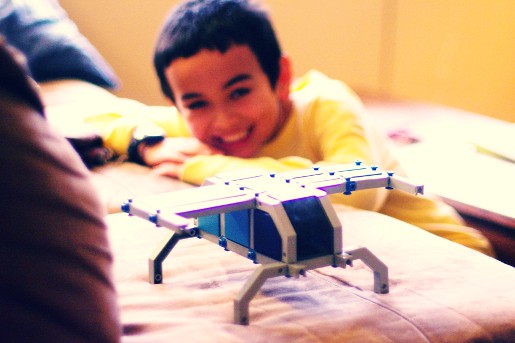
Step 1. Homeschool him for at least five years.
Step 2. Create some kind of family crisis so that for at least the last two years of his homeschool career, so you are literally not paying attention to him at all.
Step 3. Allow the student to sleep in for as long as he pleases during his homeschool career. If his usual wake up time is after 12pm, all the better.
Step 4. Give him unlimited access to a computer behind closed doors to guarantee that he’s making the most of his home educational experience. Turn a blind eye to the number of hours he spends gaming everyday. At least he’s not sexting. It’s all relative, people.
Step 5. Try out homeschooling high school at home a year early just for fun. Make sure the child fails at least three classes.
Step 6. Be sure to choose a public school who is overhauling its guidance department so you have to wait until the last week of August to register and find out anything at all about the school-class schedules, start times, bus routes, etc.
Step 7. Check the bus route when it’s finally available and announce to your student that his bus will come at the o’dark hundred hour of 6:45 AM. Snicker behind closed doors.
Step 8. Plan to go out of town for his very first week of high school. Miss Back to School night. Be unavailable to sign any syllabi or other such first week of school paperwork. Additionally be unavailable to go back to school supply shopping for all the things that apparently high school teachers don’t tell you about until you actually get to your classes. I seem to remember getting supply lists over the summer when I was in school, but clearly that was another time and generation. #thankgoodnessforamazonprime
Step 9. Enjoy the fact that is there is one less body to manage every day from 6:45 AM to 2:15 PM.
How’s school going for you this year?
]]>
I guess I should also note, that this is what a day looks like if we don’t have Bridges or therapy appointments or…or…or. Frankly, these days are kind of like unicorns which is another reason to capture it.
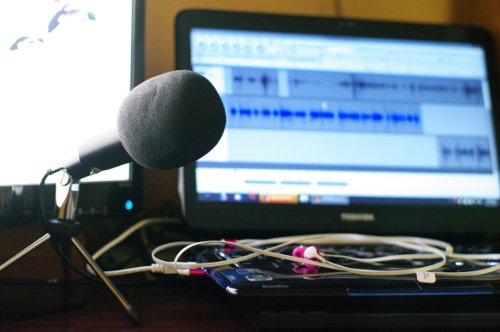
I’ve been doing my best to get up and working at around 6 AM. All circumstances and sleep deprivation aside, I’m naturally a morning person. My brain really refuses to do any real thinking roughly after 3PM. If you see something from me after that time, I probably scheduled it at 6AM. This is also the only quiet time in my house where I can record what I need to for the podcast. However, with the days getting darker and colder, I’m starting to experience the slippery snooze slope. PJ slips out the door at around 6:45 AM.
At 7 AM, Mia, a morning girl after my own heart, gets up and starts school right away. #herchoice #dreamstudent
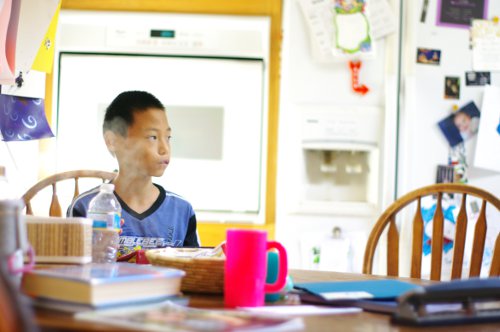
By 9 AM, I figure I should call Ty. He’s usually awake by this time, but he’s not allowed to come out until he’s been summoned. He goes straight to breakfast. If Jae doesn’t have school, he usually wanders over to eat with us, too. #theboysarealwayshungry
Ty is freshest in the morning, and my patience level is at its max, so we tackle school that requires my supervision right after breakfast. Despite my best efforts, I loose my cool over his inability to file papers in a binder…even with detailed instruction. Sometimes, we’re just going along swimmingly, and then–BAM–FASD brain.
That mist in the picture is our diffuser going. We use it to keep our emotions in check. I’m his external regulator, so if I can keep myself playful and calm, he’ll follow suit.
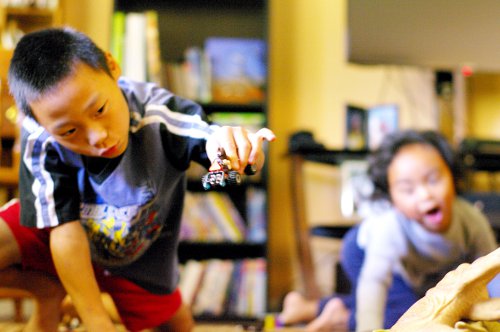
By 11:30 AM, we need a play break. Well, he plays. I work.
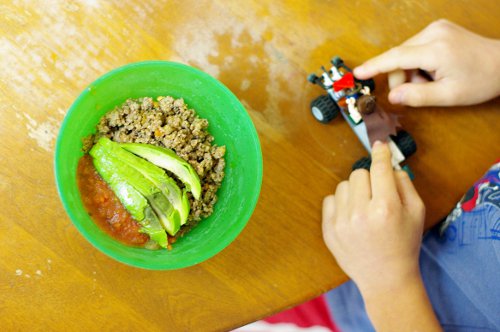
Around 12:30 PM, I sit him in front of his lunch (a taco bowl of sorts) and go take a shower. We have a solar hot water heater, so I try to do hot water activities when the sun is shining, and we can take advantage of the free energy.
After lunch, we tackle the bits of school that he can mostly do on his own. Basically, I give him one task at a time, such as alphabetizing his spelling list, and he reports back when he’s finished to have his work checked and get his next assignment.

Around 3 PM, it’s more playtime for him and more work time for me. PJ is also home by now which can change the dynamic if he decides to not be a video game hermit and engage with the rest of the house.
On Tuesdays, we eat an early dinner and head out around 6 PM for Ninja Warrior practice for Ty and archery for Mia.
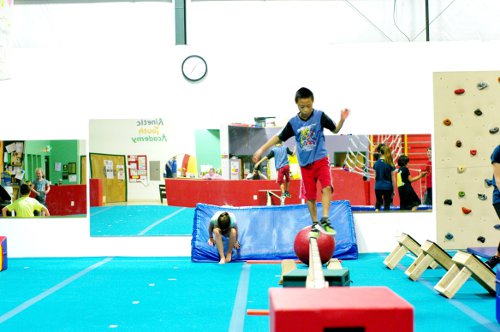
By the time we get home, it’s bedtime for Ty.
Patrick bowls on a team with some work buddies and gets home late on Tuesdays, so I usually have a podcast guest lined up to record at 9 PM or I have time to catch up on that never-ending to-do list.
What are you up to today?
]]>Also, it might be relevant to note that while I had our son who is fetal alcohol affected in mind while writing, these tips are also useful for students with other developmental disabilities and special needs.

- Go for exposure not mastery. Mastery (especially of the abstract) can be elusive for kids who have prenatal alcohol exposure. We use a lot of memory work. Most days we hit mastery (mostly because it’s all to catchy tunes), but I stopped getting frustrated if we didn’t.
[bctt tweet=”Exposure not mastery. #specialneedseducation #keepyoursanity” username=”macorkum”] - The more concrete, the better. I’m a visual learner, so I always joke, “If I didn’t see it, it didn’t happen.” For our kiddo with FASD, if he doesn’t experience it, it doesn’t happen. Whether it’s a historical event or a math problem, if he can’t experience it was all 5 of his senses, he’s lost. Similarly, if I can’t find a way to make it concrete, I definitely rely highly on #1 or just skip it all together.
[bctt tweet=”The more concrete the better. #specialneedseducation #fasd” username=”macorkum”] - Think outside the box. You’re homeschooling for goodness sakes! Take advantage of it. Maybe you just take field trips all year and creatively match them all to core subjects for your review. Depending on your state’s review requirements, this may be easier said than done. If you live in a state with heavy overview, get an IEP or ask for your child to be placed on a non-diploma track so you don’t have the pressure to jump through all the academic hoops that will probably end up crushing your child’s self-confidence and driving you batty.
[bctt tweet=”Think outside the box. #specialneedseducation #fasd #fieldtrips” username=”macorkum”] - Keep the end in mind. Think about what life skills your child will need to live as independently as possible. If you’re trying to teach something that doesn’t contribute to those life skills, refer to #1 or skip it entirely. Memorization of math facts? Really not necessary in real life. Everyone has a calculator on their phone. Knowing how to identify which key will unlock your front door, and then actually being able to use that key consistently. That’s worth spending some time on.
[bctt tweet=”Keep the end in mind. #specialneedseducation #fasd #lifeskills” username=”macorkum”] - Visuals and routine are your friends. We pretty much have the same routine every week with memory work, presentation, and spelling lists. It’s been the same routine for quite a few years. Tweaking it can be painful. As I’m writing this, I’m reminding myself how many weeks and years it took for this routine to actually be routine. I need to extrapolate this to how long I expect it to take for him to assimilate to other routines. <sigh> We started putting visual reminders up around our house this summer. A 5-step poster of what to do when I say, “Get ready to go.” Four cards on the bathroom mirror that remind him how to appropriately brush his teeth. A list of instructions of what he’s to do when he enters his Language Arts class at community (he’s in a new level this year.) He doesn’t always follow them to a “t” because…well, you know…FASD, but they are helping my sanity.
[bctt tweet=”Visuals and routine are your friends. #specialneedseducation #fasd ” username=”macorkum”]
If you’re in special needs education or homeschooling a child with special needs (maybe even FASD), I’d love your additions to the list!
]]>
Among other things (like the launch of the new unCorked podcast), September is apparently the month to increase awareness about Fetal Alcohol Syndrome and other related diagnoses. It’s also the month that we start back to a more intentional homeschooling schedule. While these things may seem unrelated, they have significant overlap in our lives since a practitioner recently confirmed what I had started to suspect…all signs point to the likely reality that Ty is fetal alcohol affected.
I probably don’t need to tell you, but just in case…No amount of alcohol use is known to be safe for a developing baby before birth. Not even a sip…especially if you’re Asian. Apparently Asians are likely to have the alcohol dehydrogenase enzyme genetic variant, leading to a doubling of the blood alcohol concentration compared with a Caucasian or other ethnicity consuming the same amount. [1]
While it was sobering to see all of his challenges lined up in black and white in yet another diagnostic report, it’s been freeing as well. I have concrete evidence via countless evaluations and an MRI that Ty has a legitimate disability. It means that I should stop banging my head against a wall over math concepts, and we don’t have to keep up with the homeschooling Joneses (or even our state’s basic academic requirements). #somuchlesspressure
Even though the most current (and I think most complete) diagnoses is fresh off the press, we’ve been dealing with the reality of it since we met Ty. We’ve also homeschooled him since the beginning (minus a trial year at a 3-afternoon preschool). Looking back, I wouldn’t have changed too much except some of my expectations.
Side note: I would go with these curriculum recommendations for students with other special needs besides FASD. Technically we’re also dealing with what looks like ADHD, Sensory Processing Disorder, and Autism Spectrum Disorder.
On expectations
When we started off, I had the same expectations of Ty that I had of the other kids. That he could learn, and we would work until he conquered. Except that sometimes he just can’t. His brain electrical activity is abnormal, and there is global atrophy of his brain. So now, I present an assignment with a wonder-if-he-can-do-this-today attitude rather than a we-have-to-get-through-this. It’s game changing. We looked at fractions on number lines today. About 30 seconds in, I thought, “Nope, so not here yet.” Instead of pushing through and getting us both frustrated like in years past, I just skipped it and moved on…or in this case back (more on our math curriculum below).
This is what we’re using for curriculum this year.
History
We’ve been using memory work as the backbone for all our grade-school-aged kiddos since the beginning. At first it was Classical Conversations, but now we use Claritas Publishing. I like Claritas’ 4-year cycles better, and they’re a perfect complement to the Story of the World materials. Each week, there’s a history song to memorized. One of Ty’s strengths is memorization through song, but even if he couldn’t memorize, we would just go with over-exposure of the song 😉 Besides using an MP3 player to listen to the memory work ad nauseum, he also copies the history sentence each week, reads the corresponding chapter from Story of the World, and participates in an enrichment activity at Bridges. If you don’t have an independent reader yet, use audiobooks liberally. Again, the expectation is for exposure…mastery or comprehension is icing on the cake.
Science
Claritas also provides a memory sentence and corresponding song each week for science. This subject looks just like history with the addition of a science experiment that is provided by our community (Bridges) every other week.
Geography
This is also provided by Claritas…see a pattern yet? I make games from our blank maps on Purpose Games to play as review. Again…go for exposure. Any amount of mastery or comprehension–for however long it lasts–is bonus.
English
Besides the memory work provided by Claritas, Ty is part of the Advanced Readers Language Arts class in our community. It uses a systematic approach to grammar and another one for writing that beautifully dovetails with classical education and memory work. The repetition and introduction of new concepts in small chunks is really FAS-friendly. Additionally, it’s a one-room schoolhouse model where I teach multiple levels at once and the class is meant to be taken multiple years in a row. This is a perfect set up for kids with special needs because they come in knowing that there will be a range of skillsets and that they don’t have to get it all on their first time through. It allows for a lot of flexibility and accommodating on home assignments as well. The grammar curriculum is also from Claritas, and we use the theme-based writing books from IEW.
Math
This is the subject where the struggle is the most apparent and intense. It’s also the place where I’ve floundered the most to find a curriculum that works. Of course, my definition of “working” has also evolved over the past couple years. Right now, we’re using Khan Academy. It’s free and there’s a great iPAD app. I like that you can hop to various concepts but it still gives you a measure to see where mastery stands overall for a certain grade. I also like that it checks the problems for you and provides video tutorials. Also, did I mention the smart technology that knows if you’re struggling on a concept based on whether you get problem correct on the first try or fifth and whether or not you used a tutorial video or step-by-step hint? I could go on and on…the on-board scratchpad, etc. I also acquiesced and allow Ty to have a calculator for any problem he wants. Honestly, having quick recall on math facts is not going to make or break a person’s ability to survive in the world. I expect it of my neurotypical kids, but the bar is different when a kid already has so many challenges to overcome.
Art and Music
Bridges provides lessons on these in community. #totalwin
When in doubt? Just do a lot of reading. Reading—out loud, silently, audiobooks, whatever—covers a multitude of homeschooling sins  I think the only school we did for the entire last quarter of last year was silent reading. But God’s mercies are new every morning…and certainly every school year. #onwardandupward!
[bctt tweet=”When in doubt? Just do a lot of reading. #homeschoollife #specialneedskids” username=”corkboardblog”]
If you’re homeschooling a child who has neurodevelopmental delays, what’s working for you? Stay tuned. I feel a tips and tricks post coming in the near future!
**UPDATE** Here’s that tips post.
]]>
I’ve met amazing people during our family’s crazy journey, and the unCorked Podcast is my way of introducing their amazing stories to you!
Karen Harris is a veteran, homeschooling mama to many. She has a great sense of humor and no-nonsense parenting style. We chat about what she’s learned from decades of parenting and her new book project.
Her kids also recently released a new musical project.
Check them out at www.praisewarriors.com.
What was your biggest takeaway from Karen’s pearly words of wisdom? Tag your answer with #theuncorkedpodcast.
]]>
Our homeschool community, Bridges, is officially back at full swing. I’m excited to be the tutor for our Logic level program which is equivalent to 7 and 8 grade (middle school). We do both grades together with a 2-year curriculum that can be taken in any order.
This is the stage where learning is driven by asking questions and applying formal logic to check your answers. In addition to traditional core subjects, one year we cover formal logic, and the other year we do fallacies. We’re on fallacies this year and using the popular Fallacy Detective book. My favorite teaching book on this stage of education is The Question by Leigh Bortins (feelings about CC aside).
Here’s the line up for this year.
Latin-I use Henle First Year as my base. I teach it from beginning to end each year adjusting the assignments for first and second year students respectively. I focus less on memorization and more on how to use a set of declension and conjugation charts and a dictionary to translate. If students have come through our Grammar (or grade school program), they have a tremendous grasp of English grammar and the Latin follows much easier than the students anticipate. I also find that moving quickly through the book keeps their attention more than spending an entire year on declensions and not understanding verbs and other parts of speech until later levels and years.
Science-I’m pulling from Science World magazine and ScienceWise 2 to design discussion-based and experiential lessons. The students will also be writing formal lab reports based on the scientific method.
English– Writing is integrated across many of the subjects. We continue to use IEW tools to guide us. For literature, we will read one classic together and dig deeper into the IEW critique model as well as explore literary critique methods and vocabulary. The rest of the books are student chosen. Each month the students read a book, write a critique, and present it to the class. I was inspired to use a more student driven approach for choosing literature after reading the Reader’s Odyssey.
Health– We’ll be reading and discussing articles from Scholastic Choices magazine.
Social Studies-The focus will be on world geography and current events. I like the Mapping the World with Art curriculum because it also checks off the required art box requirement for our state. I have the students read the lesson’s reading at home, and we complete the drawing lesson in class. We don’t do the extra enrichment activities. Additionally, we’re using Seterra to help us memorize all the countries in the world. We’re going continent by continent. For current events, the class has a subscription to WORLD Teen (yes, we’re magazine heavy in this year of the curriculum). We’ll be doing discussion around those articles through the month.
Bible-We’ll start by exploring praying in the Bible. Then we’ll study and pray for countries around the world using
Window on the World: When We Pray God Works which ties into our World Geography focus. We’ll also learn about world religions as we go.
Math– Because math is the one thing I couldn’t figure out how to teach modularly, we just provide some math study hall time. Fallacy Detective won’t take us all year, so we will also use Uncle Eric Talks about Personal Career and Financial Security as an intro to economics.
I’m in the market for a great one-year, comprehensive formal, logic course for next year. Any recommendations?
]]>Last year, we beta-tested a new classical homeschool community. While we were only 3 families, it was a really sweet year with a fabulous dynamic–kids and mamas alike. This year, we dreamed to expand in number and offering. Meet Bridges Classical Community. We added 6 families and now offer a Logic level (7th and 8th grade-ish) and a Rhetoric level (high school).
With two kids moving up a stage (Mia to Logic and PJ to Rhetoric), less opportunity for crisis, and a business still to fit in, I decided to be more intentional with our routine this year.
<<drum roll, please>>
Here is what an ideal week would look like:
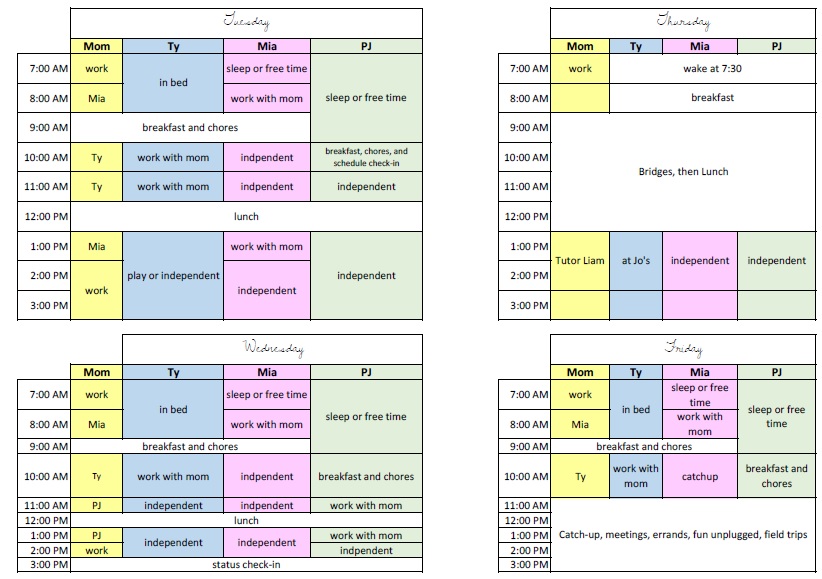
My work and planning will happen before 8AM and after 3PM most days with answering and sorting emails during lunch. While there are times listed, I’m going for routine over schedule.
Curriculum you wonder?
Click here for our Claritas Cycle 1 Resource List
Ty (Grammar Stage, independent reader, special needs)
Bible, Science, Language Arts, Art, Music, Latin, Geography, History will all be covered in our 1.5 community days. #wewin.
At home, we’ll handle math, read lots, and master the weekly memory work and spelling list.
Math is a struggle. We rotate between Math Mammoth (main spine), Right Start Math, and Khan Academy. Basically when we get stuck at a concept, we drop it and move to another concept in another curriculum, gain some confidence, then come back to where we were stuck. It pretty much always works that we get it on the second go-round.
Mia (Logic Stage)
Everything but music will happen and/or be assigned from community. #doublewin
Click here to see specifics. We’re in Year A.
For math, she’ll continue in Math Mammoth.
For music, Mia will continue to practice and teach herself piano with a little guidance from me.
PJ (Rhetoric Stage)
Again, all of PJ’s credits this year will originate in community. #stillwinning
He’ll be completing the Alpha year credits.
Patrick is putting his MA in Theology to write the Hebrew scripture course content.
Credits that don’t have a curriculum link we’re creating with the kids using a bit of Thomas Jefferson Education philosophy. The plan is to take good notes and have our experience documented to be able to share with other communities in the future.
For math, PJ will do Life of Fred Algebra. He enjoys the sense of humor and non-repetitiveness of it.
If you need help picking homeschool curriculum for your family, please let me know. I’d love to help.
If you’re all planned for this year, care to share?
]]>
I have fantastic news for you! Homeschool is not actually school (as you envision the institutional variety) at home. It’s more like education that has the home and family unit as a base. We don’t sit at desks, and I become more of a tutor than a teacher once the kids can read independently. They kids have a checklist to work through and pretty much only come find me to have something checked or to ask a question. We also do not have as much structure and schedule as school, and we certainly do NOT spend 6 or more hours doing school…or do we?
School can be anything anywhere. This is where counting the hours can get tricky. PJ is getting ready to take a hunting class, but it will happen on evenings and weekends long after traditional schooling hours are over. Mia will start sewing washable feminine hygiene products for women in developing countries. She’ll probably do them in her “free” time. Health…check. We’re getting ready to take a 4 day trip to Houston during a week the kids are “off,” but you can figure we’ll all learn something. Listening to great literature in the car? Definitely school and definitely happens for more hours than most kids are in school. We drive a LOT!
[bctt tweet=”Homeschool is not the battle you fight to get homework done every night multiplied by 8.”]
Homeschool is not the battle you fight to get homework done every night multiplied by 8. It’s having your child during the best part of his day and meeting him where he is educationally, socially, and emotionally. Homeschool is not necessarily having a child, or children, attached to you all the time. It’s teaching everyone health space and time boundaries. Homeschool is not forcing your child into a curriculum or making her do busy work. It’s the flexibility to change what’s not working to something better and to craft experiences that are meaningful and educational.
If you’re a homeschooler, how is your homeschool different than school at home?
]]>Here are activities I found when we did Cycle 3 last time. The book list has been updated (and also includes books relevant to geography).
____________________________________________________
History: September 11
While I came across plenty of lesson plans, I really like these. They are divided by age group.
Science: Acids, Bases, Salts
These topics are covered well in Christian Kids Explore Chemistry
]]>
Here are activities I found when we did Cycle 3 last time. The book list has been updated.
___________________________
History: Astronauts and the first moon landing
I feel like I’m in the minority, but I can’t get into lapbooks. The funny thing is that I love crafts and scrapbooking. I think I can’t get past the product enough to use the process. I know they will just get trashed and that irks me. Anyway, all that to say, I’m going to give it a whirl this week with this great lesson plan/lapbook. I think Mia will love it so we may have to do more of them next year.
If you have older students or can’t get into the lapbook, check out this lesson plan or this one with a heavy writing focus.
On the other hand, if you have littles to occupy, check out this or this.
This audio of the moonlanding or this timeline may also be useful.
Science: Chemical Reactions
This is Lesson 15 in Christian Kids Explore Chemistry