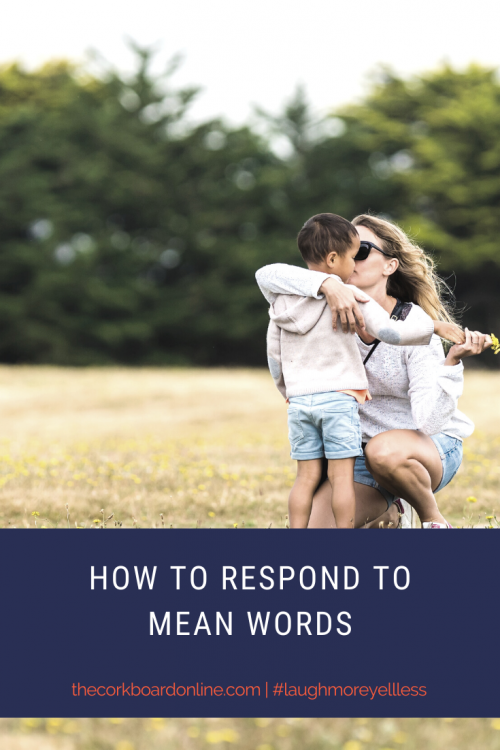
First, I want you to remember that these mean outbursts are the externalization and incorrect verbalization of your child’s inner experience. It’s like a baby crying when they’re hungry. Babies don’t have the skills to communicate properly, so they resort to crying. A lot of our kids have big feelings and not enough brain development or skills to understand their emotions, let alone communicate them properly. It just so happens that bigger kids “crying” has words attached to it that have meaning to us.
[bctt tweet=”Mean outbursts are the externalization and incorrect verbalization of your child’s inner experience.” username=”corkboardblog”]
I want you to ignore the actual words coming out of your child’s mouth and notice other cues. If we focus on the actual words, then we get triggered with our own big feelings. Then our thinking brain is useless too. Instead, stay curious. Could they be hungry? Sad? Mad? Scared?
Then, as Bryan Post encourages, “Ignore the behavior, but not the child.”
If your child is melting down over a school assignment at 4 PM, it’s probably not the assignment. Maybe it’s been a while since they’ve had a snack and a drink. You could try saying, “Wow! You seem pretty grumpy! I wonder if you’d like a __________. ”
There are actually only five reasons your child might be spewing nasty words at you. I give more details in the second video of my free masterclass on Parenting with the Brain in Mind.
If you’d like more help navigation this topic, join us for an upcoming live Behavior Management Q&A. Click here to RSVP.
]]>
“You never do anything for me!”
My primary love language is Acts of Service. All I do is do things for you.
“You love them (siblings) more than me.”
Umm…our life basically revolves around keeping you stable. Whatevs.
“You’re never proud of me or tell me you love me.”
I call B.S.
“You just wanted slave dogs, not kids.”
Dude, a maid would’ve been so much easier on so many levels.
“We’re not really family because we don’t share blood.”
Seriously?!? You’re the second generation of adopted people in our family. No one shares blood.
The problem is that our kids are speaking in a code of sorts, so addressing the actual words that come out of their mouths is an exercise in futility. Plus, our experience shows responding with logic will probably escalate you and them.
[bctt tweet=”The problem is that our kids are speaking in a code of sorts, so addressing the mean words that come out of their mouths is an exercise in futility.” username=”corkboardblog”]
As Bryan Post often says, “Ignore the behavior, but not the child.”
Any of the above could be responded to with, “Do you need a hug?” or “I love you.”
I won’t lie. This is way easier said than done. It means we’ll have to do a lot of our own work and reflection about why those things bother us so much.
This morning I was reading in Mark.
So Pilate asked him, “Are you the King of the Jews?”
He answered him, “You say so.”
And the chief priests accused him of many things. Pilate questioned him again, “Aren’t you going to answer? Look how many things they are accusing you of!” But Jesus still did not answer, and so Pilate was amazed. (Mark 15:2-5, CSB)
We can be comforted and encouraged that we are not the first people to be falsely accused. Jesus was accused by his own people, rejected for a criminal (Mark 15:6-15), and denied by one of his best friends (Matthew 26:69-74).
Jesus knew what his job was. It wasn’t to argue with people he knew would not be convinced with words. He trusted that the truth would endure. He didn’t need to defend it.
May you be confident this Easter to know that you’re a good parent doing good work. Don’t let words from hurting kids threaten your foundation or your identity.
If you need some practical steps for building a strong foundation, make sure to grab your FREE Parent Success Plan.
]]>