Or maybe you asked what he needed, and he told you to go to hell?

Having a list of trust-based parenting tools is great unless you choose to use them when they’re not effective. With kids from hard places, there is a specific set of tools you want to access when your child is triggered and in survival mode. The rest are not effective unless you have met his primal need and regained access to your child’s logic or thinking brain.
Here’s a breakdown of which tools to use when.
In the “moment,” when your child cannot be reasoned with or is in the throws of a meltdown,
- Regulate your emotional state. This is the first priority. If you don’t do this, you won’t be able to process anything else that follows on this list.
- Meet your child’s energy level. Nervous systems want to come into sync with those around them. However, if you are regulated at low energy, and your child is dysregulated at high energy, it is too big of a gap to bridge. Try being regulated at high energy.
- Embrace the privilege of saying, “Yes!” This goes almost against every parenting intuition, but saying “yes” to something you normally wouldn’t say “yes” to can stop a meltdown in it’s tracks. Be sure to get some words and respect before giving the “yes.” You can offer by saying something like, “I know you’re really upset. I would love to get you some ice cream right now <<or insert other special treat>> but I need you to ask first with good words and eyes.” Remember to keep the bar low.
- Respond to fear with connection. All the behaviors we hate are almost always driven by fear. Try validating the fear behind the behavior and entering into your child’s world in order to guide him back to felt safety.
- Take play seriously. If our kids are expecting us to get angry or get drawn into their manipulation and we offer
play , sometimes they can’t help but come along. - Practice Total Voice Control (Tone, Volume, Cadence). Whatever you do, be mindful of how you sound. Your voice alone can diffuse or escalate a situation.
- Focus on nonverbal communication. Watch for clues that your child is giving about what his emotional state or primal need is. Additionally, be mindful of what your body language is communicating. When at all possible try to maintain a posture that is below your child as opposed to towering over him.
- Respond to sensory processing needs. Offer to arm wrestle or push a wall down together. These activities often satisfy the need to be aggressive but end up calming the brain.
- Offer a snack. Sometimes low blood sugar contributes to the inability to regulate. Sucking something cold and thick like a smoothie or milkshake plays double duty on the road to regulation.
- Respond efficiently (Levels of Engagement). Be mindful about whether your reaction is diffusing or escalating.
- Encourage and praise liberally. Look beyond the current behavior and praise your child for who he is.
When your child is regulated and in control of his behavior, try these tools:
- Encouraging him to identify feelings. You may need to do this indirectly by asking him to tell the story of the day or by you telling him a story that reflects what happened with another character as central and having him identify how that character was feeling.
- Role-playing the incorrect and then correct responses to a situation. Try to work in role-playing regularly in your routine so you can start building new neuropathways that your child can access.
- A re-do. You won’t be satisfied with any re-do that happens in the “moment,” so it’s best to save it until you’re both re-regulated. Re-dos allow your child to develop muscle memory for a better response next time.
- Giving choices. A dysregulated kid will always find that third choice or refuse to make one. Giving choices pre-emptively to avoid meltdowns can also be effective.
- Offering a compromise. A child in meltdown mode may not be able to accept a compromise so connect first and remind your child you’re on his side before pulling this out of the toolbox.
Then we attempted to parent a child from a hard place with traditional, cause-effect parenting. Guess who went to go dig that book out? You’ll do anything out of desperation, right?
I was shocked when the few tools we dabbled with worked. It didn’t take long before we were all in.
While there are still consequences in our house, we do our best to eliminate, what I’ll name for the sake of argument, punishments.
[bctt tweet=”There are consequences in our house…just not punishments. #parentingwithconnection” username=”corkboardblog”]
A [kon-si-kwens] is the effect, result, or outcome of something occurring earlier.[1]
If my child is mouthy or rude or makes some other myriad of poor choices, there will be a consequence. It may be a re-do or a time-in or a simple verbal correction. However, I won’t punish mouthiness by withholding an activity or privilege. The goal is to help our kids feel safe and develop better skills. A traditional punishment will put a Band-Aid on a gaping wound at best or further escalate a situation to violence and aggression at worst. I don’t know about you, but I don’t really want to be anywhere on that scale of “success.”
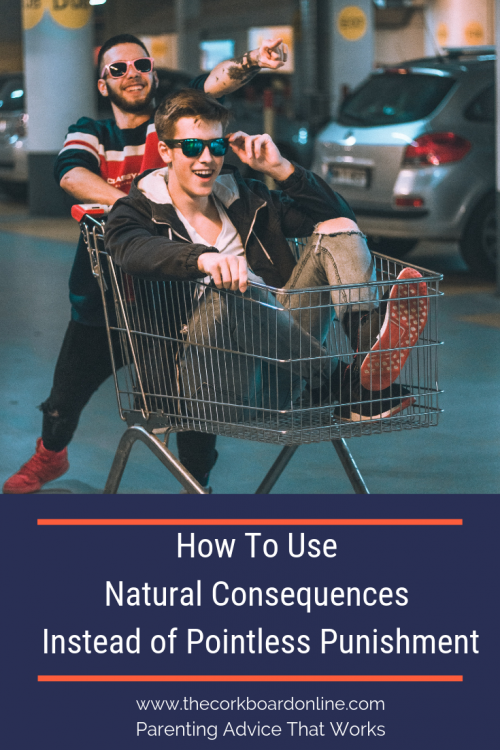
There are also what are often referred to as natural consequences. If you leave your iPod outside and it rains, it will get wet. It probably will also cease to function.
If my child has trouble with impulse control when playing with other children, he will not be allowed to play unsupervised with others.
Here are some things to consider when thinking about natural consequences with children from hard places:
- Fragility. It is not necessarily our job to protect our children from natural consequences. However, some children are more fragile than others. If you see a water bottle and a snack that is about to be left on the kitchen counter as you rush out the door, you may want to grab it if your child will rage because of a blood sugar crash. Going on a short errand and have a kid who will just be a little whiny and frustrated about it? Leave it.
- Drama. Dramatic threats of what will happen or “I told you so”’s, as tempting as they are, will cause dysregulation and disconnection. If you see a bike in the driveway or an electronic left out, try a question, “Johnny, why is the driveway not where we usually store bikes?” or “What might happen if…?” If you’re really good, use a playful voice! Similarly, if a child misses a beloved dance lesson because she was melting down and missed it, console her broken heart rather than coldly stating, “Well, I guess that’s what happens when you can’t pull yourself together.” Wait to debrief and rehearse what could’ve been done better after you reconnect and she calms down. You may even have to debrief days later.
- Stretching. “Well you were rude to me all afternoon and that wears me out. I’m pretty sure I don’t have the energy to take you to soccer practice. That’s just the natural consequence.” There may be some truth there, but your kid will see through it, and if we’re honest with ourselves it’s just a way to sneak in a punishment.
The real magic happens when there is a balance of high structure and high nurture in how you respond to any situation. The structure may be letting the iPod get wet, and the nurture may be validating your child’s feelings of how much it sucks to experience the natural consequences of irresponsibility.
Lastly, I’ll just speak a few words to those who are still gagging. You may need to go put on big person panties first.
Why do you think you feel the need to punish? It is wrapped up in how you were raised or what a portion of society has told you about what it looks like to raise children “properly?”
How do YOU feel when your child misbehaves? Fear? Embarrassment? Is your need to fix your child’s behavior through punishment more about easing your feelings of discomfort when the misbehavior happens?
Is punishment even working for you? Is it helping your child move toward healing and making better independent choices? Is it causing you to expend any less energy in the long term?
I know. Tough questions. I know them well because they run through my internal dialogue every day. I feel the pull to punish when I have to address the same thing for the 140 millionth time, but I know that it’s more for me and my big feelings than an actual solution.
You’re not alone.
]]>
What is hard about parenting a child who doesn’t meet an expectation? Have you ever heard yourself saying these phrases as a parent?
“But he SHOULD be able to do that.”
“He SHOULD remember after 500 reminders.”
Or
“I SHOULDN’T have to do that for him.”
“I SHOULDN’T have to live that way.”
Me. Me. Me…
Do you want to know the sucky thing? Despite all my feelings of what I think our son SHOULD do, he can’t. And despite the unfairness of how I SHOULDN’T be living, it’s just what needs to be done. Besides, do you know what I tell my kids ALL. THE. TIME?
“Life isn’t fair!”
About 3 years ago a practitioner introduced me to the phrase, “Radical Acceptance.” I’m still not sure how she meant for me to apply it, but I took each word literally and started taking stock of where we were as a family–including all the needs of our kids–and radically accepting and making peace with our HERE and NOW. It was almost a form of mindfulness. Through a lot of prayer and introspection and some visits to our awesome therapist, I was able to find a supernatural peace in the midst of the crazy. Well, at least sometimes. I’m not going to lie and tell you I have this figured out all the time. Because I don’t. But the crazy thing is that whenever I stop fighting against my reality, I’m calmer which makes my kids calmer which means they operate at the top of their ability set–whatever that happens to be. You know, at the end of the day, we can only control ourselves, not our situations, not our kids behaviors, not even how our kids react or respond to us.
[bctt tweet=”Whenever I stop fighting against my reality, I’m calmer. #parenthack” username=”macorkum”]
So here’s our challenge, instead of hyper zoning in on all the deficits that are annoyingly rearing their ugly heads, let’s focus on shedding all of our SHOULD statements. I know. SHOULD has 6-Letters. But you get the picture. This challenge is for me too because it’s a daily…no hourly struggle…to stay in this space of radical acceptance.
Will you try it for a week with me?
Comment below if you’re with me so we can all keep each other accountable.
]]> This week’s guest is adoptive mama extraordinaire, Nicole Pritchard. We chat about creative ways to meet the needs of kids from hard places and how to increase their tolerance over time. You’ll love her sacrifice and courage.
After you listen check out her blog at www.coffeecoloredsofa.com and meet up with her on Twitter @plainlyamess.
]]>
I’m currently in a mental battle that has been going on for the better part of a year.
“How unconditional should love really be?”
Or maybe the better question, “Does unconditional love equal unconditional relationship on the other person’s terms?”
I’m hoping not.
What if that person is a child of yours? Still hoping not.
For now, I’m going to start writing weekly letters. It’s something that I’m already doing with another one of the kids and Jay (the aged out foster youth who we tried to help but ended up in jail).
Letters feels safest. Ok, safest would actually be forgetting the relationship ever existed.
[bctt tweet=”safest would be forgetting the relationship ever existed, but…#olderchildadoption #adoptionishard” username=”corkboardblog”]
But letter writing feels safest while still believing that God has my back and will redeem this relationship in His time. They allow me to connect in a consistent, rhythmical way that protects me from an altered reality that’s meant to, in a reactive attachment kind of way, harm the mother figure in her life.
I know that what “feels” isn’t always the best way to make a decision, but I’m so bruised and tattered by this journey of loving people from hurt places. Hence the mental battle. Raw honesty? I need to pray more about it.
But I’m also hurt which is pairing up with my human need to be right…which of course I am 
Here’s to more prayer and more faith. In the meantime, I’ll add another person to my weekly letter writing ritual.
]]>