I just finished hanging out in Nehemiah (as in the book of the Bible) with the She Reads Truth community. Nehemiah was the guy who rebuilt the temple after it was destroyed by the Babylonians.
The parallel of rebuilding something after (and even during) a period of crisis and brokenness was not lost on me.
For a lot of adoptive families, trauma has left a trail of devastation not unlike what Nehemiah found when he returned to Jerusalem.
But just like the temple was rebuilt, so can we rebuild our hearts and our families.

Grieve.
“When I heard these words, I sat down and wept. I mourned for a number of days, fasting and praying before the God of the heavens.” Nehemiah 1:4, CSB
You are not crazy. You are not alone. And what your family has lost is real. Sometimes it can feel overwhelming to consider the cost you’ve paid for parenting a child from a hard place. But trust me. There is hope. This season will not last forever. My experience was that I couldn’t move forward until I accepted the state of our family and grieved it properly.
Pray.
“I said, ‘LORD, the God of the heavens, the great and awe-inspiring God who keeps his gracious covenant with those who love him and keep his commands, let your eyes be open and your ears be attentive to hear your servant’s prayer that I now pray to you day and night for your servants, the Israelites.” Nehemiah 1:5-6a, CSB
Understanding our kids’ behaviors and having connected parenting tools are imperative in this journey, but really, healing is a God-sized job. A job for the one who created not just our kids, but our whole world. No one understands like he does. Pray day and night (and all the moments in between) for your family as Nehemiah prayed for Israel.
Change what you CAN control.
“I confess the sins we have committed against you. Both I and my father’s family have sinned.” Nehemiah 1:6b, CSB
I know the word “sin” may sound harsh, and I believe you are a GOOD MOM doing hard, but GOOD WORK. But can we all at least agree that we’re not perfect? It’s so tempting to put everything we have into changing and healing our kids. Unfortunately, while sometimes we can influence them, we cannot change them. The only person we really have control over is ourselves. Take it from someone who has tried this both ways–working on yourself is hard work, but way more satisfying!
Find your people.
In Chapter 3, we read about all the people who helped rebuild each section of the wall. They are not always easy to find, but having friends and professionals who are on your side make all the difference in the world. When you download 5 Tips to Save Your Summer over at the The Adoption Connection, you’ll also receive an invitation to join our private Facebook group. This is a great place to start building that community.
Be persistent.
“When Sanballat heard that we were rebuilding the wall, he became furious. He mocked the Jews before his colleagues and the powerful men of Samaria…So we rebuilt the wall until the entire wall was joined together up to half its height, for the people had the will to keep working.” Nehemiah 4:1,6, CSB (emphasis mine)
Parenting kids from hard places is a marathon, not a sprint. Actually it’s like running a marathon into the wind. What you’re doing is NOT easy. It’s going to take some grit and persistence. Be persistent in both prayer AND action.
“So we prayed to our God and stationed a guard because of [the mockers] day and night.” Nehemiah 4:9, CSB (emphasis mine.)
Stay singularly focused.
“I am doing important work and cannot come down.” Nehemiah 6:3, CSB
This task we’ve undertaken is important. More important than all of the other pulls in life–for now. In this season, give yourself permission to sit the next meal train out and bow out of volunteering at school and church. Besides, you need to conserve your energy so you can be persistent.
Remember the truth.
“Then I replied to him, ‘There is nothing to these rumors you are spreading; you are inventing them in your own mind.’ For they were all trying to intimidate us, saying, ‘They will drop their hands from the work, and it will never be finished.’ But now, my God, strengthen my hands.” Nehemiah 6:8-9, CSB
Whether it’s your own doubts or external voices bouncing around in your head, remember the truths that you are a GOOD mom, and that, with God, healing is possible. You can do this!
Write the things you know to be true on index cards and place them in strategic places where you will see them.
[bctt tweet=”As an adoptive mom, I needed these reminders today. #adoption” username=”corkboardblog”]
What do you need to remember?
]]>A lot of adoptive moms tell me that they'd do anything for their kids, but they don't know where to start or what to do. They are tirelessly seeking out post adoption support and resources and coming up empty handed. Unfortunately, there is a HUGE gap in post adoption support. We've felt it personally.
I'm sharing what we've found helpful...even life saving...so you don't have to stumble around blindly for as long as we did.
Find A Local Tribe
There's really nothing better than being able to sit across from another mom gets your stories and validates you. You're not crazy, and you're certainly not the only one. Trust me.
If you're not sure where to start looking, search Facebook or Meetup for "<your city> Adoptive Moms." Or head to a local coffee shop once a month and advertise it in your local community publication's event calendar as an "Adoption Support Group." I did this for a season. Moms came out of the woodworks, and I'm still friends with some of them today.
If all else fails, I'd love to invite you to a virtual coffee. You can hop on my schedule by clicking HERE.
But, really, try to find some in-person people.
Find An Online Tribe
This is no substitution for a local, in-person tribe, but online communities are an important part of my support system. They are great for getting answers and advice quickly. Not sure where to start? You will receive an invite to the Adoption Connection's official FB support group when you download "5 Tips to Save Your Summer."
Train Yourself
Read a book. Listen to a podcast. Take an online course. Parenting kids from hard places is not intuitive. I had to re-learn everything I ever thought I knew about parenting.
We are offering 2 courses this summer over at the Adoption Connection--How to Keep Your Marriage Strong (for the mom who has nothing left) and How to Balance Nurture and Structure. These will both be LIVE, interactive support groups with lots of helpful tips. They start a week from tomorrow (6/7), click HERE to register now...before you forget.
Train Your People
Is it possible to die from over exposure to well-intentioned, yet uninvited, advice from you family and friends? Probably not, but I feel you.
At a minimum, have everyone who you regularly come in contact with watch this 3 minute video. Ideally, you would gather your people over 2 evenings to watch this.
The more people you have speaking from the same dictionary about your kids, the better.
[bctt tweet="If you need some post adoption support, I loved these pointers!" username="corkboardblog"]
If you're new here, welcome! You've found a safe place.
If you've been a regular visitor, you've watched a lot of transitions, but the recurring theme is that I am on a mission to help families. I never want a family to feel as lonely and hopeless as we felt when we were struggling with how to parent our kids well. I am stepping out in faith to go into parent training and coaching full-time. I'm excited to be more available to you!
Feedback on how to serve you better is always welcome. Check out the new home page and shoot me a quick message to let me know if it's helpful!
Dr. Karyn Purvis coined the term “hard place.”
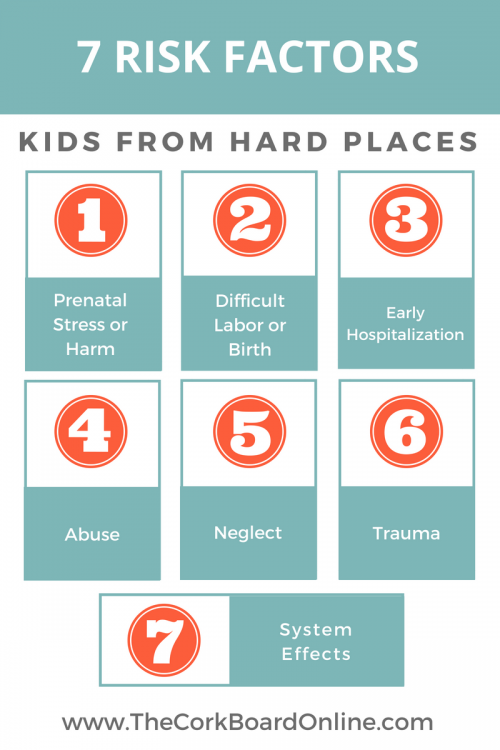
There are 7 Risk Factors that the Institute of Child Development recognizes:
-
Prenatal Stress or Harm
For children adopted at birth, it is likely that their pregnancy was not planned which automatically leads to a more stressful prenatal experience than most children. For children whose birth mother’s lived in places of extreme poverty, the stress of not knowing when the next meal was or where to sleep every night manifests as elevated cortisol levels. Even if your child is not adopted, many parents, when prompted, can recall an unusually high stress situation during pregnancy (extreme morning sickness, death in the family, contingent house buying or selling). Some research shows that stressful pregnancies can be linked to higher cortisol levels in children as long as 10 years later! (1)
-
Difficult Labor or Birth
Whether labor lasted for days on end or the cord was wrapped numerous times around baby’s neck causing oxygen deprivation or there was an emergency C-section, all of these cause surges of high cortisol levels in mama and consequently babies. (2)
-
Early Hospitalization
Infants with early medical issues and premature babies are often incubated or need care in a way that impacts the amount of physical touch they would normally receive. The decrease touch time (3) paired with the over-stimulation of their under-developed sensory system can have long-lasting impacts (4).
-
Abuse
There are many types of abuse including physical, emotional, spiritual, and sexual. Prenatal or early substance exposure also falls in this category (5).
-
Neglect
Neglect can happen for many reasons. A good mom doing her best who is just overtired and stressed or a mom who isn’t capable due to being under the influence substances. Children who grow up in institutions are often neglected. Neglect affects brain development in the same way, no matter what the reasons (6).
-
Trauma
Medical procedures, natural disasters, car wrecks, and tragedies are typical examples. In some ways, trauma is also in the eye of the beholder. Trauma is either a single event (or series of ongoing stressors) that renders a person feeling fearful and helpless.
-
System Effects
This could be any change in primary caregiver which automatically captures all children who have been adopted or fostered.
It’s important to note that prenatal stress, difficult birthing process, early medical trauma, and change of primary caregiver are often overlooked. Additionally, the first four risk factors can all apply to children even if they were adopted at birth (which is often misconceived as a lower risk adoption).
How many of the risk factors apply to your family?
]]>

What is hard about parenting a child who doesn’t meet an expectation? Have you ever heard yourself saying these phrases as a parent?
“But he SHOULD be able to do that.”
“He SHOULD remember after 500 reminders.”
Or
“I SHOULDN’T have to do that for him.”
“I SHOULDN’T have to live that way.”
Me. Me. Me…
Do you want to know the sucky thing? Despite all my feelings of what I think our son SHOULD do, he can’t. And despite the unfairness of how I SHOULDN’T be living, it’s just what needs to be done. Besides, do you know what I tell my kids ALL. THE. TIME?
“Life isn’t fair!”
About 3 years ago a practitioner introduced me to the phrase, “Radical Acceptance.” I’m still not sure how she meant for me to apply it, but I took each word literally and started taking stock of where we were as a family–including all the needs of our kids–and radically accepting and making peace with our HERE and NOW. It was almost a form of mindfulness. Through a lot of prayer and introspection and some visits to our awesome therapist, I was able to find a supernatural peace in the midst of the crazy. Well, at least sometimes. I’m not going to lie and tell you I have this figured out all the time. Because I don’t. But the crazy thing is that whenever I stop fighting against my reality, I’m calmer which makes my kids calmer which means they operate at the top of their ability set–whatever that happens to be. You know, at the end of the day, we can only control ourselves, not our situations, not our kids behaviors, not even how our kids react or respond to us.
[bctt tweet=”Whenever I stop fighting against my reality, I’m calmer. #parenthack” username=”macorkum”]
So here’s our challenge, instead of hyper zoning in on all the deficits that are annoyingly rearing their ugly heads, let’s focus on shedding all of our SHOULD statements. I know. SHOULD has 6-Letters. But you get the picture. This challenge is for me too because it’s a daily…no hourly struggle…to stay in this space of radical acceptance.
Will you try it for a week with me?
Comment below if you’re with me so we can all keep each other accountable.
]]>Our list of “things” (outside of the basic principles of trust-based parenting) has included diet, mindfulness, massage, oils, supplements, and medication.
Do you want to know the problem with using essential oils for challenging kids?
Just because you want them to work so bad, they will want NOTHING to do with them.
Do you want to know the secret about kids from hard places?
Their needs are complex and there’s no magic fix.
Tatoo it to your forehead. “There’s NO MAGIC FIX.”
Just because you want to try it, they will probably dig their feet in and hate it. Just because. And honestly, getting into a control battle with a kid to do something…even if it’s their magic fix…automatically makes it NOT the magic fix.
[bctt tweet=”There’s NO MAGIC FIX. #remindersformyself #parenting” username=”macorkum”]
P.S. I’m preaching this to myself because I’m the control queen and the queen of burning relationship bridges with my kids because I am trying to force a fix. Learn from my mistakes. Don’t be me.
However, despite the fact that oils weren’t the magic fix I was looking for, they were a magic fix for somebody else…me.
When I’d be chasing the kids around with a balancing blend, I realized, I wanted to smell it. I could feel the oils calming me down and helping me to access my other coping tools.
BONUS: Click HERE for an entire e-book on the science behind why oils work to manage our emotions. It’s really NOT all in your head…or is it?
I’ve said it before, and it’s worth saying again. “I cannot change my child, but I can change me…”
[bctt tweet=”I cannot change my child, but I can change me… #adoption” username=”macorkum”]
We can only control ourselves.
And while that seems anti-climactic, research on mirror neurons tell us that if we’re calm, our kids can calm by mirroring the calm in us.
What would happen if we had more tools as tired mamas to energize us, calm us, and literally manage our emotions from the inside out?
- Less frustration.
- More organization.
- Less overwhelm.
- More empowerment.
- More connection.
My favorite way to have oils at my disposal all day long is diffuser jewelry. Essential Charms recently sent me a diffuser bracelet to review.

The “Ancient Agate” diffuser bracelet is handmade with premium, semi-precious 12mm Decorative Pattern Agate stones, 3 beige lava stones and a custom stainless steel cube.
Agate is known for its slow and steady healing properties and is said to bring harmony and balance to body, mind and spirit. Like lava stone, it has a grounding energy and will bring you strength and stability in times of need.
I asked for the small size and was pleasantly surprised when it actually fit my tiny wrists!
FAQs
How do I use diffuser jewelry with essential oils?
Just add a drop or two of your favorite oil to the porous lava beads. Give it a couple minutes to soak in so the oil won’t rub off of the beads and leave a mark on your sleeve. If that happens, just use this nifty stain roller and it will come right out.
Which oils do you recommend?
I recommend using the emotional aromatherapy wheel to choose your blend. We use the oils from doTERRA’s emotional aromatherapy kit everyday. If you’d like to know more about why I love these specific oils for weary mamas, contact me. I’d love to chat more. Just contact me.
How long will the aroma last?
Depending on the oil a couple hours to a full day.
Can I use a different oil each day?
Yes! You can use a different oil each time you add oils to your bracelet.
Where can I buy diffuser jewelry?
Essential Charms has kindly offered a discount for you awesome mamas. Just use the code CORK15 at check out for 15% your purchase. Essential Charms offers a wide variety of precious stone bracelets and diffuser charms for necklaces.
I’m parenting a challenging child a feel hopeless. What else can I do?
Join my FB parenting support group called Essentially Connected Parenting. My goal is to help you find hope again!

I received a free product in exchange for this post. However, I was using diffuser jewelry long before receiving a freebie and would still recommend it even without compensation. This post also contains affiliate links and I may be compensated if you make a purchase after clicking on my links.
]]> This week’s guest is adoptive mama extraordinaire, Nicole Pritchard. We chat about creative ways to meet the needs of kids from hard places and how to increase their tolerance over time. You’ll love her sacrifice and courage.
After you listen check out her blog at www.coffeecoloredsofa.com and meet up with her on Twitter @plainlyamess.
]]>
If you had asked me a decade ago what would make an ideal adoptive family, I would’ve responded something about a family who had open hearts and was willing. I thought love was all you needed.
Five years ago, I would’ve told you that you also needed to understand trauma, want Dr. Purvis to live in your home, and have a strong support system.
As I reflect on our family and the other families I chat with, I’ve been thinking more about what agencies should be doing to mitigate post-placement crisis.
One thing that I keep landing on is that they should be waaay more picky about who is allowed to bring a child from a hard place into their home.
Honestly, they shouldn’t have picked us.
We don’t do simple.
We don’t have a couple tomatoes and peppers in pots. We have a 500 square foot garden which doesn’t include the grapes, berries, or fruit trees.
I don’t buy boxed homeschool curriculum. I write it and start communities.
We don’t read books and watch videos. We go half way across the country to become trainers.
None of those things are inherently bad, but they mean that we rarely have margin. We’re always filling it with new escapades and experiments. Think constant motion.
Because we’re adventurers, we suck at routine. We rarely do the same thing week to week or day to day. There’s usually some idea to chase that might get in the way of remembering to do laundry or eat…let alone cook a meal.
Lastly, I’m an intense person. I’m high energy, high strung, and my voice tends more toward army sergeant than caring preschool teacher.
Looking back, we were probably a train wreck waiting to happen.
Kids from hard places need
- Calm people. Our kids’ brains are so quick to fight/flight/freeze, that they need external regulators. Because they are in their amygdala, they need non-verbal calmness and aura which can reach that primal brain. Words and logic are useless most of the time. Some people just radiate calmness and peace more than others. Whatever I radiate, freaks my kids out.
- Uncluttered spaces. Besides people, our kids also regulate off of their environment. Simple and organized spaces invite calm while clutter invites chaos. We could all probably use less visual clutter, but it’s imperative for kids from hard places. Also, less clutter means less stuff to manage which is also a plus. Of course, just because they need it, doesn’t mean that they will help you get there or help you keep it that way.
- Predictability. It takes a lot of mental bandwidth to wonder what’s next all the time…bandwidth kids from hard places don’t have. I can’t even run the same route twice while training for a triathlon let alone do the same things every. single. day.
- Margin. Just like they need uncluttered environments with lots of white space, our kids need margin in their schedules. They need time to decompress. If thinking about watching a teen sit and stare at a wall for hours makes you twitchy, you probably shouldn’t adopt older kids. Oh wait, that might just be me.