You may have left off on good terms or maybe you’re both hurt and angry.
We’ve actually had all of that happen with all the feels that go with it. No matter how or why you have a child not living at home, and no matter what the state of your relationship is, there is hope.
Even when our kids are not living under the same roof as us, we can still use connected parenting strategies.
[bctt tweet=”Even when our kids are not living under the same roof as us, we can still use connected #parenting strategies.” username=”corkboardblog”]
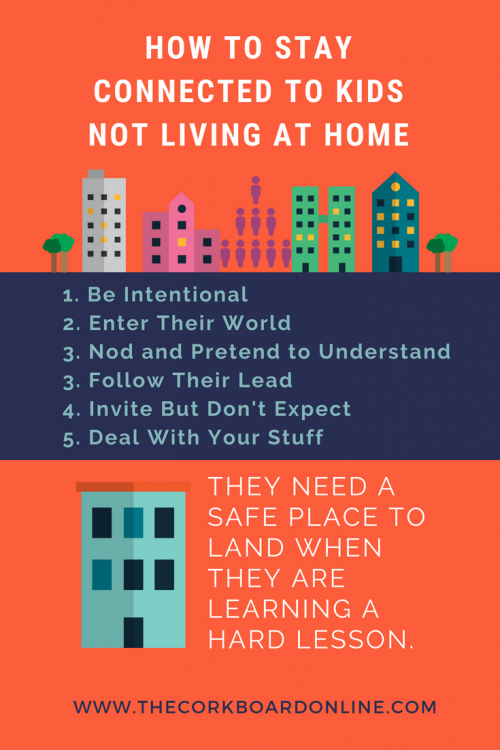
This is what is working for us right now.
Be Intentional.
This is especially important if you’re naturally task oriented instead of relationship oriented. But, either way, we’re all busy. You don’t want the ball you drop (even accidentally) to be the connection with your kids. If you have a child who never reaches out, it’s even easier to let the connection weaken. I literally have a recurring task on my to-do list app to connect with our kids who live away from home. For a couple, I send handwritten letters. Others get texts.
Enter Their World.
What are they doing? Could you go along for the ride? Maybe pop in for a visit at their workplace? Or show up at a pickup soccer game? I also feel like food is the universal truce language. If your child was adopted from an older age from another country, food experiences that reflect their culture of origin are a plus.
Nod and Pretend to Understand.
Whatever they tell you, just go with it. “Thanks for telling me” is a great neutral statement that allows you to respond in a non-critical way that also doesn’t mean you agree with whatever is going on. We can’t control them. We can’t keep them from learning the hard way. They need a safe place to land when they are learning a hard lesson. If you want to be that safe place, you’ll just have to swallow your pride, bite your tongue, and hold all questions and advice. If I can do this, so can you. I literally thought it was going to kill me, but here I am. And relationships are being restored.
Follow Their Lead.
One of our kids needs rhythmical, predictable connection, so she gets a letter weekly. I write on the same day each week, so she receives it at about the same time each week. Another is more “cool,” so a periodic, “What’s new?” works for him. And yet another has made it clear that she’d prefer to figure out life with minimal connection to us. Every interaction with her is prayerfully considered and only attempted if I’m in a position to not spiral if she hard-core rejects me again. So basically, I’m not dropping into her workplace for a “surprise” visit anytime…EVER.
Invite But Don’t Expect.
We always make a point to let the kids know that they are wanted, invited, and welcome to participate in family activities. However, they are free to decline without a guilt trip from us. At least that’s the theory. #iamhumanafterall This actually applies to our teens at home too. There are only a handful of things that I consider “mandatory,” and these are announced with much notice. Because we give so much freedom in the other things, the kids are very compliant with the 2 things a year that I really want them at. And, honestly, if they decided to not come, I wouldn’t fight it. (But don’t tell them that!)
Deal With Your Stuff.
Use this time that they’re not underfoot to deal with your emotional baggage. If the thought of having them under your roof again gives you hives or causes you to hyperventilate, that is a sign that you have stuff. I’m not saying you ever have to let them move back in, but being able to entertain the thought is a good barometer for how healthy you are in relation to them. Take it from a gal who knows. The hardest part of connected parenting is being emotionally available whenever our kids ARE ready to connect.