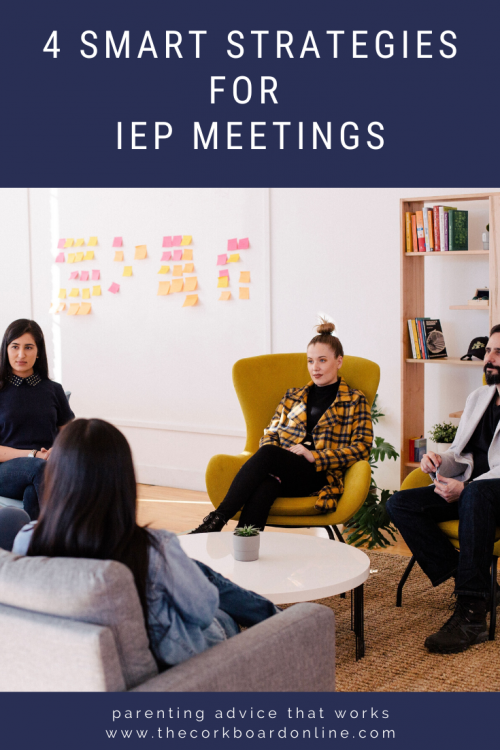
[bctt tweet=”Here are 4 things I wish someone had told me when I was new to the world of IEP meetings and adhd. #ieps #adhdparenting #pblogger” username=”corkboardblog”]
Here are four things I wish someone had told me when I was new to the world of IEPs:
1. Stay Calm. While it’s tempting to go all mama-bear on these people who seem to be failing your child, do everything in your power to take deep breaths and remain calm. Trust me, I’ve done this both ways. You have more credibility if you can keep your emotions in check.
2. Record It. Even if you take meticulous notes, it’s likely, you’ll want to go back and review what everyone said. Also, in the unfortunate case that you’ll need help from a student advocate or lawyer, you’ll want them to have the full picture. Rather than use the fact that you’re recording as a threat (which is my natural tendency), emphasize that you want what’s best for your child or that recording is the best way to share information with the other parent.
3. Know Your Rights. You should receive a booklet of parental rights when you request an IEP meeting. If not, look on your school system’s website. It will outline a timeline as well as other important rights. It’s your job to make sure the school system is treating you the way it’s supposed to. Sometimes it’s not malicious, but an oversight. You are your own best advocate.
4. Don’t Sign Anything. Meetings can be emotional and overwhelming. Despite what the team will pressure you to do, don’t sign anything in the moment. It’s your right to take it home and process all the information. Then you can make a more objective decision if the outcome of the meeting is a good fit or if you need to continue to advocate.
Are you unsure of what can happen at school to best set your child up for success? Are you not even sure what to ask the school to do?
Click here to download a list of over 100 IEP accommodations.

I wanted to lay out all of my findings and all of my opinions, but realized, for issues as divisive and polarized as this (like racism), I want to be an advocate of ideas and opinions in the context of relationship.
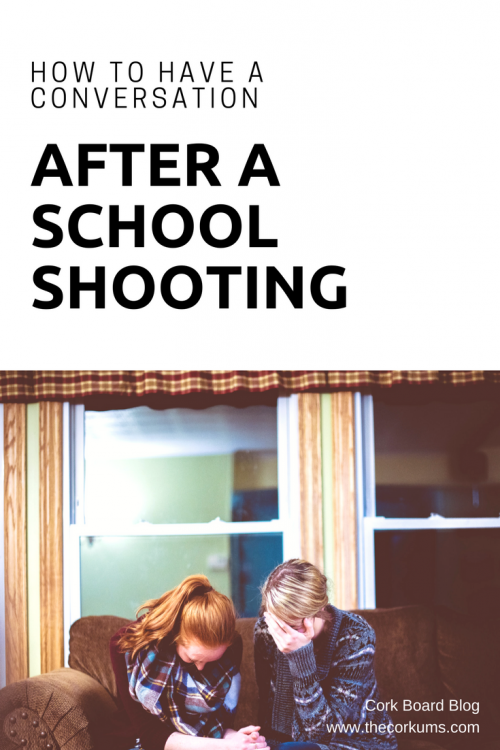
[bctt tweet=”I want to be an advocate of ideas and opinions in the context of relationship. #schoolshooting” username=”macorkum”]
Here’s the thing. I feel like if we put aside our differences for a hot second, we can agree that we want the same things—less violence and felt safety. What we disagree on is what factors affect those. There’s also a foundational desire to protect a person’s rights and freedoms, whether it be the right to bear arms or the right to life.
What would it look like to start our conversations and interactions on common ground instead of drawing our lines in the sand first? In connected parenting, we encourage parents to frame situations so that the parent and child stay on the same “side.” That might mean thinking about a parent and child fighting together against the effects of trauma instead of a parent thinking of fighting against this child and his behaviors which are ruining her family’s life. Parent and Child vs. Trauma instead of Parent vs. Child. Do you see how that could make such a huge difference relationally?
[bctt tweet=”Let’s start conversations on common ground instead of drawing our lines in the sand first.” username=”macorkum”]
Also, questions lead us to solutions. Inflammatory opinions and “truth bombs” dropped on social media only create more division.
If we really want to start solving this problem, we are going to need to work together. Not fight with each other.
One thing that really helps me is remembering that we form opinions inside our own bubble of a paradigm. If I’ve learned nothing else in the past 5 years, it’s
- How much I don’t know what I don’t know.
- Common sense isn’t so common.
- Things are not always as they appear to be.
Some of my fundamental beliefs about life have been shaken at my core which means I’m holding my opinions with much more open hands. And you know what? I’m a better human for it. It’s changed the way I do relationship with my husband, my kids, and people with whom I work. I also know that I’m still definitely a work in progress. You can ask my husband, my kids, and the people with whom I work 
I also know that how I hear and process someone’s opinion is different when I have a relationship with her because I have a paradigm that knows her heart’s deeper intentions, and I can reconcile that opinion within that framework. In simpler terms, it just helps me give a person, with whom I might disagree, the benefit of the doubt.
So, if you want to see all of my Excel graphs and hear why I don’t think the statistics on mental health and violence tell the whole story or how I’m convinced kids are still safer at school than at home, we’ll have to plan to grab coffee or at least a phone date.
If you feel strongly about all of these issues, grab a friend who thinks a little differently than you, put away your Straw Man exclamations, and have a real conversation. Figure out your common ground and make and action plan that you can work on together.
This post is also shared at:


“She has been super cooperative for me.”
Of course she has. You’re not a safe person in her book nor are you a threat to her emotionally, yet. I felt it necessary to disclose her behavioral diagnoses to you so you would understand notes that read, “We are choosing not to do homework…ever.” I tried to explain that I was fully confident that she wouldn’t act out for you because of how her attachment issues manifest themselves. I tried to explain her viscous violence was reserved for special people…like her family. When you state how she acts for you in that way, you make it sound like you think I’m the problem. That if I just treated her a certain way or change my attitude, I could get the same result. I’ve spent over 2 years trying to be the mom my daughter wants and coming up short pretty much every time. I’m exhausted and tired and sometimes really angry. When I hear you say that, I come home and cry.
“She’s really a delight to have here.”
I’m jealous we can’t feel that way about her at home. Deep down I know she’s a great kid, but a hurt one. It’s so unfortunate that the people that care about her the most are also the ones that make her feel the most unsafe. Damn attachment disorder. The entire family has sacrificed for her…financially, with our time, and emotionally, and we still get treated like the enemy. My head gets it. My heart is sick and tired of living it. I hate that you, comparatively, invest almost nothing, but you get her best side.
Aside: I know it’s typical for kids to do better for other adults. We have healthily attached kids and see that. What I’m talking about here is different…way different.
“She’s doing amazing well for only having been here 2 years and having never been to school.”
First, she’s spent over three years here fully immersed in English. That year travelling in a choir totally counts. She is not like your typical ESL students who go home and revert back to their native tongue. Second, if you say she’s never had formal schooling one more time and negate the blood, sweat, and tears of homeschooling her for the last 2 and a half years, I might punch you. I know this may sound petty, but it sounds like you’re giving her all the credit. If you only knew thankless, endless hours of having her repeat back the proper English and pronunciation so she would be understood in public.
Then there’s the comments from her.
“Ugggh…I hate being in this house. I can’t wait for school tomorrow.”
While you well-meaning readers are thinking, “Win! She wants to go to school!” I feel like I’ve been slapped in the face. I want her to want to go to school, but I don’t want her to want to go because she hates being here and hates us. See the difference?
“Mom, I like when they make me read and answer questions. We HAVE to do it and it’s helping me learn.”
Excuse me? What the H-E-Double-Hockeysticks do you think I was asking you to do? This delusion that I am a horrible teacher and was the obstacle to your learning and all your teachers are now your saviors is one I’m not strong enough to take without waves of intense, negative emotion rolling over me.
Really I’m torn over this whole school thing.
I don’t want to feel guilty or like a failure (thank you, homeschool community), and I don’t want to celebrate that we’re doing the best thing for our family. I don’t feel like celebrating that the thing we had to do to keep everyone safe involves sending her to a place where the state is mandating she learn how to add fractions when she still can’t subtract 2-digit numbers, where she’s being forced to send a Valentine to someone (which wouldn’t be so bad except she thinks is the equivalent of asking a boy to marry her), and where her ESL teacher speaks with such a heavy accent that she can’t understand him.
I’m relieved and extremely sad. Sad that this is our life. That trauma has done this to her and us.
I don’t get warm fuzzies about the school’s ability to educate her. Their hands are tied and they will be able to do little to meet her where she is academically. I hate that I can’t really care about that right now. I hate that this part of our family’s healing means putting her education on the back burner.
Yea, so that’s how school’s going.