There are 3 other diagnoses that have symptoms that mirror ADHD but have different treatment pathways.

[bctt tweet=”There are 3 other diagnoses that have symptoms that mirror ADHD but have different treatment pathways.” username=”corkboardblog”]
Sleep Apnea
Besides impulse control issues, other symptoms include falls asleep immediately after their head hits the pillow, snores, grinds their teeth,
wakes up in the night, has night time accidents or daytime accidents, is hard to understand when speaking, has under eye circles, has crooked teeth or a misaligned bite, wakes up insanely early, is irritable during the day, or has a bad appetite.
Vision Processing
When a child is bright, parents are confused by their difficulties with reading, believing they have already ruled out a vision problem at their yearly eye exam or screening. Often the child is labeled hyperactive, lazy, or slow. What makes this even worse is that many of these problems can easily be mistaken as learning disabilities or attention problems such as ADHD. Vision screenings in school and at the pediatrician’s office typically test only distance vision. Most people think that 20/20 is “perfect vision”, when in fact 20/20 is simply a measurement of what someone is able to see at a distance of 20 feet. Common symptoms for vision processing issues include headaches, poor reading comprehension, homework takes forever, trouble keeping attention when reading, poor handwriting, clumsiness, or car sickness.
Sensory Processing
If your child has misprocessing information that he’s hearing, seeing, or feeling, it can greatly distract him from focusing on the task at hand. Additionally, if your child seeks vestibular or proprioceptive input, he may look hyperactive because of jumping or spinning.
Watch the video below for suggested solutions and what to do if you suspect your child is dealing with any of these three issues.
This post brought to you by Paperless Post.
]]>One of our kids really struggles with sleep. She either can’t fall asleep at night or wakes frequently. She’s also a sleep walker. She’s on the Feingold diet which helps a lot. The amino acids 5HTP and GABA help a lot, too, but I did not want her to be dependent on them forever. I was due to upgrade Ty’s weighted lap pad that he sleeps under to a full-sized blanket, so I decided to make another one to see if it helped our daughter.
True to form, for me, I made one and then looked up a how-to. It turns out mine is nothing like the few tutorials I saw. My creation is a little simpler to make but may not be as washable depending on the weight. At 2 pounds, I could wash Ty’s. The other one I made is 10 pounds. I’ll have to spot clean that one 
Disclaimer: I’m sure this blanket would be considered a safety hazard in some way by experts. Make it and use it an your own risk using your best judgement. I recommend finding a qualified Occupational Therapist to help you address any sensory needs and to find a weighted product that is right for your situation. The rule of thumb I use for blankets is 10% of body weight.
- Choose fabric. This is the best part (besides being finished). We used a pattern of choice on one side and a plain, coordinating color on the back side. Our fabric was about 42″ wide and I used about 2.5 yards.
- Buy filler. I used poly-fill beads meant for stuffed animals. They had them at JoAnn’s in 2 pound bags. I had a lot of coupons. Otherwise, you can get them on Amazon
for a decent price. - Wash and iron fabric. Pre-washing takes care of shrinkage if needed. Make sure to at least iron the edges which usually fold in weird ways during washing.
- Place fabric right sides together. Trim if needed.
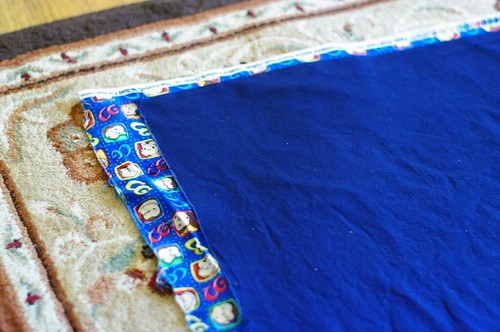
- Sew 3 sides together. Leave one of the short sides open. I used between 1/4″ an 1/2″ seam allowance.
- Turn right side out and iron. To reinforce the edges, I went back and double stitched the seams with a zig zag stitch along the edges after ironing. While you’re ironing, turn in the raw edges about 1/4″ and iron flat.
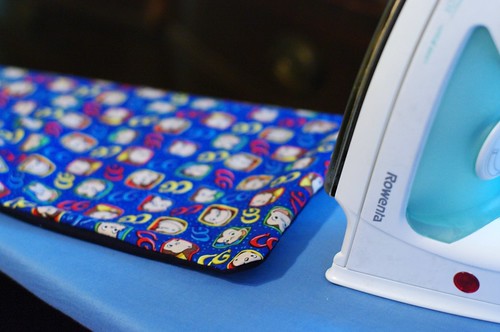


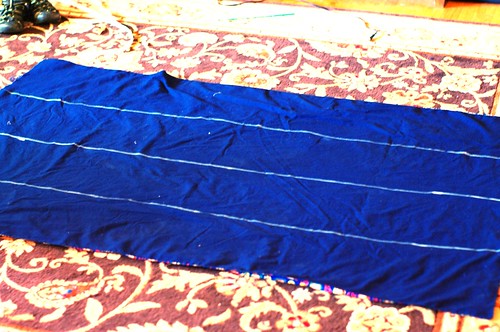
- Mark and sew the long sections. I just measured the length and width of the finished case and arbitrarily chose section sizes based on which numbers made for easy math. I marked AND sewed just the length first.
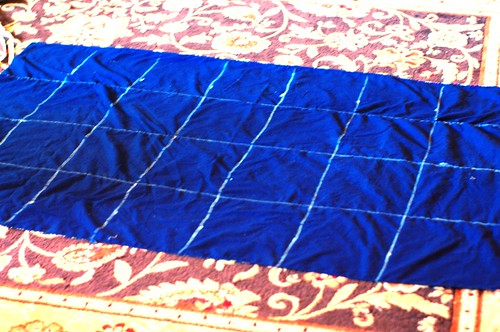
- Mark (DO NOT SEW) the short sections.
- Divide the beads. Divide the weight of your beads (in ounces) by the number of sections. Then you’ll know how much to put in each pocket. I used a kitchen scale to measure the beads out. Make sure to zero the scale with the container on it.

- Stuff the blanket. In each column put the corrent amount of beads for one section. Shake the beads down to the bottom. Sew the first row closed. Be sure to keep the beads at the bottom. It takes a little practice. I spilled beads all over my dining room during transport to sew the first section. Repeat for each row. When you get to the last row, finish off with a zig zag stich to close the two iron-hemmed pieces together.

VOILA!
The verdict? The kids to seem to love them, and sleep has been better. Whether it’s the actual blankets or psychological is yet to be determined.

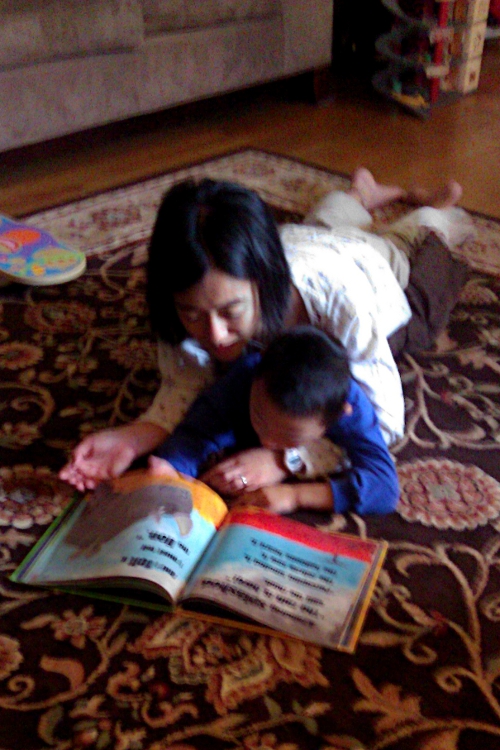
I’ve found it’s really important to intentionally meet Ty’s sensory needs throughout the day or we all pay the price. The newest trick is to lay on him while we do our read aloud for the day. ]]>
But that was B.T. (Before Ty).
This spring Ty got a formal diagnosis for something I had suspected for a while. He has sensory processing disorder (SPD). Because we have five different senses and our bodies can mis-process is many different ways (including not processing), SPD can take on many shapes and forms. For Ty, he has visual and somatic dyspraxia* and is also sensory seeking. He mostly seeks proprioceptive input.**
*His brain does not process what his eyes see correctly, and he has poor motor planning for new movements.
**Pressure or force on his joints and other parts of his body.
The dyspraxia paired with his sensory seeking make him seem like a hyperactive, disobedient, impulsive klutz.

So when he…
…walks into a classroom and proceeds to jump off a table, he isn’t blatantly ignoring basic classroom rules.
…constantly asks for gum and I almost always say “yes,” I’m not being a pushover.
…randomly hits you, drums compulsively on any surface, or constantly makes random noises, he’s not trying to be annoying.
…doesn’t concentrate on the task at hand, he’s not ignoring it or you.
Rather, these are all ways he’s communicating to you that he needs sensory input as much as he needs air.
If you’re a religious caffeine drinker, think about how your body feels when it needs a fix. That’s the way Ty feels most of his life.
So now what?
We’re working hard at home to find activities that are more constructive than jumping off of furniture to satisfy his sensory craving. Then we’re working those activities into our daily routine. We’re also giving him voice to tell us what he needs so we can help him find appropriate sensory input and still follow the rules.
So when we…
…don’t dole out a consequence for jumping the back of somone’s sofa, he’s not getting away with anything. We will, however, remind him that’s not appropriate and ask him if he needs to go find an appropriate place to jump.
…walk him to a set up steps and ask him to leap to the bottom from 4 or 5 up, we are not promoting unsafe behavior. This just happens to be one of his favorite and easily accessible sensory activities. The feeling of landing after such a long leap is deeply satisfying for him.
…require 10 pushups after he impulsively touches something, we’re not being militant. Pushups provide great proprioceptive input that helps control his impulsivity (and also happens to be great practice for Tae Kwon Do).
…put him what looks like a fabric version of a big, black trash bag, we’re not being cruel. His body sock shuts out sensory input that over stimulates him but also allows him to push against it with his limbs to get calming proprioceptive input.
Other strategies that work for Ty are:
- bike riding
- sleeping under a weighted blanket
- carrying a weighted backpack
- hauling/pushing/pulling heavy loads
- play in sensory bins
- playdough
If you have a sensory-seeking child, what are you doing?
]]>