You’re exhausted and hopeless.
A lot of times, any attempt to directly address these behaviors leads to angry outbursts or even rages.
Your entire home may feel unstable and unpredictable. Maybe you always feel like you’re walking on eggshells.
Yesterday, during a FB Live in our parent support group, I shared how to create stability in your home and have your efforts finally start to gain traction.
After watching, Margaret said, “Yes! So true!”
Tereasa shared, “Yes! I totally agree our focus is off!”
Is your pyramid tippy or solid?


A couple weeks ago, So Well, who specializes in Himalayan salt products reached out to me. I received a free product in exchange for writing this review. (I’ll also receive compensation if you decide to buy a salt lamp through a link in this post.)
As I was researching the benefits of salt lamps, I found that they:
- Release negative ions into the air which can reduce anxious feelings and promote a peaceful environment for sleep [1]. Anxiety and sleep are probably the 2 top concerns that parents ask me about. It’s always better when our kids are sleeping, right?
- Boost serotonin levels [2]. This is your happiness chemical [3]. And who doesn’t need more happy in their life?
- Minimize the effects of electromagnetic radiation or electrosmog which is released from electronics [4]. I’ll speak for myself, but as much as I’d like to minimize screens around the house, they are kind of inevitable. I mean, how can my kid learn mindfulness and meditation without his Breathe Kids or Headspace app? I’m certainly not going to spend 10 minutes speaking to him in soothing Australian tones when there’s an app for that!
- Purify the air of nastiness. Things like mold, bacteria, and other allergens. The idea is that the salt attracts water from the air. Water which is carrying all the nasties. Then the water re-evaporates into the air because of the heat from the bulb in the lamp leaving behind everything it was carrying [5]. The pollen count is about to get very high, so having a salt lamp running can only help, and it definitely won’t hurt.
- Calm mood and increase focus through their soft amber glow [6]. The soft amber glow is also great for combating the blue light from electronics that can disrupt sleep [7]. Just say, “No!” to disrupted sleep!
Seriously, what’s not to love about salt lamps?
Of course, I was the shotgun customer who just bought on appearance and ended up with a white LED lamp. That just means that my bulbs won’t heat my lamp for that negative ion release and it’s missing that calming amber glow. On the plus side, it’s super cute, and it’s close enough to my over-heating laptop that I’m sure that the water that condenses on my lamp is in fact evaporating.

[bctt tweet=”Better sleep, decreased anxiety… what’s not to love about salt lamps? #pblogger ” username=”macorkum”]
So, now what?
- Gain buy-in (if your child is able). Skip to Step 2 if this step doesn’t apply. Start with a question where the answer you want is actually, “No.” For example, “Do you want to keep feeling anxious?” Then ask, “What impact would feeling more calm have on your life?” Keep asking, “What else?” until you have a pretty comprehensive list. Lastly, go in for the kill. “If I put a salt lamp in your room that will help you feel calmer, would you be open to that?” Be respectful of a, “No.” Just respond, “No problem. If you ever change your mind, you know where to find me. I’m always happy to get one for you.” Go to Step 2 anyway because now you want one. And if you can decrease your stress, everyone in the family will win.
- Head to SoWell and see what promotions are going on and browse their collection of Himalayan Salt Lamps. I appreciate their commitment to fair trade and quality. Our kids with special needs are even less resilient to toxic load, so what we introduce to their environment matters.
- If you have a teenager who is glue to a computer, try to place the lamp close to where he sits. If you have toddlers, place it somewhere out of reach. Basically, know your child and choose a wise place for this new lamp accordingly.
- Keep it on as often as possible [8].
For answers to all the questions you have that I haven’t answered, click here to visit the SoWell FAQs page.
Do you use Himalayan salt lamps in your home? What do you think?
]]>

Imagine a world where people with disabilities and their caretakers could find instant community and break that feeling of isolation. That’s that Summer, the founder of AbleFinder, has set out to do. She also has some other brilliant ideas to make the process of getting services easier. You’ll love how her story has drive her to action in a way that will surely impact the stories of families across the globe.
To register using the nifty, new ChatBot, click here. Then click the blue “Send Message” button. You’ll also want to share it with everyone you know.
That blog post I mentioned about our kids’ futures is here.
To read the amazing stories of the AbleFinder community, follow their Instagram account here. Ty was featured in early December.
]]>[bctt tweet=”It’s impossible to think ahead to simple things like dinner, never mind securing the financial future of my child with special needs. ” username=”macorkum”]
Confirming a Fetal Alcohol Syndrome (FAS) diagnosis for Ty last year and realizing that he’s already in the double-digits was kind of a wake up call that we needed to start thinking pro-actively about what his future will look like. The fact of the matter is that he’s going to need assistance long term, and that type of assistance does not come free (as much our state’s Department of Developmental Disabilities website would like you to believe it could).
Since depending on tax-payer dollars and government assistance for Ty’s future stability does not give warm and fuzzy feelings, I’ve been contemplating other avenues for providing me with peace of mind that he’ll be taken care of long after we’re gone.

Idea #1 Invest Some Money
If you’re like me, this sounds great in theory, but VERY overwhelming in practice. I wouldn’t know where to start or who to trust. I feel like I want to research the heck out of it, but I’m already getting my honorary PhD in navigating various therapeutic services and fighting with insurance companies. However, I recently learned about Ellevest.* Ellevest is a unique financial services firm built to help women get ahead. They are a fiduciary, which means they have a fundamental obligation to act and provide investment advice in their clients’ best interest. Ellevest offers education, insight, and a free, personalized investment plan that can be created in less than 10 minutes. The process is like completing a Madlib (and who doesn’t love a good Madlib?). The plan is goals-based, so you’re able to identify your financial priorities (like saving for a down payment on a home, or saving for kid-related expenses, in addition to goals like a retirement or emergency fund.) The plan is yours to keep, whether you decide to invest with Ellevest or not. #EASYbutton Click here to try it out.
Idea #2 Build a Business with Residual Income
Four years ago, I started dabbling in essential oils. Three years and eleven months ago, I became slightly obsessed with essential oils. I started sharing them and couldn’t stop. I had stumbled onto a business opportunity that I was so NOT looking for. Until recently, I was doing it because I loved it and because I was able to bring relief and tools to so many families…specifically families struggling emotionally with kids from hard places. Those things haven’t changed per se, but someone older and wiser tipped me off that businesses are willable to our descendants. So basically, when I die, Ty could inherit my business. This may seem counterintuitive…giving a business to a severely math-challenged individual, but my business brings in residual, passive income every month even when I don’t work it. This is income that could definitely support Ty’s future. Most network marketing companies have residual income, or you can do some research (in your spare time…ha ha ha) on other residual income models. If you want to press the EASY button on this idea, contact me for an appointment to hear about how I have the flexibility to work from home, so I can manage Ty’s needs while building a dependable financial future for him.
The best news? These ideas are NOT mutually exclusive. You could definitely do both. I actually would recommend looking into both…in the name of diversifying.
If you have kids with special needs who will need lifelong assistance, what other ideas do you have for securing their future?
*We’re excited to be working with Ellevest to start this conversation about investing. We may receive compensation if you become an Ellevest client.
This post is also shared at:



Also, it might be relevant to note that while I had our son who is fetal alcohol affected in mind while writing, these tips are also useful for students with other developmental disabilities and special needs.

- Go for exposure not mastery. Mastery (especially of the abstract) can be elusive for kids who have prenatal alcohol exposure. We use a lot of memory work. Most days we hit mastery (mostly because it’s all to catchy tunes), but I stopped getting frustrated if we didn’t.
[bctt tweet=”Exposure not mastery. #specialneedseducation #keepyoursanity” username=”macorkum”] - The more concrete, the better. I’m a visual learner, so I always joke, “If I didn’t see it, it didn’t happen.” For our kiddo with FASD, if he doesn’t experience it, it doesn’t happen. Whether it’s a historical event or a math problem, if he can’t experience it was all 5 of his senses, he’s lost. Similarly, if I can’t find a way to make it concrete, I definitely rely highly on #1 or just skip it all together.
[bctt tweet=”The more concrete the better. #specialneedseducation #fasd” username=”macorkum”] - Think outside the box. You’re homeschooling for goodness sakes! Take advantage of it. Maybe you just take field trips all year and creatively match them all to core subjects for your review. Depending on your state’s review requirements, this may be easier said than done. If you live in a state with heavy overview, get an IEP or ask for your child to be placed on a non-diploma track so you don’t have the pressure to jump through all the academic hoops that will probably end up crushing your child’s self-confidence and driving you batty.
[bctt tweet=”Think outside the box. #specialneedseducation #fasd #fieldtrips” username=”macorkum”] - Keep the end in mind. Think about what life skills your child will need to live as independently as possible. If you’re trying to teach something that doesn’t contribute to those life skills, refer to #1 or skip it entirely. Memorization of math facts? Really not necessary in real life. Everyone has a calculator on their phone. Knowing how to identify which key will unlock your front door, and then actually being able to use that key consistently. That’s worth spending some time on.
[bctt tweet=”Keep the end in mind. #specialneedseducation #fasd #lifeskills” username=”macorkum”] - Visuals and routine are your friends. We pretty much have the same routine every week with memory work, presentation, and spelling lists. It’s been the same routine for quite a few years. Tweaking it can be painful. As I’m writing this, I’m reminding myself how many weeks and years it took for this routine to actually be routine. I need to extrapolate this to how long I expect it to take for him to assimilate to other routines. <sigh> We started putting visual reminders up around our house this summer. A 5-step poster of what to do when I say, “Get ready to go.” Four cards on the bathroom mirror that remind him how to appropriately brush his teeth. A list of instructions of what he’s to do when he enters his Language Arts class at community (he’s in a new level this year.) He doesn’t always follow them to a “t” because…well, you know…FASD, but they are helping my sanity.
[bctt tweet=”Visuals and routine are your friends. #specialneedseducation #fasd ” username=”macorkum”]
If you’re in special needs education or homeschooling a child with special needs (maybe even FASD), I’d love your additions to the list!
]]>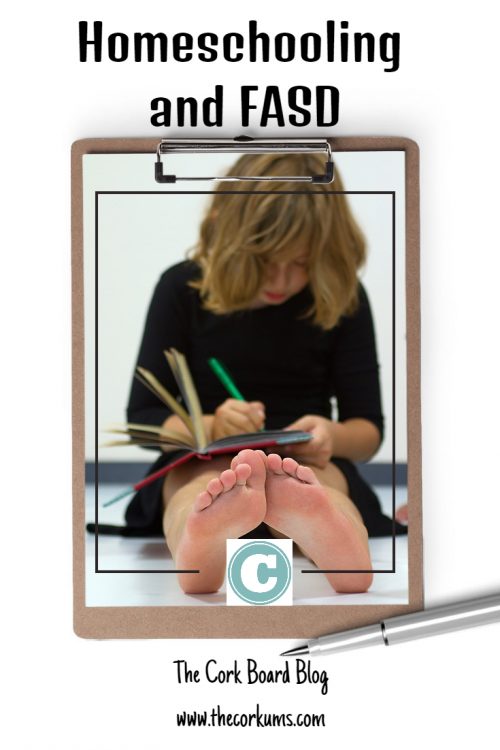
Among other things (like the launch of the new unCorked podcast), September is apparently the month to increase awareness about Fetal Alcohol Syndrome and other related diagnoses. It’s also the month that we start back to a more intentional homeschooling schedule. While these things may seem unrelated, they have significant overlap in our lives since a practitioner recently confirmed what I had started to suspect…all signs point to the likely reality that Ty is fetal alcohol affected.
I probably don’t need to tell you, but just in case…No amount of alcohol use is known to be safe for a developing baby before birth. Not even a sip…especially if you’re Asian. Apparently Asians are likely to have the alcohol dehydrogenase enzyme genetic variant, leading to a doubling of the blood alcohol concentration compared with a Caucasian or other ethnicity consuming the same amount. [1]
While it was sobering to see all of his challenges lined up in black and white in yet another diagnostic report, it’s been freeing as well. I have concrete evidence via countless evaluations and an MRI that Ty has a legitimate disability. It means that I should stop banging my head against a wall over math concepts, and we don’t have to keep up with the homeschooling Joneses (or even our state’s basic academic requirements). #somuchlesspressure
Even though the most current (and I think most complete) diagnoses is fresh off the press, we’ve been dealing with the reality of it since we met Ty. We’ve also homeschooled him since the beginning (minus a trial year at a 3-afternoon preschool). Looking back, I wouldn’t have changed too much except some of my expectations.
Side note: I would go with these curriculum recommendations for students with other special needs besides FASD. Technically we’re also dealing with what looks like ADHD, Sensory Processing Disorder, and Autism Spectrum Disorder.
On expectations
When we started off, I had the same expectations of Ty that I had of the other kids. That he could learn, and we would work until he conquered. Except that sometimes he just can’t. His brain electrical activity is abnormal, and there is global atrophy of his brain. So now, I present an assignment with a wonder-if-he-can-do-this-today attitude rather than a we-have-to-get-through-this. It’s game changing. We looked at fractions on number lines today. About 30 seconds in, I thought, “Nope, so not here yet.” Instead of pushing through and getting us both frustrated like in years past, I just skipped it and moved on…or in this case back (more on our math curriculum below).
This is what we’re using for curriculum this year.
History
We’ve been using memory work as the backbone for all our grade-school-aged kiddos since the beginning. At first it was Classical Conversations, but now we use Claritas Publishing. I like Claritas’ 4-year cycles better, and they’re a perfect complement to the Story of the World materials. Each week, there’s a history song to memorized. One of Ty’s strengths is memorization through song, but even if he couldn’t memorize, we would just go with over-exposure of the song 😉 Besides using an MP3 player to listen to the memory work ad nauseum, he also copies the history sentence each week, reads the corresponding chapter from Story of the World, and participates in an enrichment activity at Bridges. If you don’t have an independent reader yet, use audiobooks liberally. Again, the expectation is for exposure…mastery or comprehension is icing on the cake.
Science
Claritas also provides a memory sentence and corresponding song each week for science. This subject looks just like history with the addition of a science experiment that is provided by our community (Bridges) every other week.
Geography
This is also provided by Claritas…see a pattern yet? I make games from our blank maps on Purpose Games to play as review. Again…go for exposure. Any amount of mastery or comprehension–for however long it lasts–is bonus.
English
Besides the memory work provided by Claritas, Ty is part of the Advanced Readers Language Arts class in our community. It uses a systematic approach to grammar and another one for writing that beautifully dovetails with classical education and memory work. The repetition and introduction of new concepts in small chunks is really FAS-friendly. Additionally, it’s a one-room schoolhouse model where I teach multiple levels at once and the class is meant to be taken multiple years in a row. This is a perfect set up for kids with special needs because they come in knowing that there will be a range of skillsets and that they don’t have to get it all on their first time through. It allows for a lot of flexibility and accommodating on home assignments as well. The grammar curriculum is also from Claritas, and we use the theme-based writing books from IEW.
Math
This is the subject where the struggle is the most apparent and intense. It’s also the place where I’ve floundered the most to find a curriculum that works. Of course, my definition of “working” has also evolved over the past couple years. Right now, we’re using Khan Academy. It’s free and there’s a great iPAD app. I like that you can hop to various concepts but it still gives you a measure to see where mastery stands overall for a certain grade. I also like that it checks the problems for you and provides video tutorials. Also, did I mention the smart technology that knows if you’re struggling on a concept based on whether you get problem correct on the first try or fifth and whether or not you used a tutorial video or step-by-step hint? I could go on and on…the on-board scratchpad, etc. I also acquiesced and allow Ty to have a calculator for any problem he wants. Honestly, having quick recall on math facts is not going to make or break a person’s ability to survive in the world. I expect it of my neurotypical kids, but the bar is different when a kid already has so many challenges to overcome.
Art and Music
Bridges provides lessons on these in community. #totalwin
When in doubt? Just do a lot of reading. Reading—out loud, silently, audiobooks, whatever—covers a multitude of homeschooling sins  I think the only school we did for the entire last quarter of last year was silent reading. But God’s mercies are new every morning…and certainly every school year. #onwardandupward!
[bctt tweet=”When in doubt? Just do a lot of reading. #homeschoollife #specialneedskids” username=”corkboardblog”]
If you’re homeschooling a child who has neurodevelopmental delays, what’s working for you? Stay tuned. I feel a tips and tricks post coming in the near future!
**UPDATE** Here’s that tips post.
]]>